

Commentary
Judy Dempsey
{
  "authors": [
    "Judy Dempsey"
  ],
  "type": "commentary",
  "blog": "Strategic Europe",
  "centerAffiliationAll": "",
  "centers": [
    "Carnegie Endowment for International Peace",
    "Carnegie Europe"
  ],
  "collections": [],
  "englishNewsletterAll": "",
  "nonEnglishNewsletterAll": "",
  "primaryCenter": "Carnegie Europe",
  "programAffiliation": "",
  "programs": [],
  "projects": [],
  "regions": [
    "Europe"
  ],
  "topics": [
    "Climate Change",
    "EU"
  ]
}
Source: Getty
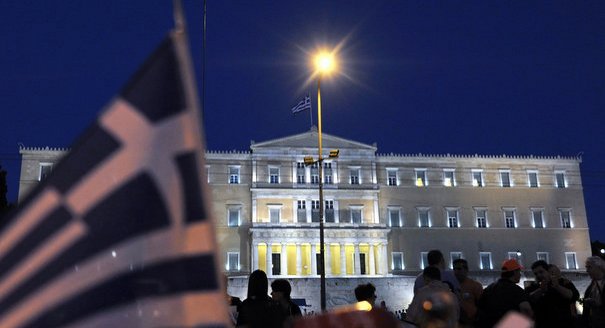
The Greeks themselves have squandered public funds, says a former deputy prime minister and now leading anti-corruption campaigner.
Theodoros Pangalos is no stranger to controversy.
The former deputy prime minister of Greece has spent most of his political career challenging authority. It didn’t matter which party was in government, even if it was Pangalos’s own Panhellenic Socialist Movement. He spoke what he thought, infuriating politicians and officials along the way.
Now retired from politics, Pangalos recently set up his own special website, mazi-ta-fagame.gr—literally translated as “We ate up everything together.”
It was the Greeks, he writes, who squandered billions of EU money and it was the Greek politicians and civil servants who got Greece into this catastrophic financial mess in the first place. So stop blaming others.
The website is a huge success. For the first time ever, Greeks are posting how they have to pay bribes for almost every service, from giving a doctor an envelope before delivering a baby to passing money under the counter to civil servants, politicians, teachers, police, pension and social insurance officials. It’s an astonishing account about what Greeks have tolerated over the decades. It also gives a fascinating and depressing picture into the level of systemic corruption and fraud within the civil service.
Mazi ta Fagami, for example, cites staggering amounts of money paid out by the Labor Ministry’s pensions department. A total of 63,500 main and supplementary pensions were found to be fraudulent. Their subsequent cancellation meant a saving of 450 million euros. That’s only the tip of the iceberg.
Pangalos’s website also is rendering the country a tremendously important service: It is helping to encourage a grass roots movement for citizens who, burdened by the austerity measures, are no longer prepared to remain silent over the bribery and corruption.
The International Monetary Fund and the European Union have also put pressure on several ministries to conduct scrupulous audits. So if a strong civil society movement can emerge as a result of Mazi ta Fagami, then perhaps Greece has a real chance in making a break with its past.
But it is very difficult to change a culture in a short time.
Look at Romania and India.
Romania joined the EU in 2007 but before and ever since has been criticized for endemic corruption, not only in the judiciary but in every area of public life. Bribery doesn’t even stop with adults. Students pay their teachers and professors for better grades. There is systemic cheating during university entrance examinations.
Changing such a culture does not work when politicians do not take the lead. But not even Prime Minister Victor Ponta seemed the least bit embarrassed when it was found out that he had plagiarized his doctoral thesis. At least in Romania, too, civil society increasingly is fed up with the culture of bribery. And then there is EU pressure, too.
And then, look at India. Any investor or anyone trying to do business in India will tell you how difficult it is to do anything efficiently or legally because of the combined inertia and corruption of the bureaucracy that seeps through to the level of village communities.
Last year, the Indian campaigner Anna Hazare set up an independent anticorruption agency called Lokpal and organized rallies in a bid to persuade the government to draft and then implement anti-corruption legislation. His campaign has stalled after becoming embroiled in political infighting.
Nevertheless, more and more citizens across India are demanding transparency even though they know it will be a long haul to overturn a culture of bribery.
Yet maybe they can take heart from Pangalos, with his ability to attract a huge following and annoy those in power. If his Mazi ta Fagame website takes off, maybe even a country like Greece can change.

Nonresident Senior Fellow, Carnegie Europe
Judy Dempsey is a nonresident senior fellow at Carnegie Europe
Recent Work
Judy Dempsey
Judy Dempsey
Carnegie does not take institutional positions on public policy issues; the views represented herein are those of the author(s) and do not necessarily reflect the views of Carnegie, its staff, or its trustees.

The EU’s new migration policy is not suited to today’s realities. With climate change increasingly becoming a driver of displacement, Europe needs to rethink its deterrence-focused approach.

Shana Tabak

The battle over free speech has taken center stage since U.S. Vice President JD Vance accused Europe of censorship. From travel bans to social media regulation, especially around the Israel-Palestine conflict, are liberal democratic governments weaponizing free speech?

Rym Momtaz, ed.
Europe seems to have accepted its sidelining in the Middle East. The EU must reassert its support for the international rules-based order and step up engagement.
Rym Momtaz

Amid uncertainty caused by the Iran war, the global drive for nonproliferation has stalled. With Europe diplomatically marginalized and countries reassessing their nuclear options, efforts to curb the spread of nuclear weapons risk becoming irrelevant.

Jane Darby Menton

Preparing candidate countries for EU membership is no longer enough. As the enlargement process becomes a reality, the union must also prepare its own societies.

Iliriana Gjoni