

Commentary
Judy Dempsey
{
  "authors": [
    "Judy Dempsey"
  ],
  "type": "commentary",
  "blog": "Strategic Europe",
  "centerAffiliationAll": "",
  "centers": [
    "Carnegie Endowment for International Peace",
    "Carnegie Europe"
  ],
  "collections": [],
  "englishNewsletterAll": "",
  "nonEnglishNewsletterAll": "",
  "primaryCenter": "Carnegie Europe",
  "programAffiliation": "",
  "programs": [],
  "projects": [],
  "regions": [
    "Europe",
    "Middle East",
    "Southern, Eastern, and Western Africa"
  ],
  "topics": [
    "EU",
    "Security"
  ]
}
Source: Getty
Germany is still not willing to address two issues that are crucial to formulating a foreign policy strategy either at the national or at the European level.
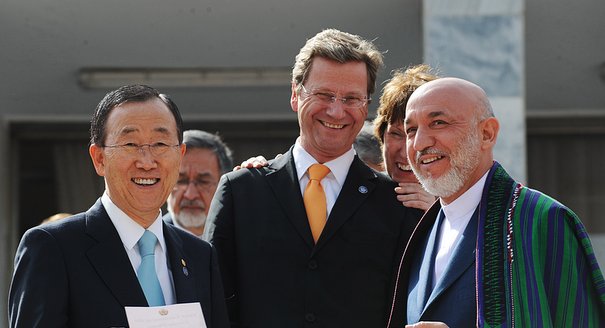
This past Wednesday in Berlin, Germany’s ministers of defense, foreign affairs, and development presented their ideas about a fascinating topic: Germany’s strategy towards fragile states.
It seemed a great opportunity to hear what Guido Westerwelle, Thomas de Maizière, and Dirk Niebel thought about an issue that is becoming all too common in the Sahel and its neighboring region. Just think of Mali, Mauritania, and Yemen, not to mention Somalia.
It is clear that the weaker the state, the greater the opportunity for meddling from the outside, especially by Al-Qaeda and its offshoots. The United States and increasingly the European Union are well aware of that.
All the more reason, said the ministers, to start thinking about how Germany can prevent fragile states from failing. The “guidelines” they have drawn up will be fleshed out in the coming months.
That is the good news. Germany, Europe’s biggest country with potentially the most important political and security clout is at least thinking about how to deal with failing states.
The disappointing news is that Germany is still not willing to address two issues that are crucial to formulating a foreign policy strategy either at the national or at the European level.
The first is that Germany is reluctant to define its interests separately from its values. And second, it is not willing to even think about including hard power on the agenda.
Making the distinction between interests and values is never easy. But it has to be made because no matter how the distinction is defined, it runs up against realpolitik. De Maizière and Westerwelle hedged the issue by saying there was a kind of complementarity between interests and values. But they refused to take a stand, especially when they were asked about weapons export policy.
Selling weapons to Saudi Arabia is about interests, supplying submarines to Israel is about values. Germany wants Saudi Arabia, a major oil producer, to remain stable. That is in Berlin’s interests. Germany has to supply submarines to Israel for historical reasons and it hugely subsidizes those deliveries. It does it because it owes to Israel to bolster its security. In this case, values supersede interests.
On the issue of interests, Westerwelle was quite frank. He said that the anti-piracy mission in Somalia was about defending Germany’s economic interests. At stake is one of the world’s busiest shipping lanes, especially crucial for German exports. Westerwelle was right when he said that Germany had an interest in keeping this part of the region stable.
In that sense, Berlin has come some way towards talking about interests and how to protect them.
Yet wasn’t former German president Horst Köhler punished for saying precisely that in May 2010?
When he was traveling in Afghanistan, he gave his candid opinion to German Radio as to why Germany was involved in certain international peace-keeping or military missions.
"A country of our size, with its focus on exports and thus reliance on foreign trade, must be aware that ... military deployments are necessary in an emergency to protect our interests—for example when it comes to trade routes, for example when it comes to preventing regional instabilities that could negatively influence our trade, jobs and incomes.”
The German media pounced on him. How dare the president say such things! When we send our soldiers, it is not about interests but values!
When Köhler realized that neither Chancellor Angela Merkel nor anybody else from his conservative Christian Democrats was going to support him, he resigned.
As the former head of the International Monetary Fund, Köhler had an acute sense of the distinction between interests and values. The Germans did not want to listen to him. They did not want to acknowledge such a simple truth about realpolitik.
The second aspect of this press conference was Westerwelle’s belief in the feasibility of political solutions to conflicts and the supremacy of soft-power. Syria was mentioned.
De Maizière and Westerwelle said the EU’s sanctions regime was being strengthened. But Russia and Iran are successfully undermining those sanctions, and Berlin knows that full well.
Then de Maizière himself brought up NATO’s “responsibility to protect.” Yet when he and Westerwelle were asked about whether that meant resorting to hard power, de Maizière fudged and Westerwelle said it meant the “capabilities to protect.”
The “responsibility to protect” is highly sensitive because it is open to many interpretations. NATO, in the view of Russia—but also several NATO allies—clearly exceeded its brief when it was given a UN mandate to enforce a no-fly zone over Libya last year and then used it to topple the regime of Colonel Gaddafi.
Even before that, hard power had a terrible reputation in most of Europe, and indeed among sections of the American public. The wars in Iraq and Afghanistan have done little for its reputation.
Yet if a country owns armed forces, an expensive item to have, it must answer the question of what they are for. Germany doesn’t. Westerwelle made that clear: hard power is simply not part of the country’s foreign policy philosophy.
So there we are: a Germany hedging its bets.
Joschka Fischer, the former Green leader and foreign minister between 1998 and 2005, threw caution to the wind over three issues.
He pushed Germans to try and think strategically, to define their interests, values, and responsibilities.
And against all the odds from his own Greens and the Social Democrats, Fischer supported the NATO bombing of Kosovo in 1999 and then pushed for German soldiers to be deployed in Afghanistan. He bolstered his personal credibility by declining to believe in the U.S. war against Iraq.
No German politician has taken up his mantel and stretched the debate further as confirmed by Westerwelle, de Maizière and Niebel.

Nonresident Senior Fellow, Carnegie Europe
Judy Dempsey is a nonresident senior fellow at Carnegie Europe
Recent Work
Judy Dempsey
Judy Dempsey
Carnegie does not take institutional positions on public policy issues; the views represented herein are those of the author(s) and do not necessarily reflect the views of Carnegie, its staff, or its trustees.

As we close out another season of Strategic Europe, it is worth taking stock of the deep shifts underway.

Rym Momtaz
The EU had to compromise to adopt a twenty-first sanctions package against Russia, exposing growing cracks in the union’s resolve. Is this latest, weaker round worth it to keep pressure on Moscow?
Rym Momtaz, ed.

Trump is distracted and Ukraine wants Europe to step up. The continent’s leaders must find their voice and assert it in talks with Russia.

Alissa de Carbonnel

Mounting economic strain and battlefield losses will not necessarily make the Kremlin less dangerous. They could instead push Moscow toward a more aggressive hybrid campaign designed to test NATO’s Eastern flank, exploit allied hesitation, and fracture European resolve.

Maksym Beznosiuk

Over the past ten years, NATO has held almost as many summits as it did during the entirety of the Cold War. Are they still useful, or is it time to stop holding annual meetings?
Rym Momtaz, ed.