

Commentary
Marc Pierini
{
  "authors": [
    "Marc Pierini"
  ],
  "type": "commentary",
  "blog": "Strategic Europe",
  "centerAffiliationAll": "",
  "centers": [
    "Carnegie Endowment for International Peace",
    "Carnegie Europe"
  ],
  "collections": [],
  "englishNewsletterAll": "",
  "nonEnglishNewsletterAll": "",
  "primaryCenter": "Carnegie Europe",
  "programAffiliation": "",
  "programs": [],
  "projects": [],
  "regions": [
    "Europe"
  ],
  "topics": [
    "EU"
  ]
}
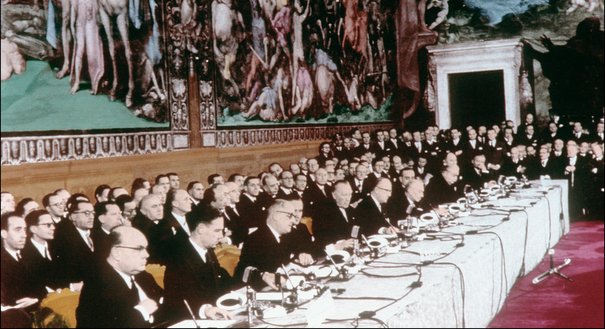
Source: Getty
This Nobel Peace Prize is a testament to the wisdom of many European leaders and to the people of Europe who supported them.
When, six months ago, I completed a 35-year career entirely devoted to the EU's external relations policy, I felt that I had been one of the many foot soldiers in charge of promoting the EU’s values around the world. I had been working for, what one of my interlocutors in a non-EU country is calling “the largest peace project in the world”. This is exactly what it means in today's tense world. This is precisely what the Nobel Peace Prize is meant to say.
When I think of my childhood in the south of France in the 1950s, I can safely say that, back then, most adults around me, family and friends, were still reliving the pains and atrocities of the Second World War. They could hardly imagine a reconciled Europe, a continent where intra-European wars would have become impossible. This has been achieved, day after day, treaty after treaty, with patience and tenacity. I have had the immense privilege of working with some of the architects of this formidable enterprise: Jacques Delors, Claude Cheysson, Simone Veil, Romano Prodi, and Jerzy Buzek, to mention only those who are not in positions of responsibility anymore.
This Nobel Peace Prize is a testament to the wisdom of many European leaders and to the people of Europe who supported them. It should also be a source of inspiration for today's leaders when they chart the future of the European Union, from its economic policy to its enlargement policy, from projecting peace abroad to supporting democratic societies around the world. The European Union may have achieved peace at home, but it still shoulders an immense responsibility outside its borders.

Senior Fellow, Carnegie Europe
Marc Pierini is a senior fellow at Carnegie Europe, where his research focuses on developments in the Middle East and Turkey from a European perspective.
Recent Work
Marc Pierini
Marc Pierini

Trump is distracted and Ukraine wants Europe to step up. The continent’s leaders must find their voice and assert it in talks with Russia.

Alissa de Carbonnel

Mounting economic strain and battlefield losses will not necessarily make the Kremlin less dangerous. They could instead push Moscow toward a more aggressive hybrid campaign designed to test NATO’s Eastern flank, exploit allied hesitation, and fracture European resolve.

Maksym Beznosiuk

Over the past ten years, NATO has held almost as many summits as it did during the entirety of the Cold War. Are they still useful, or is it time to stop holding annual meetings?

Rym Momtaz, ed.
Nearly a year and a half after Europeans leaned into sucking up to Trump, the strategy has produced some benefits when it comes to Ukraine.
Rym Momtaz
Far-right leader Marine Le Pen can—and will—run in France’s next presidential election. What does the outcome of her appeal against a 2025 embezzlement conviction mean for the country’s political future?
Catherine Fieschi