

Commentary
Judy Dempsey
{
  "authors": [
    "Judy Dempsey"
  ],
  "type": "commentary",
  "blog": "Strategic Europe",
  "centerAffiliationAll": "",
  "centers": [
    "Carnegie Endowment for International Peace",
    "Carnegie Europe"
  ],
  "collections": [],
  "englishNewsletterAll": "",
  "nonEnglishNewsletterAll": "",
  "primaryCenter": "Carnegie Europe",
  "programAffiliation": "",
  "programs": [],
  "projects": [],
  "regions": [
    "Europe"
  ],
  "topics": [
    "Climate Change"
  ]
}
Source: Getty
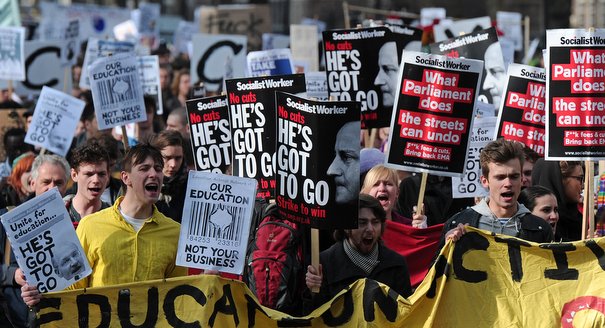
The last thing that Europe needs is an ill-educated younger generation. But that is precisely what it’s going to get as long as countries across Europe continue to cut back on teaching.
The last thing that Europe needs is an ill-educated younger generation.
But that is precisely what it’s going to get as long as countries across Europe, most notably those heavily indebted, continue to cut back on teaching.
Consider what is happening to universities. Public funding has decreased by at least 10 percent in the Czech Republic, Greece, Hungary, Iceland, Ireland, Italy, Latvia, the Netherlands, Portugal, and Spain. Lithuania’s budget was cut by 26 percent.
Education experts say the picture is diverse. What is emerging is a North-West/South-East divide in Europe when it comes to spending on higher education.
In practice, it could mean a disastrous brain drain in the South and the East. Skilled labor and educated people are prized commodities, especially at a time when Europe faces immense competition from highly educated and mobile young people from Asia. And if and when these countries’ economies start growing again, they will need a well-educated work force to sustain any growth.
In contrast, Austria, France, Germany, Poland, Denmark, Norway, and Sweden have increased funding to higher education.
Yet these figures are deceptive.
The European University Association (EUA) makes the point that increases in funding for education in absolute figures are often due to rising numbers of students. However, funding per student is often stagnating or decreasing, for example in Denmark, Germany, or Norway.
So far, the EUA has not ventured any opinion as to what these trends mean for Europe’s competitiveness. But it is clear that the more governments cut back on higher education, the heavier the price will be in the not-too-distant future. State spending on education is central: On average in Europe, the state provides 75 percent of funding to higher education.
Spain, where the government is now trying to introduce sharp cuts to the education budget, is an interesting case. It is paying a high price for the boom years. Regional governments have spent fortunes on building new universities but have not been able to turn them into centers of excellence. Raphael Minder, the International Herald Tribune’s Madrid correspondent, wrote a very good piece explaining why Spain’s higher education system was in need of a radical overhaul.
One of the most important issues any overhaul must address is the serious shortage of scientists, engineers, and mathematicians in Europe. Industry and research centers need these skills if Europe wants to remain competitive on global markets. That means investing in these disciplines, not cutting back.
And then there’s the demographic issue. A poorly educated work force will just not be able to generate enough wealth to maintain Europe’s rapidly growing number of elderly. Of course, Europe can speed up the “blue card” system that would allow skilled immigrants to work and settle in Europe.
But that is no panacea to the crisis facing Europe’s younger generation, especially those pupils attending secondary schools.
Teachers in many European countries have had their salaries slashed or their jobs cut. The consequences are plain for all to see. Young people will be put off from entering the teaching profession just when they will be needed.
According to a new report by the Organization for Economic Cooperation and Development (OECD), more than 40 percent of secondary school teachers in five EU countries (Austria, the Czech Republic, Estonia, the Netherlands, and Sweden) are aged fifty years or older. In Germany and Italy it is over 50 percent.
So with the teaching profession now being downgraded, governments will not be able to find the talent or commitment they need. As it is, the starting pay is very low in many countries. In Bulgaria, Latvia, Lithuania, and Romania, high school teachers earn about 6000 euro in their first year.
Androulla Vassiliou, the EU’s Commissioner for Education, Culture, Multilingualism, and Youth says in a report that "Teachers' remuneration and working conditions should be a top priority in order to attract and retain the best in the profession."
The problem is that reforms have become synonymous with reducing public expenditure across the board, with few questions asked about the long-term impact.
If the EU is serious about protecting education, especially when some governments have so little leeway over their finances, then it could consider reorganizing the bloc’s structural funds. During the 2007-2012 financial period, they amounted to €347 billion.
The funds are earmarked for regional development among other things. But perhaps it’s time that the next budget should focus on providing finance for teachers and the next generation.

Nonresident Senior Fellow, Carnegie Europe
Judy Dempsey is a nonresident senior fellow at Carnegie Europe
Recent Work
Judy Dempsey
Judy Dempsey
Carnegie does not take institutional positions on public policy issues; the views represented herein are those of the author(s) and do not necessarily reflect the views of Carnegie, its staff, or its trustees.

Before the next wave of EU enlargement takes place, the union needs to grapple with thorny questions of how power is distributed among its members.


Emil Sondaj Hansen, Ditte Brasso Sørensen

Are Germany’s economic, industrial, and political struggles becoming a liability for the EU’s ability to rise to the geopolitical moment?

Rym Momtaz, ed.

European Commission President Ursula von der Leyen is about to give her annual address on the state of the EU. Here’s what she won’t—but should—say.
Rym Momtaz

The aftermath of the Ceuta crisis shows Europe has drawn the wrong lessons. Rather than doubling down on failed migration policies, the EU needs to address the underlying roots of such episodes.

Richard Youngs

An overwhelming victory by a far-right-wing party in a small state in eastern Germany will have major repercussions for Chancellor Friedrich Merz’s coalition.
Judy Dempsey