

Commentary
Judy Dempsey
{
  "authors": [
    "Judy Dempsey"
  ],
  "type": "commentary",
  "blog": "Strategic Europe",
  "centerAffiliationAll": "",
  "centers": [
    "Carnegie Endowment for International Peace",
    "Carnegie Europe"
  ],
  "collections": [],
  "englishNewsletterAll": "",
  "nonEnglishNewsletterAll": "",
  "primaryCenter": "Carnegie Europe",
  "programAffiliation": "",
  "programs": [],
  "projects": [],
  "regions": [
    "Europe",
    "Middle East",
    "Southern, Eastern, and Western Africa"
  ],
  "topics": [
    "EU"
  ]
}
Source: Getty
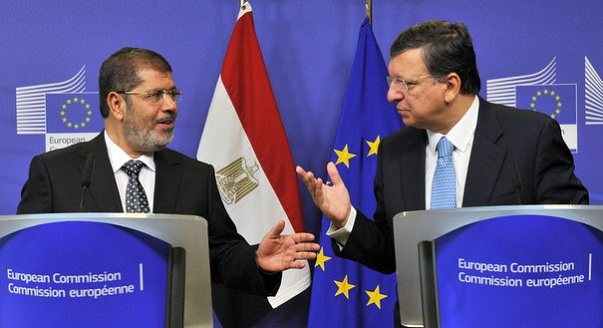
Europe and the United States were still busy praising Morsi for the cease fire that he brokered so successfully in Gaza when he, suddenly and quietly, made a grab for nearly dictatorial powers in his country.
Egypt’s President, Mohamed Morsi has dealt a nasty surprise to Europe and the United States.
They were still busy praising Morsi for the cease fire that he brokered so successfully in Gaza when he, suddenly and quietly, made a grab for nearly dictatorial powers in his country.
Faced with this coup d’état, Europeans and Americans will have to decide what value they place on democracy.
The reason is that last Thursday, November 22, Morsi granted himself sweeping new powers. He declared that no court, not even the constitutional court, could challenge his decisions. He sacked the prosecutor general. He also announced that he would re-open the trial of his predecessor, the deposed Hosni Mubarak and some of his aides.
Morsi’s supporters said he had to act because the old guard in the judiciary was resisting change.
Judges and lawyers have protested. Abdel-Meguid Mahmoud, the former prosecutor general, said he would go to court to challenge Morsi’s new powers. Thousands of demonstrators took to the streets on Friday to protest against Morsi, claiming he was usurping the revolution and its democratic, secular goals.
Morsi said he had no choice. “I don’t like, want or need to resort to exceptional measures. But I will if I see that my people, nation and the revolution of Egypt are in danger,” he told his supporters, who last Friday had rallied outside the presidential palace in Cairo.
Morsi’s constitutional decree states that the powers are temporary until a new constitution is written, presented in a referendum, and a new parliament is voted.
That has not assuaged his critics. Mubarak had retained “temporary” emergency powers that were first introduced in 1956 until he was deposed in 2011.
The judges and protestors have no reason to believe that Morsi will be any different from his predecessors.
How will the Europeans react?
Catherine Ashton, the EU’s foreign policy chief, has worked hard to establish a relationship with Morsi and his Muslim Brotherhood.
Ashton and her advisors believe, rightly, that Europe needs a dialogue with this powerful Islamic movement and that a Muslim Brotherhood in power does not preclude democracy. During his few months in office, Morsi has tried to convince the Europeans and Americans that he would defend the principles of democracy.
Many, including the author of this blog, believed that under Morsi’s leadership, a democratic Egypt could aspire to become one of the most influential countries in the region, playing a constructive role in creating regional stability and economic prosperity.
But now, Morsi’s new powers could confirm what skeptics have argued all along: an Arab Islamic president and government are incompatible with democracy.
It is too early to say how Morsi will deal with the growing opposition to his decree. But the fact that he issued it just hours after brokering a deal between Hamas and Israel, thus ending a violent eight-day confrontation, and possibly averting an Israeli invasion of Gaza, shows his growing confidence.
Morsi’s mediation was praised by the Obama administration and the Europeans, and behind the scenes, Israel. All three must be relieved that they have a strong leader at the helm in Egypt.
But they should not fall into the trap of thinking that an authoritarian president in Egypt would guarantee stability. Egypt has come so far along the road to democracy that Morsi’s grab for power will lead to less, not more stability.
Of course, Morsi now has to ensure that Israel sticks to its side of the bargain in lifting its crippling blockade on Gaza, and that Hamas prevents those who oppose the deal from firing rockets into Israel. His credibility is on the line. For these reasons, Morsi can tell his European and American interlocutors that he needs his new powers more than ever to maintain stability.
After all, say Morsi’s supporters, do the Europeans and Americans really want an unstable Egypt when the deal between Israel and Hamas is so fragile, not to mention the growing danger of Syria’s civil war spreading to neighboring Lebanon?
But it is not in Europe’s interests to accept Morsi’s new powers.
It made that mistake before the Arab Spring when Mubarak and other authoritarian leaders were in power across the Middle East. For the Europeans, stability was paramount. The price for that was turning a blind eye to human rights abuses, the state of emergency in these countries, to torture, and to the disregard of human dignity and freedom.
That is what is at stake now as Morsi strengthens his powers.
Europeans cannot allow themselves to be persuaded that these are just temporary measures. If the checks and balances are not soon restored, the gains of Tahir Square will be undermined.
Ashton and other European leaders need to use their relationship with Morsi to warn him off that path. It is not just Europe’s credibility that is at stake, but the future of democracy and stability in this part of the Middle East.

Nonresident Senior Fellow, Carnegie Europe
Judy Dempsey is a nonresident senior fellow at Carnegie Europe
Recent Work
Judy Dempsey
Judy Dempsey
Carnegie does not take institutional positions on public policy issues; the views represented herein are those of the author(s) and do not necessarily reflect the views of Carnegie, its staff, or its trustees.

The EU can impose sanctions but struggles to enforce them without the United States. With Washington increasingly disinterested in backing European interests, the bloc must now fend for itself.


Nicu Popescu, Tiago Antunes

Russia is testing the waters of NATO’s mutual defense clause. What do strikes in Romanian territorial waters mean for the alliance’s posture toward Moscow?

Dimitar Bechev

With its public finances in shambles, the far right polling at 35 percent ahead of the 2027 presidential election, and a growing protest movement, is France’s crisis a threat to the EU’s geopolitical awakening?

Rym Momtaz, ed.

Ahead of a tough winter for Ukraine, Donald Trump’s swing back toward Russia bodes ill. But instead of panicking, Kyiv’s European allies are focusing on action.
Rym Momtaz

While the EU and European governments are embracing the much-lauded middle-power moment, this entails three difficult conundrums.

Richard Youngs