

Commentary
Judy Dempsey
{
  "authors": [
    "Judy Dempsey"
  ],
  "type": "commentary",
  "blog": "Strategic Europe",
  "centerAffiliationAll": "",
  "centers": [
    "Carnegie Endowment for International Peace",
    "Carnegie Europe"
  ],
  "collections": [],
  "englishNewsletterAll": "",
  "nonEnglishNewsletterAll": "",
  "primaryCenter": "Carnegie Europe",
  "programAffiliation": "",
  "programs": [],
  "projects": [],
  "regions": [
    "Europe",
    "Middle East"
  ],
  "topics": [
    "EU"
  ]
}
Source: Getty
Europe’s disunity on the question of Palestinian statehood shows once again its lack of strategy to deal with the Israeli-Palestinian conflict, and ultimately to deal with the new Middle East.
Why is it so difficult for the Europeans to agree on recognizing a Palestinian state?
Over the years, the Europeans have supported the Palestinians, politically and financially. They recognized the Palestinian Liberation Organization. They recognized the right of the Palestinians to self-determination in the Venice Declaration of June 13, 1980.
The Europeans have been training the Palestinian security forces. They have been paying the salaries of the public sector. They have poured billions of euros into propping up the Palestinian budget, not to speak of huge infrastructure projects such as the—now long-destroyed—Gaza International Airport. They have, of course, supported peace negotiations with Israel. And they all support a two-state solution.
Yet the Europeans will not go down the final road of recognizing a Palestinian state.
Some European governments say this will derail peace talks. But what peace talks?
Others say recognition of statehood would undermine the goal of a two-state solution.
But the idea of two states living side by side is being increasingly eroded by Israel’s continuing building of settlements in the West Bank and in East Jerusalem. The consensus among Palestinian, Israeli, and international peace campaigners is that there is now more to gain than lose at the United Nations General Assembly this Thursday.
There, the Palestinians want the members to vote on whether to upgrade the status of the Palestinians from “observer entity” to “observer state.
The decision is less theoretical than it sounds.
Even as observer status, Palestine would not be a full member of the General Assembly. But the very mention of the word “state” carries enormous political symbolism for the Palestinians. And their enhanced status would allow them to join the International Criminal Court, where the Palestinians could try and accuse Israel of war crimes, or the International Court of Justice, that deals with territorial disputes.
The United States, Britain, and Israel have been working hard to deter the Palestinians from pursuing this particular path. France, a permanent member of the UN Security Council, also has misgivings about Israel possibly facing court procedures. Yet the French government said this past Tuesday that it would support the Palestinian bid.
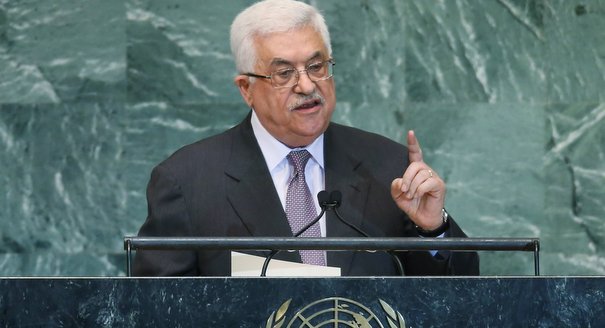
President Francois Hollande’s decision is a big boost for Mahmoud Abbas, the Palestinian president.
Over the past few years, Abbas has provided the Palestinians in the West Bank with minimal leadership. He has turned a blind eye to corruption. He has done very little to build strong democratic institutions. What interests him is remaining in power and staying ahead of Hamas. Indeed, Abbas has spent the past few years looking over his shoulder, worrying about Hamas’s power base in the Gaza Strip and its creeping influence in the largely secular West Bank.
It is because of Hamas’s growing power that Abbas has this time piled the pressure on the Europeans and the United States. His latest argument is that a vote against the Palestinian bid would weaken the Palestinian Authority just when it needs all the international support it can receive after Hamas’s recent show of strength against Israel. His real argument should be about the Palestinians’ right to human dignity and a state within the 1967 borders.
Abbas’s big diplomatic push for statehood at the UN General Assembly, where he can be sure of wide support, will not change one fact on the ground.
The Israeli settlements and the numerous military checkpoints will still be there the day after. It may even make matters worse if Israel retaliates by withholding tax revenues owed to the Palestinian Authority. That, however, would not be in Israel’s interests. Israel cannot afford a Palestinian Arab Spring.
But nor is there any reason to expect that Israeli Prime Minister Benjamin Netanyahu would kick-start peace talks were the Palestinians to withdraw their bid for statehood at the UN—and certainly not before the Israeli elections due in January.
That, then, is the sclerotic political landscape facing the Europeans.
Europe’s lack of unity over the Palestinian bid is shameful. It shows their inconsistency over supporting a two-state solution, which Israel surely needs too in order to protect the Jewish identity of its state.
It shows their inability to transcend their partiality in the Israeli-Palestinian conflict, ignoring the long-term damage on Israel and the Palestinians, as well as its wider impact on the Middle East.
Above all, Europe’s disunity shows once again its lack of strategy to deal with the conflict, and ultimately to deal with the new Middle East.

Nonresident Senior Fellow, Carnegie Europe
Judy Dempsey is a nonresident senior fellow at Carnegie Europe
Recent Work
Judy Dempsey
Judy Dempsey
Carnegie does not take institutional positions on public policy issues; the views represented herein are those of the author(s) and do not necessarily reflect the views of Carnegie, its staff, or its trustees.

Trump is distracted and Ukraine wants Europe to step up. The continent’s leaders must find their voice and assert it in talks with Russia.

Alissa de Carbonnel

Mounting economic strain and battlefield losses will not necessarily make the Kremlin less dangerous. They could instead push Moscow toward a more aggressive hybrid campaign designed to test NATO’s Eastern flank, exploit allied hesitation, and fracture European resolve.

Maksym Beznosiuk
Over the past ten years, NATO has held almost as many summits as it did during the entirety of the Cold War. Are they still useful, or is it time to stop holding annual meetings?

Rym Momtaz, ed.
Nearly a year and a half after Europeans leaned into sucking up to Trump, the strategy has produced some benefits when it comes to Ukraine.
Rym Momtaz
Far-right leader Marine Le Pen can—and will—run in France’s next presidential election. What does the outcome of her appeal against a 2025 embezzlement conviction mean for the country’s political future?
Catherine Fieschi