

Commentary
Judy Dempsey
{
  "authors": [
    "Judy Dempsey"
  ],
  "type": "commentary",
  "blog": "Strategic Europe",
  "centerAffiliationAll": "",
  "centers": [
    "Carnegie Endowment for International Peace",
    "Carnegie Europe"
  ],
  "collections": [],
  "englishNewsletterAll": "",
  "nonEnglishNewsletterAll": "",
  "primaryCenter": "Carnegie Europe",
  "programAffiliation": "",
  "programs": [],
  "projects": [],
  "regions": [
    "Europe",
    "Southern, Eastern, and Western Africa"
  ],
  "topics": [
    "EU",
    "Security"
  ]
}
Source: Getty
Stability in Mali needs the support of Algeria, which has become an increasingly more important regional player.
Algeria is back on center stage.
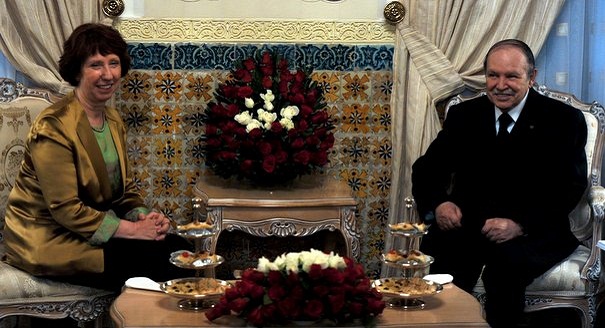
U.S. Secretary of State Hillary Clinton was there last October, followed by the EU’s foreign policy chief Catherine Ashton. French President Francois Hollande will make a high-profile two-day state visit next week.
They all have the same message: They need Algeria’s president, Abdelaziz Bouteflika, to support an African-led military intervention in northern Mali.
Together, these leaders are trying to prevent Mali in particular and the Sahel in general from becoming a safe haven for Al-Qaeda offshoots, drug and weapons traffickers, and criminal gangs. They fear that these terrorist and criminal movements could extend to Algeria and then across to Europe.
The United States and the EU have already drawn up long-term strategies for the region. Their main focus is on long-term security, development, and environmentally sustainable policies. The short term is about preventing the Sahel countries of Mauritania, Mali, and Niger from sliding into chaos and becoming failed states.
Stability in Mali needs the support of Algeria, which has become one of the most important players in the regime since Libya’s Colonel Muammar Gaddafi was ousted from power in 2011.
But for the U.S., the EU, and France, the former colonial power in Algeria, it is still not clear how Bouteflika wants to use that role. Algeria’s wretched and violent colonial past has made it highly suspicious of any kind of European interference in its neighborhood, especially France’s. Bouteflika was staunchly opposed to the NATO military mission in Libya in early 2011, particularly because France, along with Britain, had led the campaign to launch it in the first place. Algeria too has looked on with deep concern about the collapse of other authoritarian (and secular) regimes in the region.
So far, Algeria has been immune from the Arab Spring.
But Bouteflika, in power since 1999, cannot ignore the fallout from the Arab Spring, especially the impact of fighters from Mali employed by the Gaddafi regime returning home, which I discussed in an earlier blog. Nor can he ignore the rise to power of Islamist parties in Tunisia and Egypt.
Algeria spent most of the 1990s violently suppressing its own Islamist political movement. It is highly unlikely that Bouteflika would allow any Islamist political party to make inroads. He has seen what is taking place in northern Mali where Ansar Dine, an offshoot of Al-Qaeda in the Islamic Magreb (AQIM), now controls this part of the country and is using violence to impose sharia law.
In the south, the fragile interim government and the army are locked in a power struggle. The military staged a coup last March after the government in Bamako, the capital, failed to prevent Ansar Dine establishing a foothold in the north.
Since then, the African Union and the Economic Community of West African States (ECOWAS) have been vocal in demanding the return of civilian rule. They have had limited success. On December 11, the army arrested Cheikh Modibo Diarra, the interim prime minister, and forced him to resign.
They have been vocal, too, in wanting to help rebuild Mali’s army so as to regain control over the north. The prospect of Ansar Dine becoming entrenched in this part of the Sahel and using it as a launch pad for other parts of the region is just too terrifying for ECOWAS countries and indeed for the EU.
The EU and the United States have been working closely with ECOWAS. On December 10, EU foreign ministers approved sending 250 military personnel to Mali. This contingent of European soldiers will help train Mali’s armed forces, based on the rule of law and human rights.
In parallel, ECOWAS, backed by France, is seeking a UN mandate to deploy up to 4,000 troops to Mali aimed at rebuilding the army and then launching an attack to retake the north. But France can ill-afford to push quickly for a military intervention. It needs the support of Algeria.
Bouteflika loathes the idea of any foreign presence or meddling in the region, especially European. Yet Algeria’s own intelligence services are known to be active in Mali. At the same time, Boutiflika doesn’t want contagion from northern Mali, either. An African-led mission might appear the lesser evil to him.
That is why Hollande’s visit next week to Algeria could be the turning point not only for Mali. It could weaken the Algeria’s deep distrust of its former colonial ruler, finally beginning a rapprochement between Paris and Algiers.

Nonresident Senior Fellow, Carnegie Europe
Judy Dempsey is a nonresident senior fellow at Carnegie Europe
Recent Work
Judy Dempsey
Judy Dempsey
Carnegie does not take institutional positions on public policy issues; the views represented herein are those of the author(s) and do not necessarily reflect the views of Carnegie, its staff, or its trustees.

European Commission President Ursula von der Leyen is about to give her annual address on the state of the EU. Here’s what she won’t—but should—say.

Rym Momtaz

The aftermath of the Ceuta crisis shows Europe has drawn the wrong lessons. Rather than doubling down on failed migration policies, the EU needs to address the underlying roots of such episodes.

Richard Youngs

An overwhelming victory by a far-right-wing party in a small state in eastern Germany will have major repercussions for Chancellor Friedrich Merz’s coalition.
Judy Dempsey

Canadian Prime Minister Mark Carney has twice inspired praise for standing up to U.S. President Donald Trump: at the 2026 World Economic Forum in Davos and on Canada-U.S. trade negotiations. Is Carney showing a third way better than the EU has in dealing with the Trump administration?
Rym Momtaz, ed.

The EU’s responses to two recent incidents expose the gulf between European perceptions and capabilities. Unless the union can bridge that gap, it will never become a real geostrategic power.
Rym Momtaz