

Commentary
Nathalie Tocci, Jan Techau
{
  "authors": [
    "Jan Techau"
  ],
  "type": "commentary",
  "blog": "Strategic Europe",
  "centerAffiliationAll": "",
  "centers": [
    "Carnegie Endowment for International Peace",
    "Carnegie Europe"
  ],
  "collections": [],
  "englishNewsletterAll": "",
  "nonEnglishNewsletterAll": "",
  "primaryCenter": "Carnegie Europe",
  "programAffiliation": "",
  "programs": [],
  "projects": [],
  "regions": [
    "Europe"
  ],
  "topics": [
    "Climate Change",
    "EU"
  ]
}
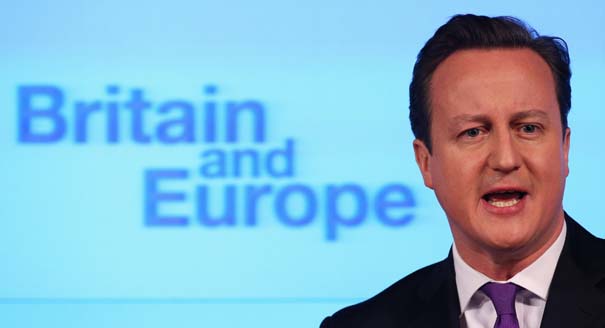
Source: Getty
The British Prime Minister wants deep economic integration in Europe, but no political unity. That view is both old-fashioned and wrong.
David Cameron delivered a tactical masterpiece this morning when he finally gave his much-awaited speech on Europe. Euro-skeptical Conservatives, members of the UK Independence Party, Labour, and Liberal Democrats will find it hard to regain the initiative and distinguish themselves next to Cameron’s seemingly consistent vision for a new European Union, and his clear dedication to an in-out referendum on a re-negotiated treaty. He has very clearly gained time and political maneuvering space on the home front, which was one of his primary objectives.
But there is one fundamental flaw in the UK Prime Minister’s thinking. It is the idea that you can separate politics and economics. His entire idea for a new EU compact based on five principles rests on the assumption that you can fundamentally deepen economic integration by completing the EU single market, while going into reverse on the political side. That somehow the sphere of commerce, industry, competitiveness, and trade has nothing to do with the sphere of taxes, budgets, debt, labor law, and social policies. It is, to say the least, stunning, that a highly educated leader of one of the most modern nations in the world should hold such a view in 2013.
David Cameron’s vision for a re-negotiated Europe looks attractive on the surface. He uses all the right buzz words: flexibility, fairness, democracy. But in reality, Cameron is pushing for mission impossible. In the long run, you either embrace in-depth economic integration across all sectors, and then more political integration will have to follow. Or you reject political integration, which is a perfectly acceptable position, but then you can’t have deep economic integration, either. At least not in the long run. This is precisely the lesson from the current crisis, which, at its core, is about the yawning gap between economic and political integration in Europe. Cameron wants all the benefits of integration while shying away from the tedious homework this will require elsewhere.
This is not a viable political position. If it reflects his true thoughts and convictions, instead of being just tactical noise for the battle back home, Cameron’s view strikes me as decidedly old-fashioned, if not entirely outdated. He seems to think that while business and trade are honorable activities, politics, especially its continental variety, is unfitting for a true gentleman. In essence, that’s romanticism. It was already wrong when it was fashionable in the 19th century, as Britain’s landed aristocracy learned the hard way. It is even less suited to reality today, when it has become fashionable again in the great, nostalgic English soul search of the early 21st century.
There are many more things, good and bad, that can be said about the speech. How Cameron takes some justified criticism of the EU institutions and spins it into a bizarre caricature of ineffectiveness and irresponsibility. How he is purposefully ambiguous on whether he wants a new EU treaty or just a re-negotiated arrangement for the UK. How he is, in the beginning and in the end, surprisingly pro-European. How the speech is scandalously thin on foreign policy—just one small remark on Mali. How Cameron is, ironically, the only leading EU politician who really wants treaty change.
The most important question now is how the UK’s European partners will react. Behind the scenes however, carefully crafted suggestions and initiatives must and will follow. There are many points where the more liberally minded economies of the North will find common ground with Cameron. Competitiveness, economic reforms, and open markets are the key to EU success. The democratic deficit of the EU is also an issue that needs urgent work, even though the position Cameron takes on national sovereignty will make the much needed reform of the European Parliament more difficult, not less.
All in all, the ambiguous message of Cameron’s speech is that he has revived the European reform debate, but that his initiative is based on a political impossibility. The big question now is whether this impossibility will lead to a constructive debate or further deepen the political rifts in the EU.
Director, Europe Team, Eurasia Group
Techau is director with Eurasia Group's Europe team, covering Germany and European security from Berlin. Previously, he was director of Carnegie Europe.
Recent Work
Nathalie Tocci, Jan Techau
Jan Techau
Carnegie does not take institutional positions on public policy issues; the views represented herein are those of the author(s) and do not necessarily reflect the views of Carnegie, its staff, or its trustees.

The European Commissioner for Trade is headed to China. But after President Xi’s bridge-building visit to Washington, can a more isolated EU overcome Beijing’s stranglehold on critical raw materials? Who will blink first?

Rym Momtaz, ed.

The domestic impacts of how long it is taking to end the war in Ukraine have pushed the French electorate to the political extremes and compromised the country’s diplomatic capacity.
Rym Momtaz

Before the next wave of EU enlargement takes place, the union needs to grapple with thorny questions of how power is distributed among its members.


Emil Sondaj Hansen, Ditte Brasso Sørensen

Are Germany’s economic, industrial, and political struggles becoming a liability for the EU’s ability to rise to the geopolitical moment?
Rym Momtaz, ed.

European Commission President Ursula von der Leyen is about to give her annual address on the state of the EU. Here’s what she won’t—but should—say.
Rym Momtaz