

Commentary
Judy Dempsey
{
  "authors": [
    "Judy Dempsey"
  ],
  "type": "commentary",
  "blog": "Strategic Europe",
  "centerAffiliationAll": "",
  "centers": [
    "Carnegie Endowment for International Peace",
    "Carnegie Europe"
  ],
  "collections": [],
  "englishNewsletterAll": "",
  "nonEnglishNewsletterAll": "",
  "primaryCenter": "Carnegie Europe",
  "programAffiliation": "",
  "programs": [],
  "projects": [],
  "regions": [
    "Europe",
    "Russia"
  ],
  "topics": [
    "EU"
  ]
}
Source: Getty
Preserving Europe’s monuments is not about bricks and mortar, or even nostalgia—it’s about retaining historical memory and ensuring long-term reconciliation.
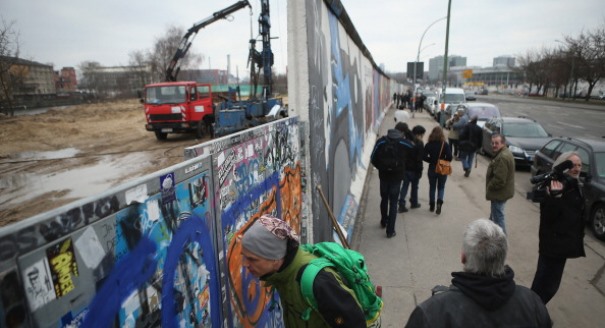
It isn’t that long—just 20 meters. Insignificant, you might think. After all, the so-called East Side Gallery, the longest stretch of the Berlin Wall that still stands, measures a total of 1.3 kilometers. There are plenty of other spots where tourists can visit remains of a wall that symbolized the division of Europe during the Cold War.
Last Friday, bulldozers moved in to dismantle this small part. The local authorities had given them the green light to make way for a luxury apartment complex in the increasingly sought-after district of Friedrichshain. Protesters succeeded in stopping most of the work—for the time being.
In 1990, months after East Germans breached the Berlin Wall, this particular stretch of the wall was transformed into the East Side Gallery. Using paint contributed by enthusiastic corporate donors, artists from Germany, Russia, and other European countries turned the drab gray concrete into an outdoor gallery that has attracted hordes of visitors ever since.
The most memorable painting is an interpretation of a famous photo showing the former Soviet leader, Leonid Brezhnev, kissing his East German counterpart, Erich Honecker, on the lips.
The demonstrators who moved in to stop the bulldozers on Friday and again on Monday did so not because they want the wall rebuilt or preserved for nostalgic reasons. It is about what the wall represents: a memory.
Memory is now one of the most contentious issues across Central and Eastern Europe.
Statues of Lenin or monuments to Soviet soldiers that were erected following the post-1945 Soviet occupation of Eastern Europe were torn down after the collapse of Communism. The new democracies wanted nothing to do with the USSR’s oppressive past.
Just recall the huge controversy in 2007 when the Estonian government removed a 2-meter-tall bronze statue built after 1945. It depicted a Soviet soldier bowing his head in mourning for those killed in the war. The statue was removed from the city and taken to a cemetery on the edge of the capital. This led to riots by the ethnic Russian community in Estonia and fierce criticism from the Kremlin.
In 2011, under the staunchly anti-Russian President Mikheil Saakashvili, Georgia’s parliament passed a law to destroy Soviet-era monuments and change street names that referred to the country’s Communist past.
Some civil society organizations questioned the decision. David Gogishvili, a civil society expert, said it was important for Georgians to understand their past. Besides, he added, “if we decide to get rid of all material leftovers of the Soviet system, we may face a situation in which half of Tbilisi will be destroyed.”
By tearing down statues and memorials, part of the past is being destroyed too. After all, these objects represent an epoch, however wretched and oppressive. Why not preserve them rather than pretend that this part of history never happened?
Furthermore, destroying these monuments makes it easier to represent a selective view of the past. What do you show to schoolchildren if you want to teach them about the makeup of history?
Ironically, by getting rid of these monuments, the new postcommunist governments were aping—albeit in a much milder form—what Stalin did during the 1930s in the former Soviet Union and after 1945 in Eastern Europe.
Anything that represented “bourgeois” values was pulled down or transformed into something Soviet. Churches and synagogues were closed or torn down or turned into recreation centers. The fate of people was worse.
The postcommunist governments in Central and Eastern Europe never took revenge to that degree. Had they done so, some ghastly but functional public buildings and apartment complexes in Prague, Warsaw, Budapest, Bucharest, and Sofia would have been pulled down years ago.
There is another side to retaining monuments: reconciliation.
There are two major memorials to the Red Army in Berlin. One dominates Treptower Park in East Berlin; the other is situated not far from the Brandenburg Gate, close to the German parliament. These monuments are no longer about the Red Army “liberating” Berlin during fierce fighting with remnants of the Nazi Wehrmacht in April 1945. They are now about reconciliation, something that Germany and Russia have long worked toward.
Reconciliation takes a very long time. The construction of the European Union would not have been possible without Konrad Adenauer, Germany’s first postwar chancellor, and Robert Schuman and Jean Monnet of France.
The thaw in Polish-Russian relations—however difficult—could not have happened without Poland, so often Russia’s victim, deciding it had to move forward instead of nursing resentment. Indeed, Stalin’s gift to the Polish people—the monumental Palace of Culture and Science—is still standing in Warsaw.
Protesters in Berlin are right to make a big issue out of a small bit of wall. They’re not just defending a stretch of painted concrete. They are defending their ownership of history and memory.

Nonresident Senior Fellow, Carnegie Europe
Judy Dempsey is a nonresident senior fellow at Carnegie Europe
Recent Work
Judy Dempsey
Judy Dempsey

The EU can impose sanctions but struggles to enforce them without the United States. With Washington increasingly disinterested in backing European interests, the bloc must now fend for itself.


Nicu Popescu, Tiago Antunes

Russia is testing the waters of NATO’s mutual defense clause. What do strikes in Romanian territorial waters mean for the alliance’s posture toward Moscow?

Dimitar Bechev

With its public finances in shambles, the far right polling at 35 percent ahead of the 2027 presidential election, and a growing protest movement, is France’s crisis a threat to the EU’s geopolitical awakening?

Rym Momtaz, ed.

Ahead of a tough winter for Ukraine, Donald Trump’s swing back toward Russia bodes ill. But instead of panicking, Kyiv’s European allies are focusing on action.
Rym Momtaz

While the EU and European governments are embracing the much-lauded middle-power moment, this entails three difficult conundrums.

Richard Youngs