

Commentary
Judy Dempsey
{
  "authors": [
    "Judy Dempsey"
  ],
  "type": "commentary",
  "blog": "Strategic Europe",
  "centerAffiliationAll": "",
  "centers": [
    "Carnegie Endowment for International Peace",
    "Carnegie Europe"
  ],
  "collections": [],
  "englishNewsletterAll": "",
  "nonEnglishNewsletterAll": "",
  "primaryCenter": "Carnegie Europe",
  "programAffiliation": "",
  "programs": [],
  "projects": [],
  "regions": [
    "Europe",
    "North America"
  ],
  "topics": [
    "Climate Change",
    "EU",
    "Security"
  ]
}
Source: Getty
France’s economic woes will seriously affect Europe’s ability to conduct military missions. Europeans should face up to that new reality.
France is realizing that political will is hollow if it isn’t underpinned by a strong economy. The government’s new Defense White Book, published this week, confirms this.
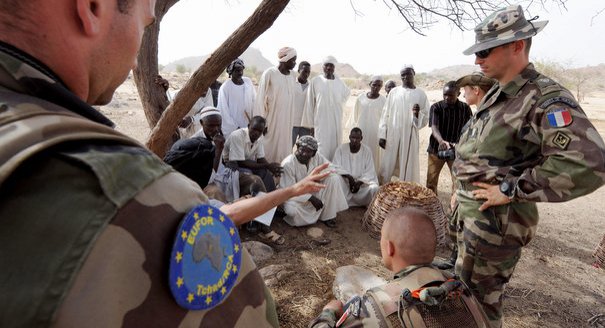
While hoping for an economic turnaround within the next five years, France is curtailing its military ambitions. It will still be able to act on its own, as it did in the recent military operation in Mali. But interventions will be on a much smaller scale.
What is more, France’s scaling down of its military reach has immense strategic implications for Europe, both in the continent’s immediate neighborhood and further afield.
Jean-Marie Guéhenno, a former diplomat who presided over the commission that drew up the French white paper, summed up his country’s ambitions and limitations.
“France’s allies did not expect it to be able to do everything everywhere,” he said. “The defense world only gradually became aware of the magnitude of choices made necessary by financial constraints.”
Along with Britain, France is one of only two powers in Europe that can act strategically. Both have the military capacity to do so. And, in the past, both have been able to match their political will with economic clout.
Now, with Europe’s two major military powers in serious economic difficulties, Camille Grand, a leading French security expert, said the White Book showed that France was struggling to preserve “a reasonable level of ambition.”
Yet France is not ready to give up its status as a major military player. (It is, after all, a nuclear power.) Indeed, the white paper sets limitations on the projection of French power, rather than proposing a whole-scale retreat.
France’s defense spending for 2014 will be kept at €31.4 billion. That is equivalent to 1.5 percent of GDP, which is below the 2 percent demanded by NATO and well below the 2.5 percent spent during the ebbing years of the Cold War. The overall defense budget for period between 2014 and 2019 is set at €179.2 billion.
Expenditure will be diverted to intelligence, midair refueling, and heavy airlift equipment—the three capabilities that were lacking during the Mali mission. The defense ministry has already ordered twelve drones.
To cut costs, the 218,000-strong armed forces will be reduced by 24,000. The civilian sector will be reduced by 10,000 from its current 66,700.
More revealing, the number of soldiers that can be rapidly deployed will be halved to 15,000. That will sorely affect France’s military reach and geopolitical priorities.
There are few European countries that can step in.
Germany is the only one that has enough economic might. But Chancellor Angela Merkel’s government is not prepared to translate that economic power into a military leadership that could shape Europe’s defense and security ambitions.
It’s not just because Germany is unwilling to define Europe’s strategic interests. It is also because Germany—like many other European countries—does not feel existentially threatened. Berlin shared Paris’s concerns over the rise of Islamic fundamentalism in Mali, but did not feel any need for military action. It was France that sent in the troops in January.
Now, the Europeans should be deeply worried by France’s recent defense reductions.
Indeed, the French (and British) cuts should be the catalyst for fundamental change in Europe’s attitudes toward defense. This is surely the time for Europeans to ask how they are going to protect their interests if they do not have adequate military and security resources to do so.
But Europe as a whole is not thinking along those lines. The record so far on pooling and sharing scarce military resources is miserable. Somehow, there is a misguided belief that the Americans will always be there to pick up the pieces.
Most European governments have not internalized the fact that the United States is disengaging from Europe.
Yet that development is hard to overlook. The United States has downgraded its missile shield plans for Poland and the Czech Republic. Over the past three years, it has brought home 10,000 troops. And two months ago, the last of America’s tanks that were based in Germany during the Cold War was shipped back across the Atlantic.
Admiral James Stavridis, the outgoing top U.S. soldier in Europe, told Congress that the Pentagon was canceling up to 140 security assistance programs with European allies because of defense cuts.
Next November, NATO will conduct a military training exercise called Steadfast Jazz 2013. Made up of 5,000 soldiers, it will be held in Estonia, Latvia, Lithuania, and Poland. It’s all about demonstrating NATO’s commitment to that part of Europe. Interestingly, the United States is planning to contribute about 150 soldiers. France will send 1,200.
Until now, the Europeans have kept their heads stuck in the sand about America’s changing priorities and about how France’s economic problems will affect Europe’s ability to conduct military missions.
Unless Europe choses to face up to reality, it will never be a global player. And, what is worse, it will renege on its political and moral responsibility to defend its interests and its citizens. Paris and Washington should say that—publicly and soon.

Nonresident Senior Fellow, Carnegie Europe
Dempsey is a nonresident senior fellow at Carnegie Europe
Recent Work
Judy Dempsey
Judy Dempsey
Carnegie does not take institutional positions on public policy issues; the views represented herein are those of the author(s) and do not necessarily reflect the views of Carnegie, its staff, or its trustees.
Europe’s reaction to the war in Iran has been disunited and meek, a far cry from its previously leading role in diplomacy with Tehran. To avoid being condemned to the sidelines while escalation continues, Brussels needs to stand up for international law.

Pierre Vimont
France and Germany’s failure to agree on the Future Combat Air System (FCAS) raises questions about European defense. Amid industrial rivalries and competing strategic cultures, what does the future of European military industrial projects look like?

Rym Momtaz, ed.
France has stopped clinging to notions of being a great power and is embracing the middle power moment. But Emmanuel Macron has his work cut out if he is to secure his country’s global standing before his term in office ends.
Rym Momtaz
Integrating AI into the workplace will increase job insecurity, fundamentally reshaping labor markets. To anticipate and manage this transition, the EU must build public trust, provide training infrastructures, and establish social protections.

Amanda Coakley
Europe’s interests in Syria extend beyond migration management, yet the EU trails behind other players in the country’s post-Assad reconstruction. To boost its influence in Damascus, the union must upgrade its commitment to ensuring regional stability.


Bianka Speidl, Hanga Horváth-Sántha