

Commentary
Judy Dempsey
{
  "authors": [
    "Judy Dempsey"
  ],
  "type": "commentary",
  "blog": "Strategic Europe",
  "centerAffiliationAll": "",
  "centers": [
    "Carnegie Endowment for International Peace",
    "Carnegie Europe"
  ],
  "collections": [],
  "englishNewsletterAll": "",
  "nonEnglishNewsletterAll": "",
  "primaryCenter": "Carnegie Europe",
  "programAffiliation": "",
  "programs": [],
  "projects": [],
  "regions": [
    "Europe",
    "Russia",
    "North America"
  ],
  "topics": []
}
Source: Getty
Every week leading experts answer a new question from Judy Dempsey on the foreign and security policy challenges shaping Europe’s role in the world.
Every week leading experts answer a new question from Judy Dempsey on the foreign and security policy challenges shaping Europe’s role in the world.
Russia is relevant, the G8 less so. Yet Moscow is not a strategic player.
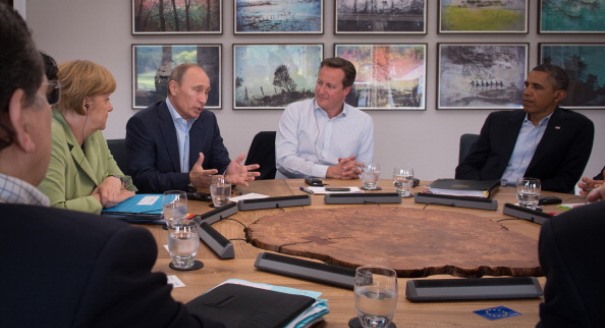
Having a seat at the G8 used to be big deal. Italy, Canada, and Russia all pushed to be accepted into the group. Now, being in the G8 is like having a membership card for an old gentlemen’s club: nice enough, but people’s daily lives do not revolve around it.
Russian President Vladimir Putin has been a master tactician, keeping power and keeping scores, but a very poor strategist. We know what America’s grand strategy is, we can guess what China’s might be, we politely agree that Europe has none—but nobody can figure out what Russia’s strategic interests are.
Does Russia want to be top dog again? Does it see itself playing a pivotal role between Asia and Europe? Or does it just want to score cheap points by defending the next bad guy (as it has in Venezuela and Syria)
Putin has no long-term strategy, therefore neither does Russia. It may be true that Moscow counts for a lot, but it will be no playmaker.
Russia is not relevant to the G8. Russian President Vladimir Putin made that clear when he did not deign to attend last year’s meeting in Camp David.
For Putin to sit at the table with a group of democracies—tattered as some of them may currently be—is a travesty. It is all the more so when he sees his role as preventing any coalescence of positions among the other members. There is not even a realpolitik rationale for Russia’s presence given its active opposition to everything the other countries are trying to achieve.
The G8 should be reinvented as a grouping of democracies and should be expanded to include such key players as Poland, Australia, and Brazil. Turkey is another potential candidate, but this will have to be held in abeyance until it is clear that Turkey is a liberal democracy.
Disinviting Russia from the G8 would be a clear signal that Putin’s policies are leading to Russia’s isolation, and that values still matter in international relations.
Whether Russia is relevant or not, the real question is whether the G8 still has a role to play. As it stands today, the G8 is neither fully Western nor fully representative of the world.
Russia’s membership in the G8 came in 1998 in the form of U.S. president Bill Clinton’s compensation to Russian president Boris Yeltsin for NATO’s enlargement, which Moscow opposed. Clinton was proud that he could walk and chew gum at the same time. The assumption then was that Russia, through the G8, would be brought into the Western fold, accept U.S. global leadership, and learn to play by the West’s rules.
Much has happened since then. Neither Clinton nor his successor, George W. Bush, cared much about Russia’s integration into the West. By the mid-2000s, Russia left the Western strategic orbit. Its economy has recovered, but it is still not in the category of its G8 partners. Its political system has become more authoritarian. Today Moscow openly says it does not fully share present-day Western values. The G8 stands as a relic of the unfulfilled promises and expectations of a bygone era.
From Moscow’s perspective, this is just fine. Russia gets the prestige it wants. President Putin doesn’t feel like a member of the family—which treats him as a stranger anyway—but doesn’t mind being the contrarian. For Russia, the G8 stands somewhere between the G20 and the BRICS, as a symbol that Russia has a foot in all important councils. Russia’s partners, however, feel uneasy: Russia’s presence in the G8 robs the group of its homogeneity and unity.
It might have been wiser to remain at seven, or to work harder to integrate Russia—but history cannot be undone. Expelling members is more difficult than accepting them, and no one wants to take responsibility. The G8’s structural awkwardness today is a price people have to pay for its creators’ carefree habits.

Nonresident Senior Fellow, Carnegie Europe
Judy Dempsey is a nonresident senior fellow at Carnegie Europe
Recent Work
Judy Dempsey
Judy Dempsey
Carnegie does not take institutional positions on public policy issues; the views represented herein are those of the author(s) and do not necessarily reflect the views of Carnegie, its staff, or its trustees.
Defense tech innovations will be at the heart of Europe’s new security strategy. But so far, Brussels has been making moves without a broader plan, undermining readiness and credibility.

Raluca Csernatoni
When the U.S.-Iran memorandum of understanding was announced, the UK, France, Germany, and Italy declared their readiness to help demine the Strait of Hormuz and lift nuclear sanctions on Tehran. But does Europe need new tools to recover a diplomatic role?

Rym Momtaz, ed.
The Franco-German relationship is on the rocks again. But unlike previous moments of tension, the epochal changes on the world stage require that both step up investment in their bilateral ties.
Rym Momtaz
The EU is putting together a new security strategy to meet today’s myriad challenges. But for any proposal to be effective, the union needs to grapple with its identity and ambitions.

Pierre Vimont
The EU’s new migration policy is not suited to today’s realities. With climate change increasingly becoming a driver of displacement, Europe needs to rethink its deterrence-focused approach.

Shana Tabak