

Commentary
Judy Dempsey
{
  "authors": [
    "Judy Dempsey"
  ],
  "type": "commentary",
  "blog": "Strategic Europe",
  "centerAffiliationAll": "",
  "centers": [
    "Carnegie Endowment for International Peace",
    "Carnegie Europe"
  ],
  "collections": [],
  "englishNewsletterAll": "",
  "nonEnglishNewsletterAll": "",
  "primaryCenter": "Carnegie Europe",
  "programAffiliation": "",
  "programs": [],
  "projects": [],
  "regions": [
    "Europe",
    "Russia",
    "Middle East",
    "North America"
  ],
  "topics": [
    "Climate Change"
  ]
}
Source: Getty
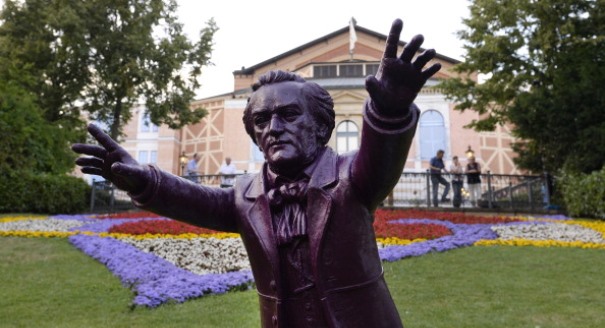
A recent adaptation of Wagner’s Ring cycle makes a provocative analogy with American oil, but misses the importance of the shale gas revolution sweeping the United States.
This is the time of year when aficionados of German composer Richard Wagner make their annual pilgrimage to Bavaria’s Bayreuth Festival. They flock to hear his monumental operas performed in a festival house designed by the composer himself.
The newest production makes a provocative analogy with American oil, but misses the central importance of the shale gas revolution.
This year is the 200th anniversary of Wagner’s birth. Bookshelves are creaking with new biographies of him, studies of his operas, and essays on how the Nazis admired his music, which invoked nature, myth, and Teutonic might.
No wonder that there was huge interest in Berlin theater director Frank Castorf’s production of this year’s Der Ring des Nibelungen (The Ring of the Nibelung), a cycle of four epic operas.
Castorf is no stranger to controversy. He loves defying convention with his super modern and super radical interpretations.
To conservatives, Castorf’s production of Das Rheingold (The Rhine Gold), the first opera in the Ring cycle performed last week in Bayreuth, must have seemed positively sacrilegious.
The setting has nothing to do with the lush banks of the Rhine River. Instead, the opera is set in a sleazy motel alongside a gas station on Route 66 in the United States, the country’s most famous highway.
In Castorf’s adaptation, Wotan and other gods are portrayed as mobsters and hookers, all up to no good. The Rhine maidens—originally water nymphs that guard the Rhine gold—are tough prostitutes, provocatively dressed to suit the atmosphere of murder, theft, and conspiracy.
The giants Fafner and Fasolt are decked out as thugs with baseball bats, while the fire god Loge is a paparazzo. The stage is a hive of activity. Scenes include a Mercedes-Benz convertible and a camper being driven and then hauled across the stage.
But the essence of Castorf’s production is not just substituting German nature and myth with American lowlife and intrigue. It’s about substituting gold with oil.
“I asked myself what The Rhine Gold can mean to us,” Castorf said in an interview with German broadcaster Deutsche Welle. “And I assumed that oil plays a similar role for us today as gold in the Ring. Our technological progress, our luxuries, and our economy all depend on oil.”
Well, it is certainly fascinating that Castorf used American oil as a metaphor for power, money, and vice. But while that may have been true even ten years ago, hasn’t the world moved on? Did Castorf forget to read up on shale gas?
Shale gas is at the heart of the energy revolution now taking place in the United States, with immense consequences for the country’s foreign policy and domestic economy. The vast reserves of shale gas that American companies are exploring at breakneck speed are setting the United States on the road to energy self-sufficiency.
In political terms, this means that the United States will no longer be dependent on the vagaries of the Organization of the Petroleum Exporting Countries oil cartel. Washington will also be less inclined to intervene in conflicts in countries that possess oil reserves.
Above all, the shale gas revolution will influence how the United States views its long-term strategic interests in the Middle East. If those interests are no longer based on the need to secure large supplies of oil, Washington’s attitude to authoritarian countries like Saudi Arabia may change quite drastically.
The Europeans should be asking what these changes will mean for them in terms of geostrategic relations. They should also be asking how they could use shale gas to reduce their dependence on Russia.
Just as Middle Eastern oil influenced U.S. policy, Russia’s political power games in Eastern Europe would change dramatically if Russia could no longer rely on the lever of withholding energy deliveries or dictating prices.
Under these circumstances, it seems a bit old-fashioned for such a cutting-edge German theater producer to have his gods squabble over oil. Productions of Das Rheingold should either catch up with America’s changing energy market or stick to gold.
Nonresident Senior Fellow, Carnegie Europe
Judy Dempsey is a nonresident senior fellow at Carnegie Europe
Recent Work
Judy Dempsey
Judy Dempsey
Carnegie does not take institutional positions on public policy issues; the views represented herein are those of the author(s) and do not necessarily reflect the views of Carnegie, its staff, or its trustees.

With its public finances in shambles, the far right polling at 35 percent ahead of the 2027 presidential election, and a growing protest movement, is France’s crisis a threat to the EU’s geopolitical awakening?

Rym Momtaz, ed.

Ahead of a tough winter for Ukraine, Donald Trump’s swing back toward Russia bodes ill. But instead of panicking, Kyiv’s European allies are focusing on action.
Rym Momtaz
While the EU and European governments are embracing the much-lauded middle-power moment, this entails three difficult conundrums.
Richard Youngs
Much has been said of the changes Brussels is trying to make to the EU enlargement process. Here’s why gradual integration might—or might not—be the answer.

Dimitar Bechev
The European Commissioner for Trade is headed to China. But after President Xi’s bridge-building visit to Washington, can a more isolated EU overcome Beijing’s stranglehold on critical raw materials? Who will blink first?
Rym Momtaz, ed.