

Commentary
Judy Dempsey
{
  "authors": [
    "Judy Dempsey"
  ],
  "type": "commentary",
  "blog": "Strategic Europe",
  "centerAffiliationAll": "",
  "centers": [
    "Carnegie Endowment for International Peace",
    "Carnegie Europe"
  ],
  "collections": [],
  "englishNewsletterAll": "",
  "nonEnglishNewsletterAll": "",
  "primaryCenter": "Carnegie Europe",
  "programAffiliation": "",
  "programs": [],
  "projects": [],
  "regions": [
    "Western Europe",
    "United Kingdom",
    "Germany",
    "Europe"
  ],
  "topics": [
    "EU"
  ]
}
Source: Getty
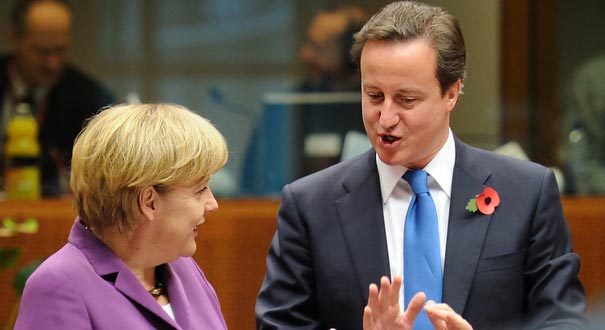
Britain’s David Cameron hopes that Germany’s Angela Merkel will support his desire to repatriate certain EU powers from Brussels to the member states. He might be disappointed.
David Cameron is the European leader who most fervently hopes for Angela Merkel to be reelected as German chancellor next Sunday.
Britain’s prime minister is convinced that he has found in Merkel an ally who will repatriate many EU powers from the central institutions to the member states.
If that is the case, Germany would be radically shifting away from its traditional support for political and economic integration and toward a more member-states-based approach. That would have immense strategic implications for the future of the EU as a political entity.
Merkel herself has given only a hint of her views on Europe’s future. Last month, she said she wanted to encourage discussions on how and whether the EU could give “something back” to member states. “We don’t have to do everything in Brussels,” Merkel added.
That was music to Cameron’s ears. No wonder he is banking on a Merkel victory. He is hoping, too, to remain prime minister and leader of his Conservative Party. This is despite being desperately weakened and humiliated in parliament three weeks ago, when his own backbenchers voted against military action in Syria.
Cameron is also hoping to be reelected at the next UK general election in 2015. His calculation is that with Merkel in the Chancellery, Berlin will then agree to certain EU treaty revisions. When, two years later, Cameron will have to keep his promise of holding a referendum on Britain’s continued EU membership, these treaty changes could make it more palatable for British voters to say yes to remaining in the EU.
Naturally, Britain’s opposition Labour Party is horrified by the thought of an alliance between Merkel, Cameron, and other like-minded conservatives across Northern Europe.
Labour lawmakers maintain that several of Europe’s Conservative parties will try to introduce revisions to the EU treaties that would weaken social and employment laws as well as financial regulations. These, of course, are the EU laws that Britain’s Conservatives hate. They regard them as intrusive and threatening to national sovereignty.
Indeed, a new movement of Tory lawmakers called the Fresh Start project has been making the rounds in European capitals. Its 40-page manifesto is a must-read because it explains what Britain, according to the Conservative mindset, wants from the EU.
Fresh Start is seeking a UK opt-out not just from all social legislation but also from all existing measures on policing and criminal justice. If EU member states were to agree to these revisions, the bloc would, to a large extent, become an à la carte organization.
Also, left-wing parties in Britain and other European countries know that if such revisions were made, especially on social legislation, support among their members for the EU would plummet.
That is why a group of Labour lawmakers and party supporters have established the Labour for a Referendum movement. The group wants Ed Miliband, the party’s leader, to call a referendum on Britain’s EU membership—and soon.
“We do need a referendum on Europe,” said Dominic Moffitt, the movement’s campaign director. “We would like it in our party’s manifesto for the 2015 elections,” he added.
The problem is that the Labour Party is not united over a referendum. Miliband will not say where he stands on the issue.
“I recognize that we on the left are not universally supportive of the EU, but we are broadly so, and that is why we must recognize the danger of what Cameron is planning,” Moffitt added.
Moffitt reckons that about 40 percent of the Labour parliamentary party would support a referendum. But even if Miliband agreed to call one—and very soon—would Labour really have enough energy, imagination, and support to change British public opinion on the EU?
The result of Cameron’s weakness and Labour’s dithering is that responsibility for the EU’s future direction rests more than ever with the next chancellor of Germany.
Merkel has already been shifting Germany’s position on Europe. During her second term, she moved away from the pro-integration community principle, long upheld by previous chancellors. As the eurozone’s biggest paymaster, she wants Germany to have a say on economic and fiscal matters in Europe, including setting standards for reforms in the highly indebted Southern European countries.
As long as it suits her own purposes, she might be inclined to help Cameron. After all, he is a close friend and valuable ally on most economic issues. But Cameron should not underestimate how much the Germans are attached to upholding social standards. Nor will they want to see banks freed of all regulation.
Even if reelected next Sunday, Merkel may have less room for maneuver than Cameron hopes.

Nonresident Senior Fellow, Carnegie Europe
Judy Dempsey is a nonresident senior fellow at Carnegie Europe
Recent Work
Judy Dempsey
Judy Dempsey
Carnegie does not take institutional positions on public policy issues; the views represented herein are those of the author(s) and do not necessarily reflect the views of Carnegie, its staff, or its trustees.

An overwhelming victory by a far-right-wing party in a small state in eastern Germany will have major repercussions for Chancellor Friedrich Merz’s coalition.
Judy Dempsey

Canadian Prime Minister Mark Carney has twice inspired praise for standing up to U.S. President Donald Trump: at the 2026 World Economic Forum in Davos and on Canada-U.S. trade negotiations. Is Carney showing a third way better than the EU has in dealing with the Trump administration?

Rym Momtaz, ed.

The EU’s responses to two recent incidents expose the gulf between European perceptions and capabilities. Unless the union can bridge that gap, it will never become a real geostrategic power.
Rym Momtaz

In supporting Europe’s far-right, MAGA and Russia both want the same thing: a weaker EU. Europe must defend itself without abandoning the openness these forces exploit.

Armida van Rij

As we close out another season of Strategic Europe, it is worth taking stock of the deep shifts underway.
Rym Momtaz