

Commentary
Before the next wave of EU enlargement takes place, the union needs to grapple with thorny questions of how power is distributed among its members.
Emil Sondaj Hansen, Ditte Brasso Sørensen
{
  "authors": [
    "Karl-Heinz Kamp"
  ],
  "type": "commentary",
  "blog": "Strategic Europe",
  "centerAffiliationAll": "",
  "centers": [
    "Carnegie Endowment for International Peace",
    "Carnegie Europe"
  ],
  "collections": [],
  "englishNewsletterAll": "",
  "nonEnglishNewsletterAll": "",
  "primaryCenter": "Carnegie Europe",
  "programAffiliation": "",
  "programs": [],
  "projects": [],
  "regions": [
    "North America",
    "United States",
    "Western Europe",
    "Europe"
  ],
  "topics": [
    "Climate Change",
    "Security",
    "EU"
  ]
}
Source: Getty
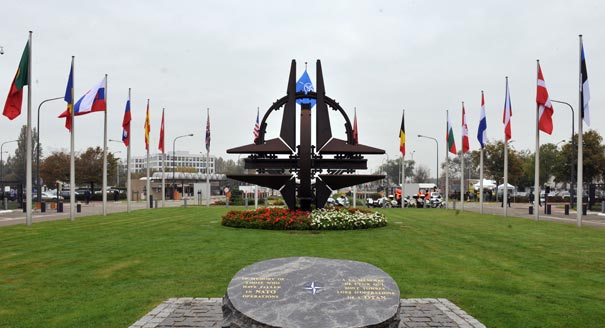
At two upcoming summits, EU and NATO leaders will praise their strategic partnership. The reality is that there is no such cooperation, and there probably won’t be anytime soon.
Preparations for two major summits are under way. In December, the EU’s heads of state and government will not, this time around, be dealing with the euro crisis, but will be trying to breathe new life into the ailing Common Security and Defense Policy (CSDP). Next year, NATO’s political leaders will be reassessing the alliance’s future after the end of its combat mission in Afghanistan.
On both occasions, participants will praise NATO-EU cooperation and will promise to work even more closely together to master future challenges. Alas, the fly in the ointment is that there is no such cooperation, and there probably won’t be any in the near future. Both institutions have been erecting Potemkin villages for years now—they even go so far as to call themselves “strategic partners.” But real cooperation does not happen at all.
No doubt, combining NATO’s military skills with the EU’s civilian capabilities would be the answer in a world in which military operations alone are unable to enforce peace and manage crises. Having both organizations work closely together would create a highly effective Euro-Atlantic stability provider. Numerous attempts have been made: structures for cooperation have been developed, and goodwill exists at many levels.
Still, as is often the case in politics, what appears to be manifestly logical and even crucial just doesn’t happen, simply because some of the players don’t want it to happen. In the NATO-EU case, the disputed status of Cyprus means that the nations involved have blocked any rapprochement between the two institutions. This runs counter to any common sense, and frustrates both allies and partners.
Others, within the EU, hide behind this conspicuous obstacle because they are still skeptical of what they see as a U.S.-dominated NATO. That concern is highly unlikely to go away quickly, in view of the recent uproar about U.S. intelligence services tapping the cell phones of major European leaders.
Both institutions suffer from this lasting stall, but the damaging consequences for the EU are greater than for the Atlantic alliance. NATO is able, to some small degree, to recruit civilian capabilities (as is currently happening with the handful of civilians being sent to Libya to assist in building up a security sector), while EU military capabilities have still to get off the ground. Although structures, plans, agencies, and even allocated forces have been available for years now, the EU has been unable to agree on a single meaningful military mission.
Regrettably, this is not just the result of a lack of consensus, but rather the realization that the CSDP has some fundamental flaws. The logic upholding the CSDP rests on three pillars. The first is continued European integration: a community that has accepted a common currency cannot allow security and defense policies to be left solely in the hands of individual nations. The second pillar is to allow for the possibility of European military intervention in crises in Europe’s neighborhood, where neither NATO nor the United States may want to be committed. Third, the expectation was that Europeans would be more willing, in times of leaner budgets, to spend money on European defense rather than on transatlantic undertakings.
All three assumptions have proved doubtful. The euro has been a success despite the current crisis, and defense is still primarily in national hands. In both Libya and Mali—crises in the European neighborhood where Washington did not want to be involved—it proved impossible for the EU to organize itself for common military action. And not enough is being spent on defense—either for the CSDP or for NATO. As if this were not enough, major players in the EU lack a common strategic culture with regard to the use of military force.
Both forthcoming summits will be crucial. For NATO, the core challenge will be to find a new narrative in a post-Afghanistan world with no major combat operation to justify a common effort. The EU, on the other hand, will have to reassess the entire rationale of a European-based CSDP. What value is there in a CSDP that, to all intents and purposes, exists mainly on paper?
These fundamental issues require sober analysis and an open discussion on all sides. Mindlessly repeating the mantra of a strategic partnership is not in the least helpful—so just quit talking about NATO-EU cooperation.
Karl-Heinz Kamp is the research director at the NATO Defense College in Rome. The views expressed in this article are the responsibility of the author.
Karl-Heinz Kamp
NATO Defense College
Carnegie does not take institutional positions on public policy issues; the views represented herein are those of the author(s) and do not necessarily reflect the views of Carnegie, its staff, or its trustees.

Before the next wave of EU enlargement takes place, the union needs to grapple with thorny questions of how power is distributed among its members.


Emil Sondaj Hansen, Ditte Brasso Sørensen

A summer of escalation in the Black Sea has hurt Ukraine economically and is exacerbating world food security. A truce is needed—as is a broader reframing of Europe’s Ukraine strategy.

Thomas de Waal

Are Germany’s economic, industrial, and political struggles becoming a liability for the EU’s ability to rise to the geopolitical moment?

Rym Momtaz, ed.

European Commission President Ursula von der Leyen is about to give her annual address on the state of the EU. Here’s what she won’t—but should—say.
Rym Momtaz

The aftermath of the Ceuta crisis shows Europe has drawn the wrong lessons. Rather than doubling down on failed migration policies, the EU needs to address the underlying roots of such episodes.

Richard Youngs