

Commentary
Judy Dempsey
{
  "authors": [
    "Judy Dempsey"
  ],
  "type": "commentary",
  "blog": "Strategic Europe",
  "centerAffiliationAll": "",
  "centers": [
    "Carnegie Endowment for International Peace",
    "Carnegie Europe"
  ],
  "collections": [
    "EU Integration and Enlargement"
  ],
  "englishNewsletterAll": "",
  "nonEnglishNewsletterAll": "",
  "primaryCenter": "Carnegie Europe",
  "programAffiliation": "",
  "programs": [],
  "projects": [
    "Eurasia in Transition"
  ],
  "regions": [
    "Europe",
    "Eastern Europe",
    "Central Asia",
    "Kazakhstan",
    "Ukraine",
    "Belarus",
    "Russia"
  ],
  "topics": [
    "EU"
  ]
}
Source: Getty
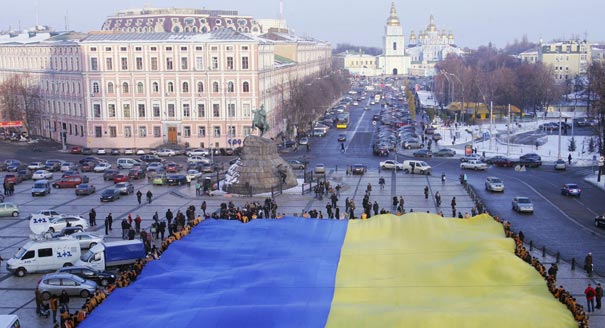
A pro-European Ukraine would have huge advantages for Poland and the rest of the EU. But it would also have broader consequences for Eastern Europe’s complex web of interests.
Ever since Poland joined the EU almost ten years ago, it has been consistent about one foreign policy priority: to bring its Eastern neighbor Ukraine closer to the EU. The path that Ukraine follows will have far-reaching ramifications for Eastern Europe’s complex web of interests.
The strategy behind Warsaw’s policy has been that closer economic and political integration would lead to stability and prosperity on Poland’s Eastern borders. Above all, further integration would strengthen Ukraine’s pro-Western and pro-European movements. That would have enormous benefits not only for Poland but for the EU as a whole.
Advocates of this policy set great store by next month’s Eastern Partnership summit in Vilnius. That is where the EU will offer new trade accords to Armenia, Azerbaijan, Belarus, Georgia, Moldova, and Ukraine. In the run-up to the summit, Russia has interfered extensively to prevent Ukraine and Moldova from signing any new agreements.
Which way Ukraine chooses to go matters greatly to Poland, given that Ukraine is the biggest country between Poland and Russia. The direction Kiev takes will have immense implications for Poland’s own security interests. A Ukraine that is firmly pro-Russian in its economic and political orientation is not the kind of neighbor that Poland—or, for that matter, other EU countries in the region—needs.
But there is another important aspect to this power game. Slowly, other non-EU countries in the Eastern neighborhood, especially Belarus and Kazakhstan, are becoming aware of the implications of Ukraine signing the EU association agreement.
Belarus and Kazakhstan are already members of Russia’s Customs Union, Moscow’s own attempt at establishing a sphere of economic and political influence as a kind of counterweight to the EU. Politically, these two authoritarian countries won’t be moving any closer to the EU just now.
Yet over the past few weeks, Belarus and Kazakhstan have started to understand that it may still be in their interest to have Ukraine sign the EU accord instead of joining up to Russia’s Customs Union.
Earlier this month, Ukraine’s Prime Minister Mykola Azarov went to Belarus, and Foreign Minister Leonid Kozhara visited Kazakhstan.
Azarov’s reception in Minsk was surprising. Belarus’s president, Alexander Lukashenko, has no intention of signing the EU accord. Yet he told Azarov that there was no problem in Kiev signing the agreement and not joining Moscow’s Customs Union.
Of course, observers don’t know what Lukashenko’s intentions really are. He has an ambiguous political relationship with the Kremlin, and his room for maneuver is limited because he is so economically dependent on Russian energy and so averse to aligning his country with the EU.
But the implied message from official press reports coming out of Belarus is that Ukraine’s signature of the EU accord could in fact help Belarus gain access to the EU market. After all, neither Ukrainian nor Belarusian businesses want to be taken over by Russia, or become so dependent on the Russian market that they will be unable to modernize and thus compete in other markets.
Meanwhile, in Astana, Kozhara and his Kazakh counterpart, Erlan Idrissov, issued a joint statement after talks there. The two sides agreed to “step up contacts as far as cooperation with the EU is concerned.” It also referred to Kazakhstan’s “special interest” in the idea of a free-trade area between Ukraine and the EU.
In other words: if Ukraine were to obtain special trade concessions from the EU, that could benefit Kazakh businesses too. By establishing subsidiaries or joint ventures in Ukraine, Kazakh firms could gain access to the lucrative EU market.
Ukraine, for its part, needs Kazakh business more than ever. Last month, Russia banned the import of freight trains made by Kryukovsky, one of Ukraine’s largest manufacturers. That was yet another attempt by Russia to pressure Ukraine into not signing the EU accord.
There is another interesting aspect to these visits by Ukraine’s top officials. Belarus and Kazakhstan have been helping Ukraine to circumvent Russia’s trade embargo by allowing Ukrainian businesses to use their countries as conduits for their goods, thus defying Russian pressure. Russia has criticized Minsk and Astana for allegedly abusing their status in the Customs Union.
Of course, Belarus and Kazakhstan (and Ukraine) can always play Russia and the EU off against each other. But when it comes to trade issues, international rules, and globalization, the big machinery and commodity enterprises in these countries realize that they have few chances to compete globally if they don’t modernize and play by the rules.
Polish diplomats increasingly recognize this, too. They have begun to see trade and economic access, when granted under certain conditions and coupled to EU support for civil society, as a way of slowly changing their Eastern neighbors.
Step by step, the stakes involved in the Vilnius summit are becoming clearer. It’s not just Polish diplomats but the whole EU that needs to steer very carefully through Eastern Europe’s multilayered web of interests.

Nonresident Senior Fellow, Carnegie Europe
Judy Dempsey is a nonresident senior fellow at Carnegie Europe
Recent Work
Judy Dempsey
Judy Dempsey
Carnegie does not take institutional positions on public policy issues; the views represented herein are those of the author(s) and do not necessarily reflect the views of Carnegie, its staff, or its trustees.

The aftermath of the Ceuta crisis shows Europe has drawn the wrong lessons. Rather than doubling down on failed migration policies, the EU needs to address the underlying roots of such episodes.

Richard Youngs

An overwhelming victory by a far-right-wing party in a small state in eastern Germany will have major repercussions for Chancellor Friedrich Merz’s coalition.
Judy Dempsey

Canadian Prime Minister Mark Carney has twice inspired praise for standing up to U.S. President Donald Trump: at the 2026 World Economic Forum in Davos and on Canada-U.S. trade negotiations. Is Carney showing a third way better than the EU has in dealing with the Trump administration?

Rym Momtaz, ed.

The EU’s responses to two recent incidents expose the gulf between European perceptions and capabilities. Unless the union can bridge that gap, it will never become a real geostrategic power.
Rym Momtaz

In supporting Europe’s far-right, MAGA and Russia both want the same thing: a weaker EU. Europe must defend itself without abandoning the openness these forces exploit.

Armida van Rij