

Commentary
Judy Dempsey
{
  "authors": [
    "Judy Dempsey"
  ],
  "type": "commentary",
  "blog": "Strategic Europe",
  "centerAffiliationAll": "",
  "centers": [
    "Carnegie Endowment for International Peace",
    "Carnegie Europe"
  ],
  "collections": [],
  "englishNewsletterAll": "",
  "nonEnglishNewsletterAll": "",
  "primaryCenter": "Carnegie Europe",
  "programAffiliation": "",
  "programs": [],
  "projects": [],
  "regions": [
    "Eastern Europe",
    "Russia",
    "Ukraine"
  ],
  "topics": [
    "Foreign Policy",
    "EU",
    "Security"
  ]
}
Source: Getty
The EU’s most immediate task in Ukraine is to stop treating Viktor Yanukovych as a privileged partner. The EU must build on its values to become a serious geostrategic player.
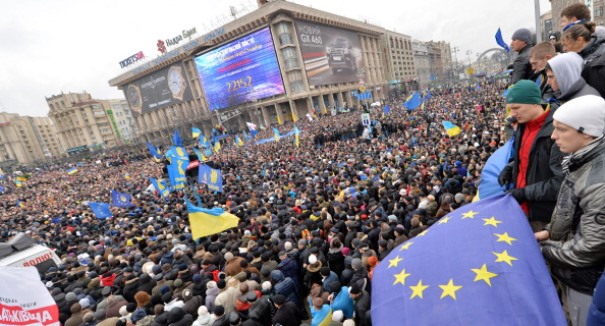
On December 1, hundreds of thousands of Ukrainians converged on Independence Square in central Kiev. They were protesting against Ukrainian President Viktor Yanukovych’s refusal to sign an association agreement with the EU at last week’s Eastern Partnership summit in Vilnius. They were also protesting against police violence meted out to pro-European demonstrators on Saturday. The EU has spoken out against the violence, but that won’t be enough.
Nine years ago, in the same place, nearly a million people gathered to protest against the rigged presidential election of 2004. Initially, Yanukovych was declared the winner of that contest. The favorite of Vladimir Putin, he had received the Russian president’s personal endorsement and congratulations. The election, Moscow assumed, was in the bag.
Yet the protesters managed to force a rerun of the ballot. Viktor Yushchenko and Yulia Tymoschenko, the two leaders of the Orange Revolution, won. But they squandered their victory through infighting and intrigue. In effect, they facilitated the return of Yanukovych, who was elected president in 2010. He now has his sights set on the 2015 election. As if nothing has been learned, the political intrigue, infighting, and bitter rivalries continue.
But some things have changed. On the one hand, Ukraine’s civil society has grown much stronger since 2004. There is a younger generation that sees the benefits of being closer to the EU.
On the other hand, corruption has become endemic, causing widespread cynicism vis-à-vis the political class. Anyone who enters the public sector is sucked into a web of backhanders and bribes, payoffs and tradeoffs. Once politicians and civil servants have been corrupted, they perpetuate an invidious culture.
Yanukovych, while paying lip service to the EU’s demands for reforms, has effectively prolonged Ukraine’s dysfunctional system. After all, implementing real reforms would hurt his personal interests. Over the past decade, Yanukovych has relied on various wealthy oligarchs to bankroll his political ambitions. He has also accumulated considerable wealth for his family.
Yet neither the opposition nor the EU has any convincing ideas of how to deal with the systemic corruption that is ruining the fabric of Ukraine’s social and political life.
The opposition is still divided and inchoate. Being against the Yanukovych clique is not enough. Being pro-European is not enough either. The opposition needs a program and leaders. The heavyweight boxer Vitali Klitschko may try to stand against Yanukovych in the 2015 election, but he is not yet a unifying figure.
As for the EU, it has yet again been outmaneuvered by Putin and Yanukovych. The European Commission and EU diplomats on the ground were too slow to understand how badly Russia’s import ban on a large part of Ukrainian goods was hurting the local economy.
Of course, Yanukovych never publicly complained about Russian pressure. Instead, in the run-up to last week’s Eastern Partnership summit, he asked the EU for a whopping €20 billion ($27 billion) as a reward for signing the EU’s accord, which would have meant closer political and trade links between Kiev and Brussels.
The biggest change that has taken place over the past decade concerns Putin. Russia’s president has come to understand the EU’s importance as a potential strategic player in this part of Europe. He has also seen the enduring attraction of the EU.
That is why the Kremlin went to such extremes to shore up its influence in the region, trying, for instance, to blackmail Moldova’s leadership into rejecting the EU association agreement. And Putin is right to fear the competition of values and the consequent loss of Russian influence; Moldova ended up initialing the accord.
The EU should exploit these changes in its Eastern neighborhood. That won’t be easy. The Eastern Partnership is all but in tatters. But the Europeans cannot afford to turn their back on civil society in these countries.
In the case of Ukraine, the EU’s most immediate task is to stop treating Yanukovych as a privileged partner and end the silence over his government’s corruption and nepotism. It should also use the fact that Yanukovych says he has not given up on signing the association agreement. The EU needs to be serious about imposing strict conditionality when it comes to implementing reforms that have already been passed.
In parallel, it is time the EU communicated to Ukrainians what it stands for. Above all, the EU has to reach out to young people through education, training, and investment programs. If it is the EU’s values that Putin fears, then the EU should build on those values to become a serious geostrategic player in Eastern Europe.

Nonresident Senior Fellow, Carnegie Europe
Judy Dempsey is a nonresident senior fellow at Carnegie Europe
Recent Work
Judy Dempsey
Judy Dempsey
Carnegie does not take institutional positions on public policy issues; the views represented herein are those of the author(s) and do not necessarily reflect the views of Carnegie, its staff, or its trustees.

An overwhelming victory by a far-right-wing party in a small state in eastern Germany will have major repercussions for Chancellor Friedrich Merz’s coalition.
Judy Dempsey

Canadian Prime Minister Mark Carney has twice inspired praise for standing up to U.S. President Donald Trump: at the 2026 World Economic Forum in Davos and on Canada-U.S. trade negotiations. Is Carney showing a third way better than the EU has in dealing with the Trump administration?

Rym Momtaz, ed.

The EU’s responses to two recent incidents expose the gulf between European perceptions and capabilities. Unless the union can bridge that gap, it will never become a real geostrategic power.
Rym Momtaz

In supporting Europe’s far-right, MAGA and Russia both want the same thing: a weaker EU. Europe must defend itself without abandoning the openness these forces exploit.

Armida van Rij

As we close out another season of Strategic Europe, it is worth taking stock of the deep shifts underway.
Rym Momtaz