

Commentary
Judy Dempsey
{
  "authors": [
    "Judy Dempsey"
  ],
  "type": "commentary",
  "blog": "Strategic Europe",
  "centerAffiliationAll": "",
  "centers": [
    "Carnegie Endowment for International Peace",
    "Carnegie Europe"
  ],
  "collections": [],
  "englishNewsletterAll": "",
  "nonEnglishNewsletterAll": "",
  "primaryCenter": "Carnegie Europe",
  "programAffiliation": "",
  "programs": [],
  "projects": [],
  "regions": [
    "Western Europe",
    "Germany",
    "Europe"
  ],
  "topics": [
    "Security",
    "EU"
  ]
}
Source: Getty
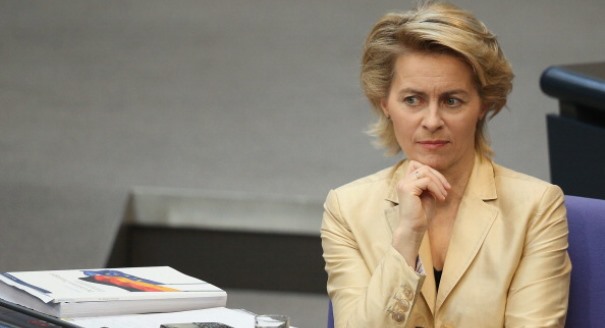
Germany’s new defense minister has an opportunity to make a big difference to her country’s role in Europe. Will Ursula von der Leyen succeed in this challenging office?
Ursula von der Leyen is one of Germany’s most popular politicians.
As a leading member of Chancellor Angela Merkel’s Christian Democrats, she has managed to annoy older conservatives with her determination to modernize the party, while winning praise and support from the younger generation.
In Germany’s new grand coalition government between the conservatives and the Social Democrats, von der Leyen will be the defense minister. That surprise nomination could give her an unlooked-for opportunity to make a difference to Germany’s role in Europe.
During her previous stints as family minister and labor minister, von der Leyen, a fifty-five-year-old mother of seven, stood her ground on many controversial issues, despite pressure from Merkel and Germany’s influential business lobby.
Von der Leyen has been a consistent defender of a minimum wage and gender quotas that would allow professional women to break through the glass ceilings set by Germany’s predominantly male managers. She campaigned hard, too, to expand the network of child-care facilities for children aged three and older.
Throughout her time in the German parliament, von der Leyen has been tipped as a successor to Merkel. Surprisingly, she has so far escaped the fate of her more ambitious male colleagues, who were quickly sidelined if they dared to pose a threat to Merkel’s authority.
Now, von der Leyen will be the first woman to head the defense ministry, at a time when it is in desperate need of a thorough overhaul. If she succeeds in this extremely difficult office, she will have confirmed her reputation as a competent and creative politician. If she fails, her chances of running for the Chancellery will be finished—a fact that Merkel is perfectly aware of.
Merkel, despite taking very little interest in security and defense affairs, must know that Germany’s reputation in this field is miserable, in Europe as well as the United States. Yet she never made the slightest effort to encourage any kind of strategic thinking. That suited the defense ministry just fine. After all, it has also shunned any serious debate about Germany’s strategic security and defense ambitions since Merkel took office in 2005.
Thomas de Maizière, Merkel’s trusted lieutenant for many years, held the defense portfolio from 2011 to 2013. In that time, he did little to push forward the reforms that his brash, ambitious, and courageous predecessor, Karl-Theodor zu Guttenberg, had started.
Guttenberg managed to abolish conscription against a great deal of opposition from conservatives and Social Democrats alike. As part of his modernization plans, he also wanted to shake up the defense procurement system. And he supported sharing resources with other European countries. Above all, he wanted to streamline the ministry despite huge resistance from the military’s top echelons. He wanted a modern Bundeswehr.
De Maizière, in contrast, saw his task as bringing stability to the ministry after the upheavals of his predecessor.
But even he admitted to the difficulties of running this particular ministry. Last June, de Maizière had to face a parliamentary committee. It was set up to investigate why the ministry had continued with the Euro Hawk drone project despite safety concerns and a lack of permits to use European airspace.
De Maizière chose not to accept responsibility, instead blaming others in the ministry for keeping him in the dark. There were calls for his resignation, but Merkel chose to defend her loyal friend. The fact that all of this happened in the middle of an election campaign undoubtedly played a role as well.
Now, de Maizière, scion of an old Huguenot family, will return to the interior ministry, not an easy job either, given the competition among the various intelligence agencies and the continuing controversy over the U.S. National Security Agency spying scandal.
Von der Leyen must surely know that she is entering the “snake pit,” as former defense minister Manfred Wörner (the first and only German to head NATO) described his department.
She must surely know, too, that the defense ministry destroys careers. Since it was established in 1955, sixteen ministers have passed through its doors. Seven had to resign, the most recent being Guttenberg in 2011—for plagiarizing his doctoral thesis.
Von der Leyen’s skills as a former family and labor minister will serve her well. But to survive politically, and make a difference, she will need to bring in her own small army of trusted civil servants. She will also need smart advisers who understand why Germany needs to think and act strategically. As Europe’s most important country, its contribution to strategy has been shameful.
Appointing von der Leyen as defense minister is Merkel’s only bold move at the beginning of her third term in office. Putting this modern, ambitious conservative at the helm of Germany’s most difficult ministry is a gamble. If von der Leyen succeeds, she will have proven herself a fit competitor for the Chancellery. Much more importantly, she may also finally have shaken Germany out of its complacency over military affairs.

Nonresident Senior Fellow, Carnegie Europe
Judy Dempsey is a nonresident senior fellow at Carnegie Europe
Recent Work
Judy Dempsey
Judy Dempsey
Carnegie does not take institutional positions on public policy issues; the views represented herein are those of the author(s) and do not necessarily reflect the views of Carnegie, its staff, or its trustees.

A summer of escalation in the Black Sea has hurt Ukraine economically and is exacerbating world food security. A truce is needed—as is a broader reframing of Europe’s Ukraine strategy.

Thomas de Waal

Are Germany’s economic, industrial, and political struggles becoming a liability for the EU’s ability to rise to the geopolitical moment?

Rym Momtaz, ed.

European Commission President Ursula von der Leyen is about to give her annual address on the state of the EU. Here’s what she won’t—but should—say.
Rym Momtaz

The aftermath of the Ceuta crisis shows Europe has drawn the wrong lessons. Rather than doubling down on failed migration policies, the EU needs to address the underlying roots of such episodes.

Richard Youngs

An overwhelming victory by a far-right-wing party in a small state in eastern Germany will have major repercussions for Chancellor Friedrich Merz’s coalition.
Judy Dempsey