

Commentary
Nathalie Tocci, Jan Techau
{
  "authors": [
    "Jan Techau"
  ],
  "type": "commentary",
  "blog": "Strategic Europe",
  "centerAffiliationAll": "",
  "centers": [
    "Carnegie Endowment for International Peace",
    "Carnegie Europe"
  ],
  "collections": [],
  "englishNewsletterAll": "",
  "nonEnglishNewsletterAll": "",
  "primaryCenter": "Carnegie Europe",
  "programAffiliation": "",
  "programs": [],
  "projects": [],
  "regions": [
    "Eastern Europe",
    "Russia",
    "Ukraine"
  ],
  "topics": [
    "Foreign Policy",
    "EU"
  ]
}
Source: Getty
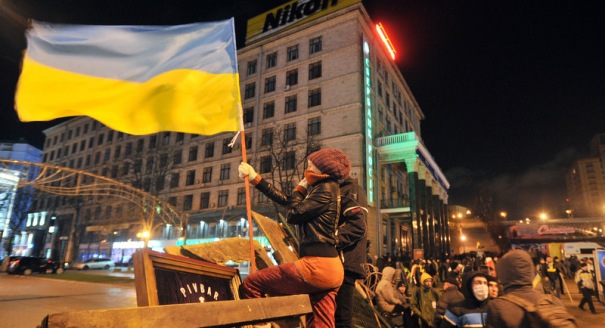
The protesters in Kiev have a real chance of ushering in a more democratic system. If taking sides with them means taking a stance against Russia’s Vladimir Putin, so be it.
Last week, Carnegie Europe’s Ulrich Speck went to Kiev to see for himself what was playing out on the streets of Ukraine’s capital. He had received too many interview requests, and felt that he needed a better sense of the situation on the ground before answering them all. After a number of meetings in Kiev and a visit to Independence Square, he sent me a short e-mail, which ended with a very Ulrich Speck–like note: “This is the frontline of liberal democracy.”
More out of gut feeling than calculation, I decided to post that sentence on Twitter. It immediately got a good number of retweets, which is usually a sign of approval. But one of my followers did not like what he saw, and replied: “The Cold War is over, isn’t it? Why do so-called ‘liberals’ always need an enemy?”
“Frontline,” of course, is a problematic word. It is war vocabulary, and despite its widespread figurative, nonmilitary usage, anyone who uses it must expect to be accused of militarizing the conversation.
And indeed, after some back-and-forth with my critical Twitter follower, it turned out that his primary (but not only) objection to Ulrich’s statement was the use of the word “frontline.” He did not elaborate, but it became clear that he thought this term was unnecessarily polarizing and harked back to the confrontational mode of the systemic conflict between the West and the Soviet Union.
I do not believe that the West is entering a second Cold War with Russia. “Cold War” denotes a very specific kind of conflict: one based on the logic of mutually assured destruction, Marxist-Leninist world revolution, and the Berlin Wall—none of which is in place today. Nor is Russia, despite its post-Soviet hiccups, a superpower empire like the USSR. But it is clear that the West is in some kind of competitive relationship with Russia. Let’s not fool ourselves.
For many, this truth is difficult to swallow. Some people deny it outright, because they think there is enough space on this planet for everybody’s truths and preferences, and that political competition is archaic, brutish, and so yesterday.
Others, such as EU diplomats, dislike the zero-sum logic that lurks behind the concept of competition. They prefer to think in terms of win-win situations, which is actually a very intelligent way of turning the loser of a contest into a winner. Still others dread the notion of Western superiority that “frontline” somehow implies. They point to the West’s many political and cultural shortcomings, which would disqualify it from taking the moral high ground.
For most observers, however, the problem lies in the fact that the word “frontline” forces them to take sides. Taking sides is uncomfortable, because it means running a risk. One could end up on the wrong side—or on the losing side. And everyone has to take a stand, even if they’re unsure what that stand is. A few months ago, I wrote about how I often felt wobbly on complex foreign policy issues, and that I regularly found it difficult to come to decisive conclusions that others find easy to reach.
Ukraine today is no such case. There, taking sides is not difficult. Granted, not all opposition politicians look like the kind of folks you’d like to be associated with at all times. And granted, the political instability that might follow a change of government in Kiev is a real, undeniable risk.
But on balance, how can one not take sides? After all, Ukrainians want to turn their country into a place where the system is based not on the self-appointed, kleptocratic few, but on the sovereign many who choose their own leaders. That is exactly the right thing to do. Unlike their unfortunate counterparts in the Arab world, the people of Euromaidan, as the Kiev protests have become known, have a decent chance of replacing what they have now with something that could resemble liberal democracy.
Why, then, does taking sides with Ukraine’s democratic opposition put you at risk of being called a Cold Warrior? Because there is a hidden automatism that makes the issue so controversial. In theory, of course, being in favor of democracy in Ukraine has nothing to do with Russia. But in practice, it has everything to do with Russia. That is why, unfortunately but unavoidably, taking sides with the Ukrainian demonstrators means taking a critical stance toward Russia.
That uneasy automatism was created by Russian President Vladimir Putin, not by the West. A democratic Ukraine is a lot riskier for him than an undemocratic one is for the West. So for Putin, the outcome of the protests in Kiev is a much more existential question than it is for leaders in Europe or the United States. If there is a Cold Warrior in this case, it’s Putin, not Ulrich Speck.
Putin’s fear is understandable: his survival is at stake. I can’t help him. But I wish the Ukrainians could fight only their domestic opponent. Their tragedy is that Putin has decided that they must fight him too. If being a supporter of Kiev’s democrats means being an opponent of Putin, so be it. If he can’t help taking sides, then I can’t help it either.
Director, Europe Team, Eurasia Group
Techau is director with Eurasia Group's Europe team, covering Germany and European security from Berlin. Previously, he was director of Carnegie Europe.
Recent Work
Nathalie Tocci, Jan Techau
Jan Techau
Carnegie does not take institutional positions on public policy issues; the views represented herein are those of the author(s) and do not necessarily reflect the views of Carnegie, its staff, or its trustees.

Trump is distracted and Ukraine wants Europe to step up. The continent’s leaders must find their voice and assert it in talks with Russia.

Alissa de Carbonnel

Mounting economic strain and battlefield losses will not necessarily make the Kremlin less dangerous. They could instead push Moscow toward a more aggressive hybrid campaign designed to test NATO’s Eastern flank, exploit allied hesitation, and fracture European resolve.

Maksym Beznosiuk

Over the past ten years, NATO has held almost as many summits as it did during the entirety of the Cold War. Are they still useful, or is it time to stop holding annual meetings?

Rym Momtaz, ed.
Nearly a year and a half after Europeans leaned into sucking up to Trump, the strategy has produced some benefits when it comes to Ukraine.
Rym Momtaz
Far-right leader Marine Le Pen can—and will—run in France’s next presidential election. What does the outcome of her appeal against a 2025 embezzlement conviction mean for the country’s political future?
Catherine Fieschi