

Commentary
Judy Dempsey
{
  "authors": [
    "Judy Dempsey"
  ],
  "type": "commentary",
  "blog": "Strategic Europe",
  "centerAffiliationAll": "",
  "centers": [
    "Carnegie Endowment for International Peace",
    "Carnegie Europe"
  ],
  "collections": [],
  "englishNewsletterAll": "",
  "nonEnglishNewsletterAll": "",
  "primaryCenter": "Carnegie Europe",
  "programAffiliation": "",
  "programs": [],
  "projects": [],
  "regions": [
    "Western Europe",
    "Europe"
  ],
  "topics": [
    "Security",
    "EU"
  ]
}
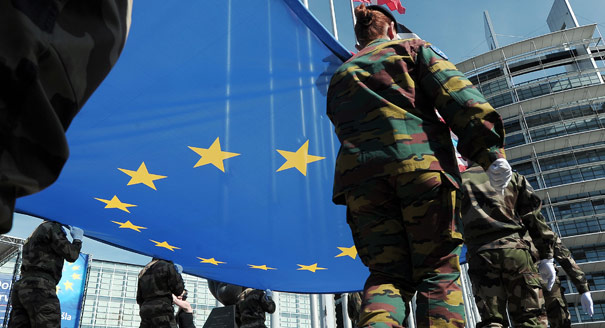
Source: Getty
Despite the instability of its neighborhoods, most European leaders have no political ambition to think and act strategically. That myopia will be very costly.
When Herman Van Rompuy, the president of the European Council, drafted his invitation letter to the EU’s twenty-eight leaders who are holding a Council summit on European defense today, he did not include the word “strategy.”
Under pressure from some countries that believed it was high time to have a debate about Europe’s strategic ambitions, he amended it. The letter was then dispatched.
“I should indeed like us to have a strategic discussion on one of the major current challenges in the field of defense,” Van Rompuy wrote. “What should we be doing, as Union and as EU Member States, to retain and develop the capabilities that are critical for our defense and our security?” he asked.
What indeed?
Europe’s security and defense policy is in bad shape. This is despite huge security challenges in its Eastern and Southern neighborhoods and beyond. Yet EU leaders are divided as to how they should collectively deal with the security and defense responsibilities they face both for their citizens and the many civilians caught up in conflicts in Europe’s neighborhoods.
The Council Summit’s draft conclusions boast of “more than 7,000 staff in 12 civilian missions and four military operations.” Yet Europe, collectively, has about 1.6 servicemen and women.
Nothing illustrates the reasons for that huge discrepancy better than the depressing saga of the EU battle groups, a small, collective rapid reaction force that was supposed to give Europe the means to quickly intervene in any developing crisis.
It was London and Paris that had come up with this idea in 2004. The battle groups were to be the answer to Europe’s notoriously slow response to crises and conflicts. The aim was to have these forces on standby for six months. They were supposed to be deployable within days and could be sustainable for thirty days.
Of course, this concept was already the result of a radical downsizing of the initial Franco-British defense plans for Europe. Remember the St-Malo summit in 1998. It was there that former British prime minister Tony Blair and then French president Jacques Chirac announced the “headline goals” for European defense. They wanted Europe to have no less than sixty thousand soldiers at its disposal for peacekeeping and other missions.
Nothing came of the headline goals except the much more modest idea of battle groups. And now, it would seem that nothing will come of the battle groups, either.
Just weeks before today’s long-awaited EU summit on defense, European military and security experts drew up plans to finally send an EU battle group into its first mission ever. They wanted it to go into the Central African Republic to help France’s mission there.
But it is Britain that is currently leading the battle group. London’s reaction to a possible EU mission in the Central African Republic was so hostile that Paris officially never even raised the issue of calling in the battle group.
The reason is the UK referendum on British EU membership planned for 2017: Britain’s Conservatives, already under huge pressure, do not want to give the country’s Eurosceptics any additional leverage. They were scared, too, by an article published this week in Britain’s Daily Telegraph that suggested the Commission wanted to set up a European army.
The result was that France – which is now Europe’s unquestioned leader of defense – dispatched twelve hundred of its own troops to the Central African Republic in order to prevent the ethnic and religious conflict from plunging this former French colony into a full-scale civil war.
Paris then began to request bilateral aid from its EU partners – who, it should be said, had all endorsed this military intervention. France did receive some support for air transport, but no other country has so far been willing to send troops.
Nor have France’s call for financial support been successful. President François Hollande, having been forced into sharply cutting the defense budget, has asked for a permanent EU fund, to be run by the Commission, to finance armed operations. Britain strongly opposes this.
Germany could help. But that would require an enormous change for Chancellor Angela Merkel who has stifled any debate over her country’s security and defense strategy.
As it is, the idea of German troops on standby for a battle group mission is anathema to the way Berlin makes decisions. Any mission requires a mandate from the parliament. One wonders why Berlin ever signed up to the battle groups in the first place.
So where does that leave Europe? Despite the instability of its neighborhoods, most European leaders have no political ambition to think and act strategically. That myopia will be very costly.
As it stands, the close military alliance forged since 1998 between Britain and France seems to be over. And without British and French cooperation over defense and security issues, there is little hope for Europe building a credible security strategy in the foreseeable future.

Nonresident Senior Fellow, Carnegie Europe
Judy Dempsey is a nonresident senior fellow at Carnegie Europe
Recent Work
Judy Dempsey
Judy Dempsey
Carnegie does not take institutional positions on public policy issues; the views represented herein are those of the author(s) and do not necessarily reflect the views of Carnegie, its staff, or its trustees.

Are Germany’s economic, industrial, and political struggles becoming a liability for the EU’s ability to rise to the geopolitical moment?

Rym Momtaz, ed.

European Commission President Ursula von der Leyen is about to give her annual address on the state of the EU. Here’s what she won’t—but should—say.
Rym Momtaz

The aftermath of the Ceuta crisis shows Europe has drawn the wrong lessons. Rather than doubling down on failed migration policies, the EU needs to address the underlying roots of such episodes.

Richard Youngs

An overwhelming victory by a far-right-wing party in a small state in eastern Germany will have major repercussions for Chancellor Friedrich Merz’s coalition.
Judy Dempsey

Canadian Prime Minister Mark Carney has twice inspired praise for standing up to U.S. President Donald Trump: at the 2026 World Economic Forum in Davos and on Canada-U.S. trade negotiations. Is Carney showing a third way better than the EU has in dealing with the Trump administration?
Rym Momtaz, ed.