

Commentary
Judy Dempsey
{
  "authors": [
    "Judy Dempsey"
  ],
  "type": "commentary",
  "blog": "Strategic Europe",
  "centerAffiliationAll": "",
  "centers": [
    "Carnegie Endowment for International Peace",
    "Carnegie Europe"
  ],
  "collections": [],
  "englishNewsletterAll": "",
  "nonEnglishNewsletterAll": "",
  "primaryCenter": "Carnegie Europe",
  "programAffiliation": "",
  "programs": [],
  "projects": [],
  "regions": [
    "Western Europe",
    "Germany",
    "Europe",
    "Middle East"
  ],
  "topics": [
    "Security",
    "EU"
  ]
}
Source: Getty
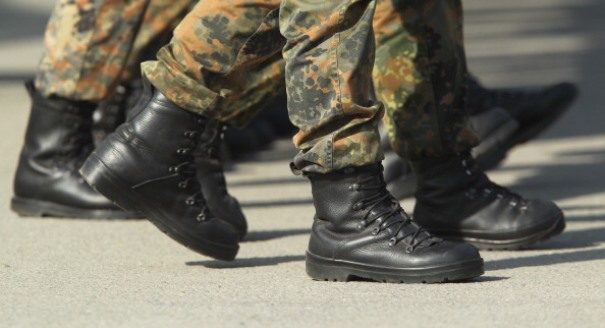
Germany’s nascent defense debate needs to focus on the principle of the responsibility to protect. Crucially, that means Germans can no longer shirk the use of force.
Angela Merkel has always been highly reluctant to engage in debates on security and strategy. Since she became German chancellor in 2005, Germany has followed a policy of military restraint. But now she risks being bypassed by her country’s President Joachim Gauck, Defense Minister Ursula von der Leyen, and Foreign Minister Frank-Walter Steinmeier.
At this year’s Munich Security Conference from January 31 to February 2, these three dominated the headlines. They said it was time for Germany to move out of the shadow of the past and confront a rapidly changing world that required Germany to assume more responsibility.
By speaking out, Gauck, von der Leyen, and Steinmeier opened an important debate on Germany’s role in the world and how Berlin should support EU attempts to finally draw up a coherent defense and security doctrine. As that debate moves forward, it should focus on the principle of the responsibility to protect.
Yet while others are talking about defense, Merkel remains silent. Clearly, she is in no rush to abandon the culture of military restraint. She only has to read the opinion polls to see that the German public is opposed to giving the armed forces a more prominent role in international peacekeeping or combat missions. So for the moment, the ever-cautious Merkel will let Gauck, von der Leyen, and Steinmeier do the talking, and see how far they get.
There is another reason for her silence. Everywhere in Europe—with the exception of France and perhaps Denmark—the appetite for military engagements is dwindling. It’s not just the huge human and financial cost of NATO’s combat mission in Afghanistan that has led to war-weariness. It is something much more fundamental: Europeans have come to doubt the effectiveness of the use of force.
This issue was barely touched on during the debates at the Munich summit and subsequent discussions about the new German responsibility. It was as if the speakers did not want to deal with the complex and controversial moral and political issues involved in such a reflection. After all, the record of recent military interventions has been questionable, to say the least.
In the eyes of the skeptical German public, developments in Afghanistan, Iraq, and Libya show that the use of force has a short-term positive impact at best. Yes, al-Qaeda was ousted from Afghanistan, but the Taliban and insurgents are back with a vengeance. No matter what NATO or German officials say publicly about how the Afghan National Army is at the forefront of providing security; privately, European and U.S. security experts are profoundly worried about the deteriorating security situation in Afghanistan.
In Iraq, suicide bomb attacks are becoming more frequent again. An attack by jihadists on January 26 near the city of Falluja—where so many U.S. soldiers lost their lives in 2004—has jolted the government in Baghdad.
Libya, too, is far from stable. Britain and France, with the support from some other NATO countries, led a military mission there in 2011 with the goal of regime change. Having achieved that, NATO quit, leaving a vacuum that has since been exploited by a plethora of different groups.
But can the mixed results of past interventions justify inaction in the face of new bloodshed? To take the concrete case of the Syrian civil war, with its 100,000 dead: Is it acceptable to reject the use of force—for example, to enforce a no-fly zone—even though a failure to act would lead to even more killings?
Gauck touched on this in his speech in the Bavarian capital. “Brutal regimes must not be allowed to hide behind the principles of state sovereignty and nonintervention,” he said. “This is where the concept of ‘responsibility to protect’ comes to bear. . . . In the very last resort, military means can be used.” Yet in Syria, the UN, the United States, and the EU have done very little to live up to their responsibility to protect.
It is this aspect of responsibility that should be central to the debate that has finally begun in Germany. Accepting that responsibility means that the use of force cannot be excluded. Yet on the whole, Germans still do not want to contemplate using force. That is not just because they are pacifist—although many use pacifism and the Holocaust as an excuse for taking no responsibility. It is because they have to be convinced that force is sometimes necessary—and can even improve a situation.
The last time Germans were told why they had to act was in 1999 before the NATO bombing campaign against Serbia. The then Green foreign minister, Joschka Fischer, argued that precisely because of its past, Germany had a responsibility to act and use force.
That debate about responsibility stopped under Merkel’s first “grand coalition” of conservatives and Social Democrats. Her second coalition, of conservatives and Free Democrats, was wedded to the culture of restraint, believing that political and diplomatic solutions supported by sanctions were the best tools available.
Clearly, some ministers in Merkel’s third government, another grand coalition, believe it is time to reconsider those policies. That will require a major parliamentary and public debate on the effectiveness of the use of force and, indeed, the culture of military restraint. Much political capital and commitment will be needed. It’s time for Merkel to weigh in.

Nonresident Senior Fellow, Carnegie Europe
Judy Dempsey is a nonresident senior fellow at Carnegie Europe
Recent Work
Judy Dempsey
Judy Dempsey
Carnegie does not take institutional positions on public policy issues; the views represented herein are those of the author(s) and do not necessarily reflect the views of Carnegie, its staff, or its trustees.

Before the next wave of EU enlargement takes place, the union needs to grapple with thorny questions of how power is distributed among its members.


Emil Sondaj Hansen, Ditte Brasso Sørensen

A summer of escalation in the Black Sea has hurt Ukraine economically and is exacerbating world food security. A truce is needed—as is a broader reframing of Europe’s Ukraine strategy.

Thomas de Waal

Are Germany’s economic, industrial, and political struggles becoming a liability for the EU’s ability to rise to the geopolitical moment?

Rym Momtaz, ed.

European Commission President Ursula von der Leyen is about to give her annual address on the state of the EU. Here’s what she won’t—but should—say.
Rym Momtaz

The aftermath of the Ceuta crisis shows Europe has drawn the wrong lessons. Rather than doubling down on failed migration policies, the EU needs to address the underlying roots of such episodes.

Richard Youngs