

Commentary
Judy Dempsey
{
  "authors": [
    "Judy Dempsey"
  ],
  "type": "commentary",
  "blog": "Strategic Europe",
  "centerAffiliationAll": "",
  "centers": [
    "Carnegie Endowment for International Peace",
    "Carnegie Europe"
  ],
  "collections": [],
  "englishNewsletterAll": "",
  "nonEnglishNewsletterAll": "",
  "primaryCenter": "Carnegie Europe",
  "programAffiliation": "",
  "programs": [],
  "projects": [],
  "regions": [
    "Eastern Europe",
    "Western Europe",
    "Europe"
  ],
  "topics": [
    "Political Reform",
    "EU",
    "Civil Society"
  ]
}
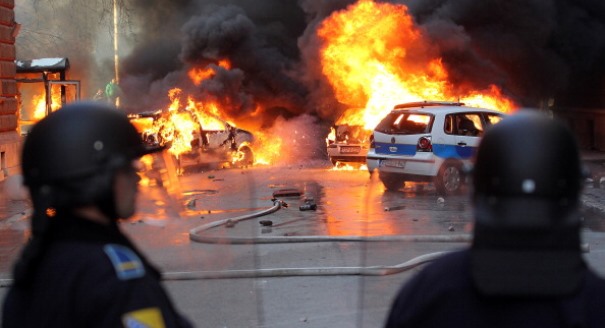
Source: Getty
Every week a selection of leading experts answer a new question from Judy Dempsey on the foreign and security policy challenges shaping Europe’s role in the world.
Every week a selection of leading experts answer a new question from Judy Dempsey on the foreign and security policy challenges shaping Europe’s role in the world.
The EU may not have failed yet, but the sudden explosion of public anger shows that the current situation is unsustainable, and time is of the essence.
Protesters in Bosnia and Herzegovina are not waving EU flags like those in Kiev, but they are not burning them either, as demonstrators sometimes do in Athens. The protests have their roots in Bosnia’s deep economic misery, and are directed against the country’s self-serving and corrupt political elite. EU officials who have negotiated endlessly with the current political leadership on reforming dysfunctional institutions share some of this frustration.
Yet the international community, including the EU, bears some responsibility for the current state of affairs. As Bosnia for a long time appeared stagnant but stable, the international community became distracted by more urgent business elsewhere, and lacked the determination to overcome obstacles to reform. The hope was that, over time, Croatia’s EU membership and Serbia’s progress toward accession would pull along Bosnia, too. The EU also focused too much on constitutional fixes and neglected the deteriorating economy.
That cannot go on. Now, there is no alternative to urgent economic and political reform. The drive for change has to come from the local population. But the EU too needs to raise its game and help Bosnia finally move forward.
Bosnia was failed primarily by its own leaders. But the EU shares part of the blame.
For almost two decades, while many Central and Eastern European countries have been pursuing reforms, Bosnia’s leaders have become champions of the status quo. State administration eats up some 40 percent of gross domestic product, and unemployment is persistently high at around 44 percent. In a country deeply divided between Bosniaks, Serbs, and Croats, successive governments have created a corrupted elite based on parallel ethnic patronage.
As for the EU’s efforts in Bosnia, two elements have not worked. First, the strategy of talking exclusively to the leaders of Bosnia’s six main political parties has ignored the country’s bleak economic prospects and society at large. Second, conditioning Bosnia’s EU progress toward accession on unpalatable changes to the country’s constitutional and electoral law (implementing a 2009 ruling by the European Court of Human Rights on the notorious Sejdić-Finci case on racial and ethnic discrimination) was unfair and unproductive.
Yet the lack of progress is not for a lack of trying: civil society engagement has been an EU priority in recent years, and the European Commission is now pursuing a bilateral economic dialogue with Bosnia. Unfortunately, that is not part of the body of EU law that aspiring members must adopt, so it is not underpinned by the legal or political instruments required to enforce it.
Judging success or failure in Bosnia goes beyond just the EU. It took the skills and perseverance of U.S. diplomat Richard Holbrooke to end the bloodshed in late 1995 with the complex Dayton peace accords. Among other provisions, that agreement offered Bosnia’s nationalist leaders a chance to reward their allies-in-arms during war with posts of political and economic influence in what was, at first, a highly tenuous peace.
From the point of view of early 1996, much has been achieved. Yet when assessing today’s situation against the backdrop of large flows of aid, foreign forces, and other outside help, Bosnians and the international community alike have every right to feel disappointed.
A trip to Bosnia these days suggests that little can move forward without an overhaul of the arrangements bequeathed by the Dayton agreement. Of the international bodies in Bosnia, the EU probably has the largest formal role. But can it take on this new task, in addition to Ukraine, Kosovo, and many others?
The author writes here in a strictly personal capacity.

Nonresident Senior Fellow, Carnegie Europe
Judy Dempsey is a nonresident senior fellow at Carnegie Europe
Recent Work
Judy Dempsey
Judy Dempsey
Carnegie does not take institutional positions on public policy issues; the views represented herein are those of the author(s) and do not necessarily reflect the views of Carnegie, its staff, or its trustees.
The EU had to compromise to adopt a twenty-first sanctions package against Russia, exposing growing cracks in the union’s resolve. Is this latest, weaker round worth it to keep pressure on Moscow?

Rym Momtaz, ed.

Trump is distracted and Ukraine wants Europe to step up. The continent’s leaders must find their voice and assert it in talks with Russia.

Alissa de Carbonnel

Mounting economic strain and battlefield losses will not necessarily make the Kremlin less dangerous. They could instead push Moscow toward a more aggressive hybrid campaign designed to test NATO’s Eastern flank, exploit allied hesitation, and fracture European resolve.

Maksym Beznosiuk

Over the past ten years, NATO has held almost as many summits as it did during the entirety of the Cold War. Are they still useful, or is it time to stop holding annual meetings?
Rym Momtaz, ed.
Nearly a year and a half after Europeans leaned into sucking up to Trump, the strategy has produced some benefits when it comes to Ukraine.
Rym Momtaz