

Commentary
Judy Dempsey
{
  "authors": [
    "Judy Dempsey"
  ],
  "type": "commentary",
  "blog": "Strategic Europe",
  "centerAffiliationAll": "",
  "centers": [
    "Carnegie Endowment for International Peace",
    "Carnegie Europe"
  ],
  "collections": [],
  "englishNewsletterAll": "",
  "nonEnglishNewsletterAll": "",
  "primaryCenter": "Carnegie Europe",
  "programAffiliation": "",
  "programs": [],
  "projects": [],
  "regions": [
    "Eastern Europe",
    "North America",
    "United States",
    "Russia",
    "Ukraine",
    "Western Europe",
    "Europe"
  ],
  "topics": [
    "Security",
    "Foreign Policy",
    "EU"
  ]
}
Source: Getty
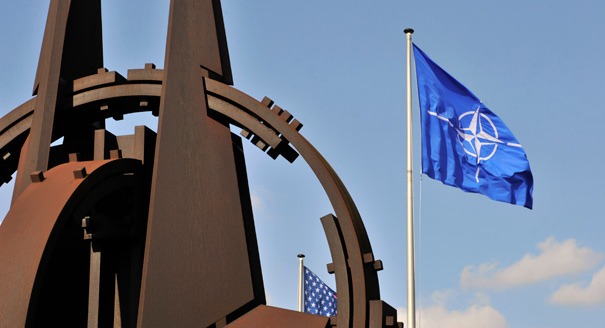
The Crimea crisis has refocused NATO’s attention on the alliance’s Eastern members. But what does that mean for those countries sandwiched between NATO and Russia?
NATO is abuzz. The search for a post-Afghanistan narrative is over. Russia’s annexation of Crimea has in fact given the alliance “a post-Crimea narrative,” as one NATO ambassador put it. But what does that mean in practice?
Steps such as increasing the Baltic states’ air defenses or sending U.S. fighter jets to Poland are reassuring. Talk of NATO reaffirming its commitment to its Article 5 mutual-defense clause is also good news for the organization’s Eastern members. No doubt, the NATO foreign ministers’ meeting in Brussels on April 1–2 will reveal a new sense of purpose that was much needed after the alliance’s long, difficult, and controversial combat mission in Afghanistan.
But none of these gestures is an adequate military deterrent if Russian President Vladimir Putin decides to invade Eastern Ukraine. Much could happen in Ukraine and in neighboring Moldova by the time Jens Stoltenberg, a former Norwegian prime minister, takes over as NATO secretary general in September.
Of course, historical experiences of Russia conditioned the views of Poland and the Baltic states toward Moscow. At the same time, many Western European NATO countries downplayed their Eastern neighbors’ concerns, even treating them as a second-class tier inside the alliance. Crimea has changed all that—for the moment.
For Poland, Russia’s annexation of Crimea means that the United States will go ahead with its missile defense system, however scaled down it may be. NATO also intends to hold more military exercises in Eastern Europe to show its commitment to territorial defense.
As for non-NATO countries such as Finland and Sweden, they are already taking a hard look at their own defense capabilities and considering closer ties to the alliance. In 2012, Finland acquired a standoff cruise missile from the United States. That bilateral deal confirmed that Finland needed a strong deterrent weapons system—clearly motivated by the threat from Russia as well as the growing geosecurity importance of the Arctic.
But is beefing up territorial defense enough to deter further Russian advances into Ukraine or to bolster the security of other countries sandwiched between NATO and Russia?
Russia took over Crimea without any attempt by Ukraine’s armed forces to prevent it. Perhaps that explains why Ukraine’s interim defense minister, Ihor Tenyukh, was recently forced to resign. The ease with which Putin annexed Crimea may tempt him to invade parts of Eastern Ukraine, which would surely destabilize a country now embarking on a presidential election campaign. As it is, Russian troops are amassing on Ukraine’s borders.
It is hard to find a Western European government or public willing to contemplate the use of force, either by Ukraine’s own military or by some sort of NATO mission. Yet most NATO countries, especially the Eastern members, know what is at stake: the post–Cold War consensus on borders, territorial integrity, and international rules. But it stops there. Even if the United States has rediscovered its interest in NATO, U.S. President Barack Obama has no appetite for resorting to force either.
Instead, the West believes and hopes that its panoply of soft power tools, including tougher sanctions, will stop Putin. But as long as Putin can bank on soft power, there is little reason to believe he will stop meddling in Ukraine or Moldova.
In short, with NATO now returning home to Europe, its rediscovery of territorial defense will reassure Poland and the Baltic states. But that will hardly comfort its increasingly vulnerable non-NATO Eastern neighbors. They are becoming Russia’s new playground, where the West’s values and resolve are being sorely tested.

Nonresident Senior Fellow, Carnegie Europe
Judy Dempsey is a nonresident senior fellow at Carnegie Europe
Recent Work
Judy Dempsey
Judy Dempsey
Carnegie does not take institutional positions on public policy issues; the views represented herein are those of the author(s) and do not necessarily reflect the views of Carnegie, its staff, or its trustees.

Are Germany’s economic, industrial, and political struggles becoming a liability for the EU’s ability to rise to the geopolitical moment?

Rym Momtaz, ed.

European Commission President Ursula von der Leyen is about to give her annual address on the state of the EU. Here’s what she won’t—but should—say.
Rym Momtaz

The aftermath of the Ceuta crisis shows Europe has drawn the wrong lessons. Rather than doubling down on failed migration policies, the EU needs to address the underlying roots of such episodes.

Richard Youngs

An overwhelming victory by a far-right-wing party in a small state in eastern Germany will have major repercussions for Chancellor Friedrich Merz’s coalition.
Judy Dempsey

Canadian Prime Minister Mark Carney has twice inspired praise for standing up to U.S. President Donald Trump: at the 2026 World Economic Forum in Davos and on Canada-U.S. trade negotiations. Is Carney showing a third way better than the EU has in dealing with the Trump administration?
Rym Momtaz, ed.