

Commentary
Judy Dempsey
{
  "authors": [
    "Judy Dempsey"
  ],
  "type": "commentary",
  "blog": "Strategic Europe",
  "centerAffiliationAll": "",
  "centers": [
    "Carnegie Endowment for International Peace",
    "Carnegie Europe"
  ],
  "collections": [],
  "englishNewsletterAll": "",
  "nonEnglishNewsletterAll": "",
  "primaryCenter": "Carnegie Europe",
  "programAffiliation": "",
  "programs": [],
  "projects": [],
  "regions": [
    "Western Europe",
    "Germany",
    "Russia"
  ],
  "topics": [
    "Democracy",
    "EU"
  ]
}
Source: Getty
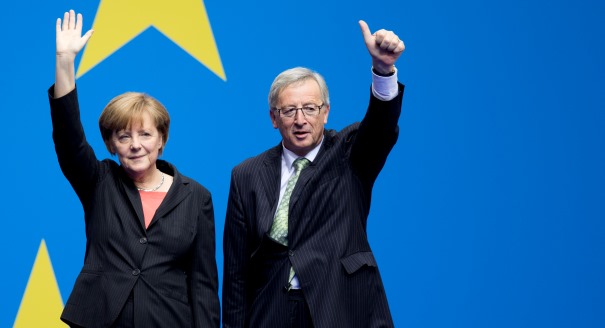
For Germany’s conservatives, getting the European Parliament to end daylight saving time is more important than campaigning for Jean-Claude Juncker as the next European Commission president.
Jean-Claude Juncker is well known and well liked among Germans. He speaks fluent German and appears regularly on German radio and television. He still burns with ambition for Europe.
This former prime minister of Luxembourg, who has spent almost his entire political career campaigning for European integration, is running to become president of the European Commission later this year.
Juncker is the nominee of the conservative European People’s Party (EPP). Not all conservatives are pleased with his nomination, not least Chancellor Angela Merkel, who leads Germany’s Christian Democratic Union (CDU), the EPP’s biggest and most powerful member party. But after the Party of European Socialists elected Martin Schulz, a German, as their candidate for commission president, the EPP had no choice but to put forward its own candidate.
In contrast, Merkel’s speech was lackluster, revealing no sense of emotion for the European idea. Yet delegates feted her, not Juncker. And instead of debating ways to push Europe forward, the most momentous decision that the CDU took that day was to urge the next European Parliament to abolish daylight saving time! You really wouldn’t think that this was the party once led by former chancellors Konrad Adenauer or Helmut Kohl.
Even more telling is the CDU’s campaign strategy. Juncker’s picture will not be on any of the party’s election posters. Instead, they will show Merkel, despite the fact that she isn’t standing as a candidate.
This is all about tactics, of course. Merkel loathes the idea of Juncker heading the European Commission, because he would be a powerful and independent-minded player. The same cannot be said of the current incumbent, José Manuel Barroso, whom Merkel personally endorsed twice precisely because he is weak.
Having an underwhelming commission president suited Merkel just fine, as her inclination is far less integrationist than that of her conservative predecessor as chancellor, Helmut Kohl. For ten years, Merkel’s choice robbed the EU of a strong, convincing, and creative voice. Power shifted back toward national capitals, particularly Berlin.
Now as then, the last person she wants running the commission is someone like Juncker. But can she really refuse to back him if the European People’s Party emerges from May’s elections as the strongest group in the European Parliament?
She can. It is the European Council, which brings together EU heads of state and government, that chooses the commission president. That gives Germany (and France), whose voting strength is considerable, immense clout to lobby for its preferred candidate.
And even if the European Parliament’s political factions believe that their decision to nominate their own candidates carries weight, they will be quickly brought back to reality once the member states begin the horse trading over top EU jobs as soon as the elections are over.
If the European Council decided to opt for someone other than Juncker or Schulz, it would have a hard sell to get that candidate approved by the parliament. EU leaders may not want that kind of confrontation, particularly as many smaller member states, fearful of German domination, will prefer a strong commission president.
Merkel knows that, of course. That is why it is her photo on the German election posters and not Juncker’s. As the most popular politician in Germany today, and with her party doing well in the opinion polls, Merkel must be hoping that her own personality and popularity will pull in as many votes as possible for the CDU.
If she succeeds, Merkel could strengthen both the EPP’s presence in the European Parliament and her own bargaining position with regard to Barroso’s successor. After all, she could argue that it was she who boosted the EPP’s showing in the elections. She would then be in a strong position to lobby for a candidate who would not threaten her or Germany’s national interests.
But will the EU really be served well by another weak European Commission president? With the euro crisis threatening a comeback, the possibility of a British EU referendum looming, and the Ukraine crisis unresolved, the EU needs someone who wants an ambitious Europe—someone who will reach out to its citizens, will dare to push for further integration, and will be no one’s puppet.
In other words, Europe does not need another Barroso.

Nonresident Senior Fellow, Carnegie Europe
Judy Dempsey is a nonresident senior fellow at Carnegie Europe
Recent Work
Judy Dempsey
Judy Dempsey
Carnegie does not take institutional positions on public policy issues; the views represented herein are those of the author(s) and do not necessarily reflect the views of Carnegie, its staff, or its trustees.

As we close out another season of Strategic Europe, it is worth taking stock of the deep shifts underway.

Rym Momtaz
The EU had to compromise to adopt a twenty-first sanctions package against Russia, exposing growing cracks in the union’s resolve. Is this latest, weaker round worth it to keep pressure on Moscow?
Rym Momtaz, ed.

Trump is distracted and Ukraine wants Europe to step up. The continent’s leaders must find their voice and assert it in talks with Russia.

Alissa de Carbonnel

Mounting economic strain and battlefield losses will not necessarily make the Kremlin less dangerous. They could instead push Moscow toward a more aggressive hybrid campaign designed to test NATO’s Eastern flank, exploit allied hesitation, and fracture European resolve.

Maksym Beznosiuk

Over the past ten years, NATO has held almost as many summits as it did during the entirety of the Cold War. Are they still useful, or is it time to stop holding annual meetings?
Rym Momtaz, ed.