

Commentary
Judy Dempsey
{
  "authors": [
    "Judy Dempsey"
  ],
  "type": "commentary",
  "blog": "Strategic Europe",
  "centerAffiliationAll": "",
  "centers": [
    "Carnegie Endowment for International Peace",
    "Carnegie Europe"
  ],
  "collections": [],
  "englishNewsletterAll": "",
  "nonEnglishNewsletterAll": "",
  "primaryCenter": "Carnegie Europe",
  "programAffiliation": "",
  "programs": [],
  "projects": [],
  "regions": [
    "Eastern Europe",
    "Western Europe",
    "Europe"
  ],
  "topics": [
    "Democracy",
    "EU",
    "Security",
    "Civil Society"
  ]
}
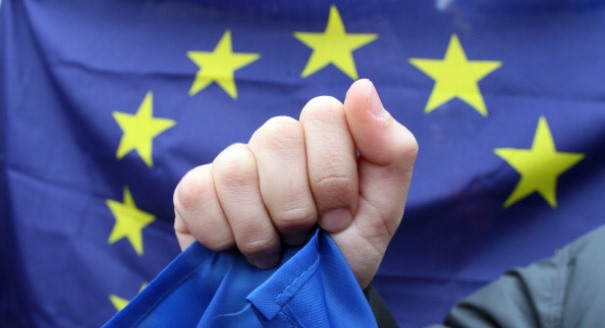
Source: Getty
Far-right parties are vying to get elected to the European Parliament. If they shape the EU’s future, Europe will stop being the home that people yearning for freedom long for.
As German Foreign Minister Frank-Walter Steinmeier came to the end of his eloquent speech at the European Writers’ Conference held in Berlin on May 8–9, he introduced Ágnes Heller.
Heller, who celebrates her eighty-fifth birthday on May 12, is a still-feisty intellectual who stands up for her beliefs.
As Steinmeier told his audience, Heller is a survivor. She is a Hungarian Jew whose father was deported in 1944 with some 450,000 others to Auschwitz, where he died. As a young woman, she joined the Hungarian Communist Party but didn’t toe the line sufficiently. Heller was expelled from the party in 1949, became a dissident, and was eventually forced into exile in 1977.
She has even earned the wrath of Fidesz, the governing conservative party led by Viktor Orbán, because she has criticized Orbán’s authoritarian tendencies. Yet for all that, she still believes Europe is her home.
“[When I was] a child and young woman, ‘Europe’ meant European literature to me. The ideal Europe, the real Europe one could believe in, despite the real Europe of Nazism and Bolshevism, a Europe I actually lived in,” she told the writers’ conference. “For me, poetry was truth, despite all the realities. The promise of a better world.”
This promise of a better world became a reality for many Central and Eastern Europeans after the collapse of Communism. For them, Europe is about freedom, civic values, and tolerance. They appreciate what Western Europeans have long taken for granted and what far-right parties standing in this year’s European Parliament elections now want to curtail.
“A united Europe represents a kind of heaven on earth for us,” Faruk Šehić, a writer from Bihać, Bosnia and Herzegovina, wrote in the conference manifesto. “Until recently, we needed visas to enter this paradise, now we don’t need one, so we should consider ourselves lucky that we have moved up from third-class to second-class Europeans,” he added.
If, as expected, far-right parties make big gains in the European Parliament elections on May 22–25, they will make every effort to create a new “fortress Europe.” Their hostility toward immigrants and refugees negates the meaning and legitimacy of post-1945 and post-1989 Europe. It negates, too, the idea and reality that Europe is home to the fundamental, universal values that fostered the emergence of the European Union in a war-torn and divided continent.
The depressing aspect of the rise of far-right parties is that mainstream political parties in France, the Netherlands, Belgium, Britain, and Hungary have shamelessly pandered to them.
Mainstream politicians try to play the populist card instead of confronting extremists and nationalists. As a result, the political parties that remade Europe after 1945 and again after 1989 are themselves undermining the values of freedom and democracy. Those are the very values that people in Eastern Europe could only dream about before the fall of the Iron Curtain—and that some still die for.
“One can’t talk of the decline of Europe until Europe boasts of people ready to die for democracy, for the rule of law, and for human rights, as it’s been on Kyiv Maidan this winter,” wrote Oksana Zabuzhko, a writer who lives in Kiev, referring to recent antigovernment protests in the Ukrainian capital.
Yet the decline of Europe is a real possibility if prominent European politicians—especially those competing for the EU’s top jobs that are up for grabs this year—do not speak out about why Europe has to defend its values and why it must be a place that people can call home. It’s not for the handouts that people in neighboring countries yearn to join the EU. It’s because Europe is a place for shared values.
“What people have lost in their countries due to poverty, discrimination, or an undemocratic system, they hope to recover in Europe. Europe is the final frontier for these people,” wrote Şeyhmus Diken, a Kurdish writer living in Turkey.
Ágnes Heller hopes it will remain so. Toward the end of her speech, in a reference to the European Parliament elections, she warned that extremists across Europe are trying to open the doors to enter the parliament. “Keep the door safely closed,” she pleaded.

Nonresident Senior Fellow, Carnegie Europe
Dempsey is a nonresident senior fellow at Carnegie Europe
Recent Work
Judy Dempsey
Judy Dempsey
Carnegie does not take institutional positions on public policy issues; the views represented herein are those of the author(s) and do not necessarily reflect the views of Carnegie, its staff, or its trustees.
The war in Iran proves the United States is now a destabilizing actor for Europe and the Arab Gulf. From protect their economies and energy supplies to safeguarding their territorial integrity, both regions have much to gain from forming a new kind of partnership together.

Rym Momtaz
French President Emmanuel Macron has unveiled his country’s new nuclear doctrine. Are the changes he has made enough to reassure France’s European partners in the current geopolitical context?
Rym Momtaz, ed.
European reactions to the war in Iran have lost sight of wider political dynamics. The EU must position itself for the next phase of the crisis without giving up on its principles.

Richard Youngs
Europe isn’t as weak in the new geopolitics of power as many would believe. But to leverage its assets and claim a sphere of influence, Brussels must stop undercutting itself.

Dimitar Bechev

Europe’s reaction to the war in Iran has been disunited and meek, a far cry from its previously leading role in diplomacy with Tehran. To avoid being condemned to the sidelines while escalation continues, Brussels needs to stand up for international law.

Pierre Vimont