

Commentary
Judy Dempsey
{
  "authors": [
    "Judy Dempsey"
  ],
  "type": "commentary",
  "blog": "Strategic Europe",
  "centerAffiliationAll": "",
  "centers": [
    "Carnegie Endowment for International Peace",
    "Carnegie Europe"
  ],
  "collections": [],
  "englishNewsletterAll": "",
  "nonEnglishNewsletterAll": "",
  "primaryCenter": "Carnegie Europe",
  "programAffiliation": "",
  "programs": [],
  "projects": [],
  "regions": [
    "Eastern Europe",
    "Ukraine"
  ],
  "topics": [
    "Political Reform",
    "Democracy",
    "Economy",
    "EU"
  ]
}
Source: Getty
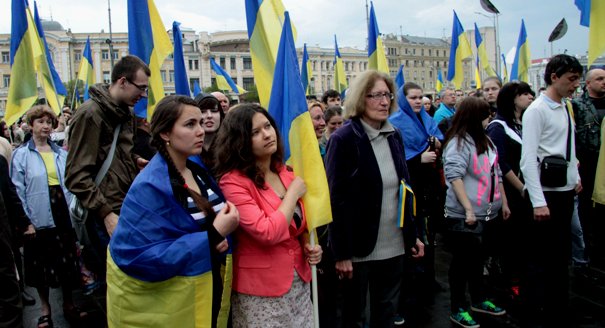
Besides pushing back Russia, Ukraine’s new leaders face the huge task of transforming the country from an oligarchy to a democratic free-market economy.
Pavlo Sheremeta has no illusions about Ukraine’s economy. As the country’s minister for economic development and trade, he knows that the institutions he became responsible for earlier this year are dysfunctional.
Since Ukraine’s failed Orange Revolution of 2004–2005, successive administrations have robbed the institutions of what transparency, accountability, and independence they ever had. The entire state became dominated by a culture of corruption and intense rivalry between political leaders, each of whom had their own oligarch godfathers. The rule of law was substituted by the reign of oligarchs.
Not that the oligarchs had suddenly come on to the stage after 2004. They established their fiefdoms not long after Ukraine declared its independence from the Soviet Union in 1991. By 2004, leaders of the likes of Viktor Yushchenko, Yulia Tymoshenko, or Viktor Yanukovych were in no position to take them on. Politicians were too much beholden to the oligarchs.
Sheremeta, who studied in the United States, was president of the Kyiv School of Economics before being catapulted into one of the interim government’s most difficult jobs in February.
Speaking at this year’s Wrocław Global Forum on June 5–7, a conference that was dominated by the Ukraine crisis, Sheremeta explained how his country had to move as quickly as possible to complete the revolution. His priorities were “macroeconomic stabilization, deregulation, and institutional development, particularly the courts,” he said. When asked how it would be possible to introduce far-reaching reforms given the power of the oligarchs, Sheremeta replied, “The prominence of the oligarchs in the Ukrainian economy should be decreased.”
“It’s going to take a lot of time to do that,” Sheremeta told Carnegie Europe afterward. “Much depends on the kind of strong state institutions that we build.”
Previous administrations in Kiev only ever paid lip service to the need for institution building. There was little political will for reform. Nor was there much pressure from Brussels, even though the EU was supposed to watch over Ukraine’s implementation of its agreements with the union.
Indeed, many in Brussels held the naive and misguided belief that the lure of an association agreement with the EU would be enough to make reforms happen—as if European diplomats based in Kiev did not know how Ukraine was slowly turning into a failed state. Reforms that would have increased transparency and accountability were impossible to implement. The state institutions could not deliver them because they would have gone against the interests of the oligarchs.
Sheremeta knows full well the power of the oligarchs. Petro Poroshenko, the newly sworn-in president, is one of them. Yet by all accounts, Poroshenko built up his hugely successful chocolate business with clean hands. He also established an independent, private television channel that was very important for the Maidan protest movement.
Poroshenko is now supported by the EU and the United States, not just politically but also economically through huge financial support. His task, apart from dealing with Russia’s interference in Ukraine, is to prevent funds from seeping away into the deep pool of corruption or into the deep pockets of the oligarchs.
Both Poroshenko and Sheremeta will be subject to intense scrutiny from the Maidan. This civil society movement, in which over 100 people were killed during prodemocracy demonstrations last February, will put huge pressure on Poroshenko and Ukraine’s government to push forward with real change. The movement wants to complete Ukraine’s long-overdue unfinished revolution.
This is good news for Sheremeta. For far too long, government ministers acted with impunity or powerlessness while the oligarchs pursued their own interests. Too often, Ukraine’s parliament became a club of competing interests between the oligarchs instead of a legislative forum answerable to its citizens. Accountability and transparency were as remote to Kiev as the idea of installing gas meters on the border with Russia, which could have monitored exactly how much Russian gas was flowing into Ukraine’s pipes.
The existence of a strong civil society is Ukraine’s best hope to make the government deliver. The Maidan movement wants a Ukraine anchored to the Western rule of law not to Russian diktats. It will need EU and the United States to help pave that way.
Above all, as Sheremeta told the conference in Wrocław, “the most important is that we in the West stand by our values.” This time round, despite Russia’s attempts to derail Ukraine’s prodemocracy efforts, failure cannot be an option.

Nonresident Senior Fellow, Carnegie Europe
Judy Dempsey is a nonresident senior fellow at Carnegie Europe
Recent Work
Judy Dempsey
Judy Dempsey
Carnegie does not take institutional positions on public policy issues; the views represented herein are those of the author(s) and do not necessarily reflect the views of Carnegie, its staff, or its trustees.

With its public finances in shambles, the far right polling at 35 percent ahead of the 2027 presidential election, and a growing protest movement, is France’s crisis a threat to the EU’s geopolitical awakening?

Rym Momtaz, ed.

Ahead of a tough winter for Ukraine, Donald Trump’s swing back toward Russia bodes ill. But instead of panicking, Kyiv’s European allies are focusing on action.
Rym Momtaz

While the EU and European governments are embracing the much-lauded middle-power moment, this entails three difficult conundrums.

Richard Youngs

Much has been said of the changes Brussels is trying to make to the EU enlargement process. Here’s why gradual integration might—or might not—be the answer.

Dimitar Bechev

The European Commissioner for Trade is headed to China. But after President Xi’s bridge-building visit to Washington, can a more isolated EU overcome Beijing’s stranglehold on critical raw materials? Who will blink first?
Rym Momtaz, ed.