

Commentary
Judy Dempsey
{
  "authors": [
    "Judy Dempsey"
  ],
  "type": "commentary",
  "blog": "Strategic Europe",
  "centerAffiliationAll": "",
  "centers": [
    "Carnegie Endowment for International Peace",
    "Carnegie Europe"
  ],
  "collections": [],
  "englishNewsletterAll": "",
  "nonEnglishNewsletterAll": "",
  "primaryCenter": "Carnegie Europe",
  "programAffiliation": "",
  "programs": [],
  "projects": [],
  "regions": [
    "Eastern Europe",
    "East Asia",
    "China",
    "Japan",
    "Russia",
    "Ukraine",
    "Western Europe",
    "Europe",
    "Asia"
  ],
  "topics": [
    "Security",
    "Military",
    "Foreign Policy"
  ]
}
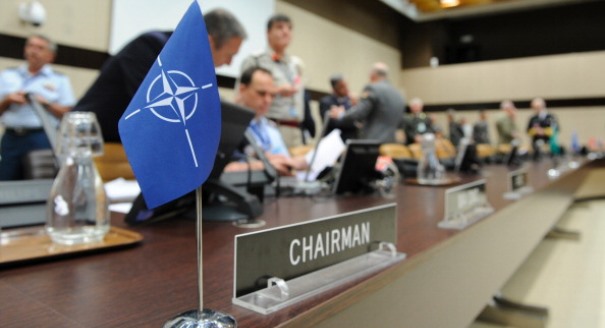
Source: Getty
NATO is emerging from the Ukraine crisis without a new sense of purpose or direction. Yet the rest of the world is investing huge hopes in the Western military alliance.
As a major NATO summit scheduled for September in South Wales draws closer, it is becoming clear what the Ukraine crisis means for the Western alliance. The most important conclusion is that, contrary to many NATO officials’ initial hopes, the alliance is not emerging from this crisis with a clear new sense of purpose, unity, and determination.
Let’s briefly remember the situation at the beginning of 2014. NATO, after serving for over a decade in a long and costly war in Afghanistan, was searching hard for a new role. With military action deeply unpopular in most member states, the U.S.-led military alliance was unsure of what its next raison d’être could be.
Then, Ukraine’s prodemocracy movement forced the then president, Viktor Yanukovych, into exile. Russia’s President Vladimir Putin retaliated against the ouster of his ally by annexing the Crimean Peninsula. This, and the instability that ensued in eastern Ukraine, put the spotlight back on NATO.
So what decisions can be expected from NATO at its summit in South Wales?
First of all, it is increasingly clear that the alliance’s military reaction to Russia will remain very low key. Of course, Poland and the Baltic states are still pushing for NATO to refocus on territorial and collective defense. They want NATO to boost the defenses of its Eastern European members, preferably by deploying permanent bases in some of those countries.
Interestingly, these voices were muted at the annual Strategic Military Partner Conference that took place on June 17–19 in Sofia. Military officers seemed to have realized they were not going to get what they wanted, even though it would have sent a strong signal to Russia that NATO’s eastern flank would no longer be neglected. But Germany in particular sees boosting Eastern Europe’s defenses as a provocation to Russia that should be avoided.
A second consequence of the Ukraine crisis is that NATO is becoming more unwilling than ever to bring in new members that could draw the alliance into a military confrontation with Russia. Countries like Ukraine or Georgia don’t stand a chance right now of joining NATO. The current member states simply consider it too dangerous to extend the mutual defense guarantee of the NATO treaty’s article 5 to these countries.
So at the Sofia meeting, no mention was made of the possibility of admitting Montenegro, or of granting Georgia a Membership Action Plan, which would put the country on the path toward joining the alliance. Indeed, senior Georgian defense ministry officials recognized that the big Western European countries were opposed to granting Membership Action Plan status to Tbilisi at NATO’s September summit.
“If that is the case, we just have to show even more than we have in the past that we are excellent partners. But shouldn’t it be reciprocal?” a senior Georgian military officer asked.
Despite the fact that caution is reigning supreme at NATO, the expectations that the outside world has of the Western alliance are higher than ever. Given Russia’s behavior in Ukraine, partner countries from Finland to Azerbaijan want much closer strategic, political, and military ties with NATO.
Even beyond Europe and its neighborhood, eyes are turning toward NATO. During the Sofia conference, Mitsuo Sakaba, the Japanese ambassador to NATO, a diplomatic post Tokyo established only last year, said his country wanted “a stronger partnership between NATO, Japan, and partner countries.” Japan, however, did “not expect nor foresee any direct involvement or military presence of NATO in the Asia-Pacific.”
Why, then, does Japan, whose security is guaranteed by the United States, need a partnership with NATO? Sakaba listed shared security challenges from cybersecurity and piracy to the proliferation of weapons of mass destruction and terrorism.
But what was striking about this unusually forthright speech was the Japanese ambassador’s assessment of the Ukraine crisis. “We cannot accept changes to the status quo by force or coercion,” he said. “This is a global issue that impacts Asia as well.”
Sakaba said that China, which had embarked on a huge defense spending spree and a rapid modernization of its armed forces, was trying to change the status quo in the East China Sea and South China Sea by coercion. As a result, Japan was conducting a fundamental reassessment of its security policy, which since the end of World War II had been based on pacifism.
Peace, opined Sakaba, could no longer be considered a given due to the rise and threat of China’s military strength. It was time for Japan to play a “proactive role to make and maintain peace in the world.”
Japan intended to do that by cooperating with NATO. Indeed, the Japanese government is already supporting Operation Ocean Shield, NATO’s antipiracy mission off the coast of Somalia, and intends to participate in joint exercises with countries involved in that mission.
Is there any chance that NATO can live up to these huge expectations? With less than three months to go until its summit in South Wales, the picture that NATO presents is less than convincing. But to a world that is deeply worried by Russia’s and China’s behavior, even a weak and indecisive Western alliance seems better than nothing.

Nonresident Senior Fellow, Carnegie Europe
Judy Dempsey is a nonresident senior fellow at Carnegie Europe
Recent Work
Judy Dempsey
Judy Dempsey
Carnegie does not take institutional positions on public policy issues; the views represented herein are those of the author(s) and do not necessarily reflect the views of Carnegie, its staff, or its trustees.

The aftermath of the Ceuta crisis shows Europe has drawn the wrong lessons. Rather than doubling down on failed migration policies, the EU needs to address the underlying roots of such episodes.

Richard Youngs

An overwhelming victory by a far-right-wing party in a small state in eastern Germany will have major repercussions for Chancellor Friedrich Merz’s coalition.
Judy Dempsey

Canadian Prime Minister Mark Carney has twice inspired praise for standing up to U.S. President Donald Trump: at the 2026 World Economic Forum in Davos and on Canada-U.S. trade negotiations. Is Carney showing a third way better than the EU has in dealing with the Trump administration?

Rym Momtaz, ed.

The EU’s responses to two recent incidents expose the gulf between European perceptions and capabilities. Unless the union can bridge that gap, it will never become a real geostrategic power.
Rym Momtaz

In supporting Europe’s far-right, MAGA and Russia both want the same thing: a weaker EU. Europe must defend itself without abandoning the openness these forces exploit.

Armida van Rij