

Commentary
Judy Dempsey
{
  "authors": [
    "Judy Dempsey"
  ],
  "type": "commentary",
  "blog": "Strategic Europe",
  "centerAffiliationAll": "",
  "centers": [
    "Carnegie Endowment for International Peace",
    "Carnegie Europe"
  ],
  "collections": [],
  "englishNewsletterAll": "",
  "nonEnglishNewsletterAll": "",
  "primaryCenter": "Carnegie Europe",
  "programAffiliation": "",
  "programs": [],
  "projects": [],
  "regions": [
    "Eastern Europe",
    "Russia",
    "Ukraine",
    "Western Europe",
    "United Kingdom",
    "Europe"
  ],
  "topics": [
    "EU",
    "Civil Society",
    "Foreign Policy"
  ]
}
Source: Getty
The Ukraine crisis has shown the weakness of the EU’s soft power in countering Russian propaganda. Europeans must understand the value of providing independent information.
Step on a bus or grab a taxi in almost any city or town in Eastern Europe, and the chances are that the radio will be on full blast. Despite the growth of the Internet, radio remains a cheap and highly popular way to obtain news.
So what could be better than for Europe to exploit this medium? If the EU really is as committed to soft power as it likes to say, it could serve its values by spreading independent news to its Eastern neighbors.
The region sorely needs an independent voice, as the Ukraine crisis has shown. In eastern Ukraine, the inhabitants are exposed mostly to Russian state television and radio. Most Ukrainian channels have been taken off the air. In Russia itself, outside the big cities, access to the Internet is patchy. That is why one should not underestimate the power of Russian television and radio.
That’s all very well. But there’s not enough of that sentiment. Even though “old” Eastern Europe—the Baltics and the states of Central Europe—has joined the EU, listeners in several of these countries don’t get an unbiased view of the world. There is still a big need for trusted and independent news reporting via the radio.
As for “new” Eastern Europe—Ukraine, Belarus, and Moldova—this is where the EU could make the biggest difference in providing balanced news. And the one country that could do that is Britain.
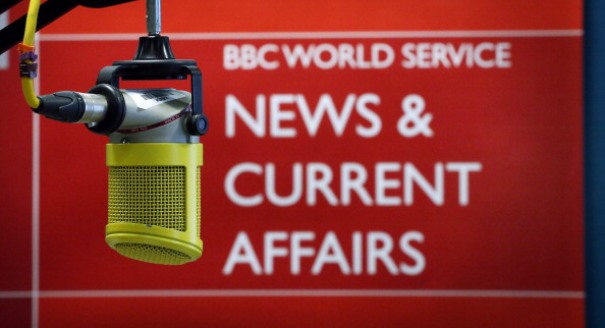
Britain (still) has an invaluable media commodity. It’s the BBC World Service. Previously called the BBC Overseas Service, the broadcaster provided a crucial service in beaming in news to countries behind the Iron Curtain during the Cold War. Yes, it was often difficult to avoid the jamming, but in the end, with careful fiddling around on the shortwave dial, you could hear the BBC’s signature tune, Lillibullero.
The Ukraine crisis has shown the weakness of the EU’s soft power in countering Russian propaganda.Tweet This
But over the past several years, the World Service has fallen into the hands of accountants and technocrats. Institutional memory hardly plays a role. The pressure to react quickly to complex events and stories is immense, and gifted newscasters and reporters have to vie with a creeping trend of dumbing down.
Just as worrying is that the number of language services is declining. In 2005, the World Service boasted 43 languages. Today, it offers just 28. Broadcasting to Europe is a shadow of its former self. The BBC no longer provides programs in the languages of the Balkans and southeastern Europe. Russian and Ukrainian are the only two Slavic languages now available.
Given the dangerous amount of unfinished business across the Balkans, Eastern Europe, and the Caucasus, the last thing these countries need is a media and information flow controlled by oligarchs, media barons, and politicians. Yet this is increasingly the reality. The latest report by the NGO Freedom House says that media freedom is at its lowest level in a decade.
It is a tragedy that in this situation, the World Service and indeed the British government are losing sight of why they should continue to invest in language services that offer listeners another voice, another worldview.
In April 2014, the funding of the World Service was transferred from the Foreign and Commonwealth Office—the UK foreign ministry—to the BBC itself.
The World Service will be funded out of the general license fee that the British public pays for the BBC’s domestic radio and television. For the period 2014–2015, the World Service has been allocated a budget of £245 million ($420 million). But a recent report by the House of Commons Foreign Affairs Committee stated that “no budget has yet been announced for years beyond 2014-15.” That is hardly confidence inspiring to retain what remains of a gifted but demoralized staff.
Furthermore, the World Service will have no direct say over the BBC’s executive or management Boards. The service’s director will now be “just one of many competing voices on the News Group Board which will take decisions on how the World Service should meet its objectives and targets under the Operating Licence,” the parliamentary report added.
The BBC’s top brass maintains that the World Service is in safe hands. But anyone traveling through Europe knows otherwise. The values that Britain and its European allies espouse are not getting across to Eastern Europe. Not only that; Europe as a whole is failing to recognize that institutions such as the BBC World Service are influential soft power tools.
Russia’s President Vladimir Putin, a former KGB spy, understands the value of information perfectly well. It’s a shame that neither the BBC bosses nor the British government recognizes the implications of that.

Nonresident Senior Fellow, Carnegie Europe
Judy Dempsey is a nonresident senior fellow at Carnegie Europe
Recent Work
Judy Dempsey
Judy Dempsey
Carnegie does not take institutional positions on public policy issues; the views represented herein are those of the author(s) and do not necessarily reflect the views of Carnegie, its staff, or its trustees.

Before the next wave of EU enlargement takes place, the union needs to grapple with thorny questions of how power is distributed among its members.


Emil Sondaj Hansen, Ditte Brasso Sørensen

A summer of escalation in the Black Sea has hurt Ukraine economically and is exacerbating world food security. A truce is needed—as is a broader reframing of Europe’s Ukraine strategy.

Thomas de Waal

Are Germany’s economic, industrial, and political struggles becoming a liability for the EU’s ability to rise to the geopolitical moment?

Rym Momtaz, ed.

European Commission President Ursula von der Leyen is about to give her annual address on the state of the EU. Here’s what she won’t—but should—say.
Rym Momtaz

The aftermath of the Ceuta crisis shows Europe has drawn the wrong lessons. Rather than doubling down on failed migration policies, the EU needs to address the underlying roots of such episodes.

Richard Youngs