

Commentary
Judy Dempsey
{
  "authors": [
    "Judy Dempsey"
  ],
  "type": "commentary",
  "blog": "Strategic Europe",
  "centerAffiliationAll": "",
  "centers": [
    "Carnegie Endowment for International Peace",
    "Carnegie Europe"
  ],
  "collections": [
    "Europe’s Eastern Neighborhood"
  ],
  "englishNewsletterAll": "",
  "nonEnglishNewsletterAll": "",
  "primaryCenter": "Carnegie Europe",
  "programAffiliation": "",
  "programs": [],
  "projects": [],
  "regions": [
    "Russia",
    "Europe",
    "Western Europe",
    "Germany"
  ],
  "topics": [
    "Foreign Policy",
    "EU"
  ]
}
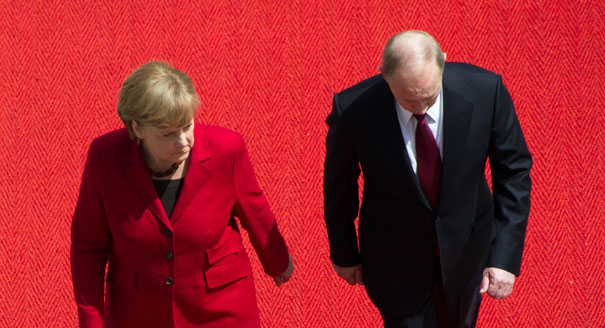
Source: Getty
A letter sent by three German ministers to parliamentarians makes clear that Berlin’s special relationship with Russia is all but over.
A three-page letter that was sent to German parliamentarians on August 18 makes sober reading.
Ostensibly, the letter is about how Europe’s sanctions against Russia and vice versa might affect the German economy. But the real message that Sigmar Gabriel, Social Democrat leader and minister for economic affairs and energy, Wolfgang Schäuble, federal minister of finance, and Christian Schmidt, food and agriculture minister, want to get across is that Germany’s special relationship with Russia is all but over.
It’s not as if Chancellor Angela Merkel—who will travel to Kiev on August 23—and Foreign Minister Frank-Walter Steinmeier haven’t worked endlessly with Russia to seek some diplomatic solution to end the Ukraine crisis.
The ministers’ letter conveys a real sense of the changes taking place in Merkel’s coalition of conservatives and Social Democrats vis-à-vis Russia.
“From the very beginning, we pursued a common European position in order to meet this challenge,” the letter states. “It is also thanks to our efforts that Europe has found a clear, common position. We want a political solution to the conflict in Ukraine. Yet this also means that we are ready to take all necessary steps, together and in solidarity—including all sectors and members states—to lend weight to our position.”
Then comes the part about Russia.
Now it is up to Russia to make its contribution to the resolution of the crisis. Unfortunately, there is little to be seen of that so far. On the contrary, the Russian president does not use his clearly existent influence on the separatists to convince them of moderation and to secure the borders in Europe that are accepted through international law.
With military exercises, a massive presence of troops in the immediate vicinity of the conflict area, and at the least the toleration of the transit of weapons and fighters, Russia is not making an effort for a sustainable deescalation of the situation. This, the West could not leave unanswered. With the sanctions, we want to lend weight to the demands of the EU and the United States that Russia should end destabilizing the situation in Ukraine and play a constructive role in the search for a peaceful solution to the conflict there.
Of course, the ministers know full well the effects of the countersanctions that Russia imposed on German and other European food producers. They write:
The sanctions imposed by the European Union vis-à-vis Russia, but even more the “countermeasures” that Russia took in a demonstrative and arbitrary way, worry German business. We take these worries very seriously.
Beyond that, it has also been the case in the past (for instance, with sanctions against Iran or Syria) that the state does not take responsibility for external risks. These are solely the responsibility of entrepreneurial decisions. Yet we must be aware of the fact that, if the crisis continues to escalate, the number of German companies concerned may increase.
Despite this, the ministers believe that the effect on the German producers “will in all probability be noticeable but manageable.”
That’s not the view of the Ost-Auschuss, an influential committee that lobbies for German companies doing business in Russia, Eastern Europe, the Balkans, and Central Asia. On August 19, the Ost-Auschuss argued how Russia’s sanctions would affect German companies and what losses to expect.
Interestingly, the ministers took an indirect swipe at the Ost-Auschuss and those parliamentarians that have been reluctant to take a firm stance against Putin’s policies. “It is understandable that in the constituencies there will be some uncertainty emerging . . . we must preempt exaggerated worries through objective information,” they note.
Even more revealing is how the ministers weigh up the short-term costs of the sanctions with the long-term policy of standing up to Putin’s illegal annexation of Crimea and his military interference in eastern Ukraine. “We must explain why in the long term it would be much more costly for us to tolerate the illegal and destabilizing approach of the Russian side,” the ministers write.
In other words, Chancellor Angela Merkel and her government are in for the long haul when it comes to dealing with Russia and resolving the Ukraine crisis.
Now that Germany has abandoned Ostpolitik, Merkel’s government has a chance to put in place a new policy toward Eastern Europe. That will require not only a huge economic and political input from Berlin and its European counterparts. It will also require Eastern Europe’s leaders to reciprocate by introducing reforms and tackling endemic corruption. In short, it will require a new Ostpolitik by both sides.
Note: The August 18 letter written by Ministers Gabriel, Schäuble, and Schmidt has been translated from German to English for this blog by the author.

Nonresident Senior Fellow, Carnegie Europe
Dempsey is a nonresident senior fellow at Carnegie Europe
Recent Work
Judy Dempsey
Judy Dempsey
Carnegie does not take institutional positions on public policy issues; the views represented herein are those of the author(s) and do not necessarily reflect the views of Carnegie, its staff, or its trustees.
Europe isn’t as weak in the new geopolitics of power as many would believe. But to leverage its assets and claim a sphere of influence, Brussels must stop undercutting itself.

Dimitar Bechev
Europe’s reaction to the war in Iran has been disunited and meek, a far cry from its previously leading role in diplomacy with Tehran. To avoid being condemned to the sidelines while escalation continues, Brussels needs to stand up for international law.

Pierre Vimont
France and Germany’s failure to agree on the Future Combat Air System (FCAS) raises questions about European defense. Amid industrial rivalries and competing strategic cultures, what does the future of European military industrial projects look like?

Rym Momtaz, ed.
France has stopped clinging to notions of being a great power and is embracing the middle power moment. But Emmanuel Macron has his work cut out if he is to secure his country’s global standing before his term in office ends.
Rym Momtaz
Integrating AI into the workplace will increase job insecurity, fundamentally reshaping labor markets. To anticipate and manage this transition, the EU must build public trust, provide training infrastructures, and establish social protections.
Amanda Coakley