

Commentary
Judy Dempsey
{
  "authors": [
    "Judy Dempsey"
  ],
  "type": "commentary",
  "blog": "Strategic Europe",
  "centerAffiliationAll": "",
  "centers": [
    "Carnegie Endowment for International Peace",
    "Carnegie Europe"
  ],
  "collections": [
    "EU Integration and Enlargement",
    "Brexit and UK Politics"
  ],
  "englishNewsletterAll": "",
  "nonEnglishNewsletterAll": "",
  "primaryCenter": "Carnegie Europe",
  "programAffiliation": "",
  "programs": [],
  "projects": [],
  "regions": [
    "Europe",
    "Western Europe",
    "United Kingdom"
  ],
  "topics": [
    "EU"
  ]
}
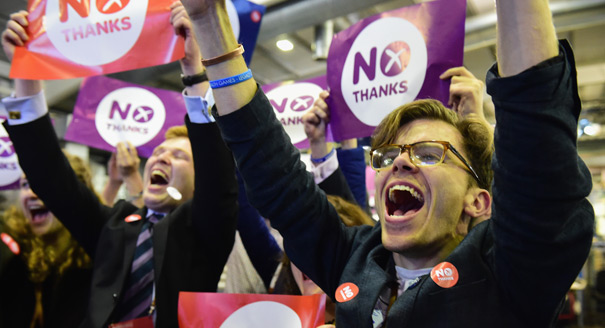
Source: Getty
Now that Scotland has voted to remain in the UK, Britain has to decide if it wants to remain in Europe.
Scotland has voted against independence, and how—55.3 percent of voters chose to remain part of the UK, against 44.7 percent who voted in favor of Scottish independence.
The 84.59 percent turnout was fantastic. Disregarding the bitter, emotional, and inward-looking nature of the campaign, the high turnout showed the importance of the issue. It also revived political participation and engagement, which have become so miserably low across almost all of Europe.
After this long, two-year campaign—so studiously ignored by Prime Minister David Cameron’s government until polls suggested that the “Yes” vote might indeed destroy the UK—Scots decided that it was better to retain the status quo rather than go it alone.
The result is good news for England because the referendum led to much-needed soul-searching among the English. They had to consider what it would have meant for their identity and status were Scotland to break away from the UK. An England without Scotland would also have generated an intense discussion in Wales and Northern Ireland, not forgetting Ireland, about the future of their relations with the government in London.
As it is, Cameron has already started that debate. He promised the Scots that if they voted against independence, London would devolve far-reaching political powers to Edinburgh. To honor that pledge, he tasked Lord Smith of Kelvin on September 19 with overseeing the process of devolving more powers to Scotland, even over taxation.
Cameron’s decentralization policies will be watched very closely, not just by the rest of the UK but also by other political movements that are seeking greater freedom from central governments.
In another context, the Scottish “No” vote is a pointer to 2017. That is when the British may vote on whether to remain in the EU, following a referendum pledge that Cameron has made if his Conservative Party is reelected next year.
If Cameron and other British political party leaders could campaign, belatedly, with such vigor and commitment for Scotland to remain in the UK, then surely they could consider doing the same for the UK to remain in the EU.
Scots have chosen to retain the status quo because they believed that remaining together was in their interests—the same argument could be made for Britain to stay in the EU.
Together does mean stronger, despite all the deficiencies of the EU and Cameron’s petty populism and intellectual cowardice in not understanding that Great Britain and Europe would be mutually damaged if the Brits vote to step out of the EU. There are, to be sure, some countries outside Europe that would relish that idea.
This is why the Scottish result places an onus on both London and Brussels to find a modus operandi. Cameron’s constant whining about Europe is not endearing him toward Europeans. Indeed, during the run-up to the Scottish referendum, which received wide coverage across Europe, there was almost a feeling that the Scots should give Cameron a bloody nose with a Yes vote because of his attitude toward Europe.
As it stands, Cameron is lucky. Even though he denied it, his political future would have been in question had he lost Scotland. Now, he has to turn the No vote to Britain and to Europe’s advantage. That means moving the debate away from populist and emotional issues (Cameron: “It would break my heart if Scotland left the United Kingdom,") to strategic questions that were so absent by both sides in the Scottish campaign.
A strategic debate by the British government about its role in Europe, and whether Europe itself has any future as a major global actor, is long overdue. Today’s outcome in Scotland should be the catalyst for starting this conversation. If not, Cameron could squander Britain’s future in the EU, and the Scottish vote.

Nonresident Senior Fellow, Carnegie Europe
Judy Dempsey is a nonresident senior fellow at Carnegie Europe
Recent Work
Judy Dempsey
Judy Dempsey
Carnegie does not take institutional positions on public policy issues; the views represented herein are those of the author(s) and do not necessarily reflect the views of Carnegie, its staff, or its trustees.

As we close out another season of Strategic Europe, it is worth taking stock of the deep shifts underway.

Rym Momtaz
The EU had to compromise to adopt a twenty-first sanctions package against Russia, exposing growing cracks in the union’s resolve. Is this latest, weaker round worth it to keep pressure on Moscow?
Rym Momtaz, ed.

Trump is distracted and Ukraine wants Europe to step up. The continent’s leaders must find their voice and assert it in talks with Russia.

Alissa de Carbonnel

Mounting economic strain and battlefield losses will not necessarily make the Kremlin less dangerous. They could instead push Moscow toward a more aggressive hybrid campaign designed to test NATO’s Eastern flank, exploit allied hesitation, and fracture European resolve.

Maksym Beznosiuk

Over the past ten years, NATO has held almost as many summits as it did during the entirety of the Cold War. Are they still useful, or is it time to stop holding annual meetings?
Rym Momtaz, ed.