

Commentary
Judy Dempsey
{
  "authors": [
    "Judy Dempsey"
  ],
  "type": "commentary",
  "blog": "Strategic Europe",
  "centerAffiliationAll": "",
  "centers": [
    "Carnegie Endowment for International Peace",
    "Carnegie Europe"
  ],
  "collections": [
    "Transatlantic Cooperation"
  ],
  "englishNewsletterAll": "",
  "nonEnglishNewsletterAll": "",
  "primaryCenter": "Carnegie Europe",
  "programAffiliation": "",
  "programs": [],
  "projects": [],
  "regions": [
    "Europe",
    "Western Europe",
    "Germany"
  ],
  "topics": [
    "EU",
    "Security"
  ]
}
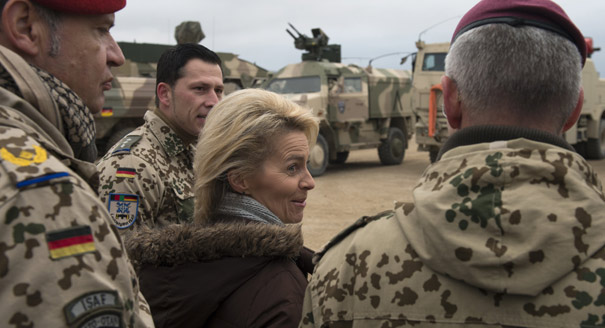
Source: Getty
Germany’s armed forces are so badly equipped that they would be unable to support another NATO mission. This is bad news for Germany and for the EU’s foreign policy ambitions.
As 150 German soldiers were preparing to return home from serving in Afghanistan, they were told their aircraft had broken down.
Under normal circumstances, the commander would have called for another military transport plane. But there were none available. They weren’t fit to fly. If necessary, the government’s plane, used by German Chancellor Angela Merkel, was on standby.
All this would be laughable were it not so serious.
Germany’s poorly equipped armed forces have serious implications. They hamper the country from meeting its responsibilities that Joachim Gauck has been advocating since becoming German president in March 2012.
The grounded soldiers in Afghanistan are just one example of the sorry state of the Bundeswehr, Germany’s armed forces. The country’s military is in such bad shape that Berlin would find it difficult to patrol the skies over the Baltic states, a task NATO has taken on. Germany cannot even provide two helicopters to support the EU’s antipiracy mission off the coast of Somalia.
And when in September Germany agreed to train and supply weapons to the Kurds in northern Iraq, German Defense Minister Ursula von der Leyen traveled in advance of the mission, only to discover none of the trainers or equipment had arrived.
The mission’s military transport plane had broken down; so had the two replacement planes. On top of that, the first batch of guns and antitank missiles was delayed—the Dutch transport plane used to carry them wasn’t feeling well either!
So what’s wrong with Germany’s armed forces? Lack of money? Hardly. Germany spent $49 billion on defense in 2013, the equivalent of 1.3 percent of the country’s GDP. Even though it falls way short of the 2 percent benchmark set by NATO, that still is a huge amount of money. Per capita, Germany’s defense spending amounted to $505 in 2013. The average for European NATO members was $401.
If money is not the real problem, then priorities are. Half of the German defense budget goes to personnel costs, compared with 35.0 percent in the UK and 36.5 percent in the United States.
There have been shifts in the allocation of the defense budget. Soldiers deployed in Afghanistan had complained about poor equipment and protection. That was remedied by Karl-Theodor zu Guttenberg, the flamboyant defense minister who scrapped military conscription but who resigned in 2011 for plagiarizing his PhD thesis.
However, Germany paid too little attention to restructuring its armed forces, a task that Guttenberg’s successor, Thomas de Maizière, hardly tackled. Above all, a top-heavy bureaucracy combined with more protection for German troops failed to notice (or ignored?) the fact that money was not being spent on spare parts. Hence the problems with maintaining helicopters and other air transport for the army and navy.
These shortcomings came to light in September during a hearing of the German parliament’s defense committee, in which top military officers were quizzed. It turned out that only 24 of Germany’s 56 transport planes and sixteen of its 83 helicopters could function. And when Germany sent Patriot missiles to Turkey to protect the country against any possible attack by Syrian government forces, only half of the Patriot systems were in working order.
As for fighter jets, only 42 out of 109 Eurofighters and 38 out of 89 Tornados can be used. After promising 60 Eurofighters to patrol the skies over the Baltic states, von der Leyen said Germany would not be able to meet its NATO commitment.
Von der Leyen, who has been in the job for just over a year, has been quick to deflect criticism, saying she inherited many of the military’s problems, which is true. But now she is going to need much political support to fix things in a defense ministry that is notorious for destroying political careers.
All the reports about the miserable state of Germany’s armed forces could be turned to von der Leyen’s advantage. This is her chance to explain how the Bundeswehr works, what the money is spent on, and why security matters to German and European citizens. Otherwise, the pleas by Gauck and von der Leyen that Germany should take on more responsibilities will remain just rhetoric—much to the disappointment of the country’s allies.

Nonresident Senior Fellow, Carnegie Europe
Judy Dempsey is a nonresident senior fellow at Carnegie Europe
Recent Work
Judy Dempsey
Judy Dempsey
Carnegie does not take institutional positions on public policy issues; the views represented herein are those of the author(s) and do not necessarily reflect the views of Carnegie, its staff, or its trustees.

Are Germany’s economic, industrial, and political struggles becoming a liability for the EU’s ability to rise to the geopolitical moment?

Rym Momtaz, ed.

European Commission President Ursula von der Leyen is about to give her annual address on the state of the EU. Here’s what she won’t—but should—say.
Rym Momtaz

The aftermath of the Ceuta crisis shows Europe has drawn the wrong lessons. Rather than doubling down on failed migration policies, the EU needs to address the underlying roots of such episodes.

Richard Youngs

An overwhelming victory by a far-right-wing party in a small state in eastern Germany will have major repercussions for Chancellor Friedrich Merz’s coalition.
Judy Dempsey

Canadian Prime Minister Mark Carney has twice inspired praise for standing up to U.S. President Donald Trump: at the 2026 World Economic Forum in Davos and on Canada-U.S. trade negotiations. Is Carney showing a third way better than the EU has in dealing with the Trump administration?
Rym Momtaz, ed.