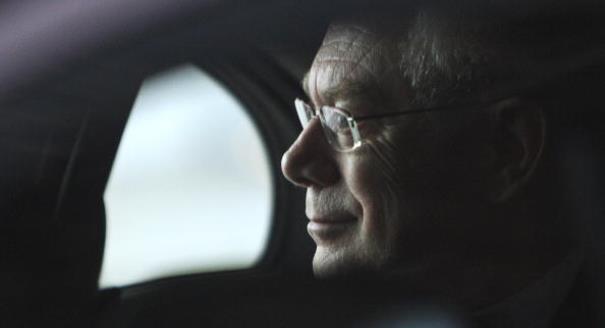
What does Herman Van Rompuy want to be remembered for after he hands over the presidency of the European Council to Donald Tusk on December 1? “I am not sure,” he told me, sipping a glass of beer over lunch, “that this has any relevance whatsoever.” Then he quoted former U.S. president John F. Kennedy, saying that “a good conscience is our only sure reward.”
This modesty is vintage Van Rompuy. It may have been partly cultivated: not everybody has the right Kennedy quotes to hand. But this approach has been key to everything he has done during his two mandates in the EU’s highest office.
Herman Van Rompuy, who spent most of his political life in Belgian politics, was the first post–Lisbon Treaty president of the European Council, which brings together EU heads of state and government.
There was no script for him. The EU’s presidents and prime ministers chose him because he seemed to be a harmless gray mouse, which suited them.
That image suited him, too. When he got the job in 2009, he had been prime minister of Belgium for a year. He had attended enough European Council meetings to grasp what the essence of his new adventure would be: to calm 27 (now 28) leaders, many with swollen egos marching into summits in Brussels with television crews on their heels. Only then could there be any deal making.
If Van Rompuy wanted the leaders to negotiate their way out of the eurozone crisis, the most serious in the EU’s history, he first had to win their trust. For this, he needed a low profile. There could be no sniping, plotting, or settling of scores on his part. Otherwise he would not survive more than a few months in the job.
This is why the gray mouse image was convenient for Van Rompuy—an ardent Anderlecht football supporter with a biting sense of humor. It was a useful facade. The only personal signifier he allowed himself were his haikus, which received so much attention that they almost obtained cult status.
In public, @euHvR was careful. In private, he could be cunning.
In public, he was careful, not marching ahead of the troops. Behind the scenes, though, he could be cunning.
When former Italian prime minister Silvio Berlusconi submitted disappointing economic reform proposals during a turbulent phase in the crisis in October 2011, German Chancellor Angela Merkel and then French president Nicolas Sarkozy ridiculed Berlusconi openly. Van Rompuy chose another strategy: he refused to acknowledge receipt of the proposals until they were up to standard. Berlusconi had to adjust the plans several times. Had Van Rompuy humiliated him publicly, it would probably have backfired.
Van Rompuy was often criticized, for instance by the French, for not being tough enough against Germany. Why didn’t he protest more loudly whenever Berlin suggested bilateral instead of collective eurozone rescue funds? In fact, he was frequently critical of Germany, which ended up agreeing to all the policies it had opposed in the beginning—from loans to Greece to a banking rescue fund. Merkel has been cross with him quite a few times for contradicting her. Van Rompuy always expressed his views to her in private.
The European Council meeting in October provided another example of the Belgian’s strategy. At a press conference, British Prime Minister David Cameron lashed out against the EU because Britain had to pay a self-inflicted extra contribution to the EU budget. Van Rompuy had reasons to be fed up with Cameron’s frequent, unannounced outbursts. But he only said that “inside the meeting room, the tone was different.”
These dry, factual remarks are typical for him. Insiders usually get the message. But to outsiders, these comments sound boring and cryptic. After a speech and a question-and-answer session in the Austrian parliament earlier this year, a student said he was disappointed in Van Rompuy. “I came here to learn from this man. But what does he stand for?”
The president’s office was always an oasis of calm. Once past the click-locked doors, visitors automatically walk more slowly and lower their voices. Van Rompuy, who never manically taps his cell phone and seldom raises his voice, has often said that reading fiction and taking time off with his family have kept him sane. A devout Catholic, he would sometimes disappear into a monastery for one or two days. He delegated a lot to his private staff, several of whom are Belgian diplomats.
Hours after Malaysia Airlines flight 17 was shot down over Ukraine in July, killing all on board, Van Rompuy left on an official visit to Haiti and the Dominican Republic. He was aware the disaster could trigger the first serious sanctions against Russia. After Haiti, Van Rompuy had planned a family holiday in Peru, which he didn’t cancel either. That surprised some EU leaders. No EU summit could be held without Van Rompuy’s presence.
His staff dealt with the matter by circulating written proposals among EU capitals in Van Rompuy’s name. The president was hardly reachable by phone. Some said this showed the man wasn’t important; after all, wasn’t it Merkel whose push for tough sanctions prevailed in July? Others drew the opposite conclusion and argued that even in his absence, things went exactly the way Van Rompuy wanted them to go.
Behind the scenes, Van Rompuy can be witty and outspoken. He believes in a strong Europe and has often warned heads of state and government against bypassing the European Commission. He says his best moment was when the EU won the Nobel Peace Prize in 2012 because “it was an award for the world’s biggest voluntary peace project.”
.@euHvR helped the #eurozone overcome the acute phases of the crisis.
His preparations for European Council meetings were aimed at preventing clashes and paving the way for workable solutions—even if those solutions wouldn’t win a beauty contest. In his own way, he helped the eurozone overcome the acute phases of the crisis. Whether he succeeded in steering the EU out of danger altogether is far too early to tell.
When former European Commission president José Manuel Barroso left office on November 1, he handed out books of his old speeches and showed a thirty-minute film entirely about himself. Catherine Ashton, on stepping down as the head of the European External Action Service on the same day, produced a similar movie. As for Van Rompuy, he asked his wife to buy chips and drinks for one of his farewell receptions. He assures visitors there will be no tell-all memoirs. He says he never even kept notes.