

Commentary
Judy Dempsey
{
  "authors": [
    "Judy Dempsey"
  ],
  "type": "commentary",
  "blog": "Strategic Europe",
  "centerAffiliationAll": "",
  "centers": [
    "Carnegie Endowment for International Peace",
    "Carnegie Europe"
  ],
  "collections": [
    "Europe’s Eastern Neighborhood"
  ],
  "englishNewsletterAll": "",
  "nonEnglishNewsletterAll": "",
  "primaryCenter": "Carnegie Europe",
  "programAffiliation": "",
  "programs": [],
  "projects": [],
  "regions": [
    "Europe",
    "Eastern Europe",
    "Ukraine"
  ],
  "topics": [
    "Political Reform",
    "EU"
  ]
}
Source: Getty
Every week, a selection of leading experts answer a new question from Judy Dempsey on the foreign and security policy challenges shaping Europe’s role in the world.
Every week, a selection of leading experts answer a new question from Judy Dempsey on the foreign and security policy challenges shaping Europe’s role in the world.
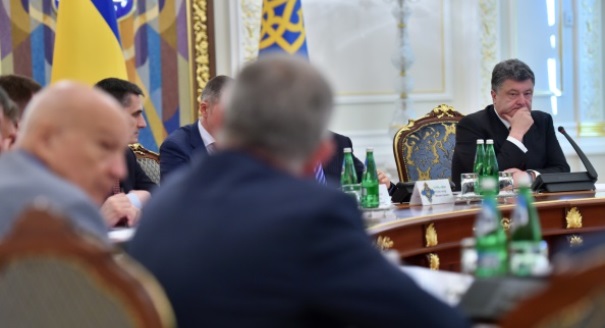
Poroshenko can’t reform Ukraine—but Ukrainians can.
Real reform of state institutions requires a deep social consensus.Tweet This
The lesson of the past twenty-five years in Europe is that the scope for top-down reforms is limited. The leadership of a country can create macroeconomic stability (hard in Ukraine’s case) and keep external threats at bay (even harder). But real reform of state institutions requires a deep social consensus. People have to want to live and work differently.
Ukraine is plagued by a predatory political class and a provincial Soviet-era bureaucracy. The country’s thriving civil society and increasingly consolidated sense of nationhood are a welcome counterbalance to those problems—but they are not yet, I fear, enough to overcome them.
No. Only the EU can reform Ukraine.
#Ukraine has proved that it cannot reform itself from within.Tweet This
Ukraine has proved that it cannot reform itself from within and that only outside pressures can combat the widespread corruption and dysfunction that have plagued the country since the end of the Soviet Union.
The October 26 parliamentary election produced some potential allies for reform, but only a sustained and focused effort by the EU to tie all assistance to reform will have a chance of succeeding. This assistance has to be far more serious than the lackluster efforts made in Bulgaria and Romania and represents Ukraine’s last best chance to join the West.
After Ukraine’s parliamentary election on October 26, the conditions for implementing deep reforms are good, at least with regard to the situation in Kiev.
Not only will there be a reform-oriented coalition government and the opportunity to form a pro-EU constitutional majority in the parliament. The high number of reputable civil society activists and investigative journalists in the legislature should also help avoid reforms being subverted by manipulative modifications or repeated postponement.
Russian destabilization could lead to the destruction of #Ukraine.Tweet This
An additional pro-reform factor is the partly ratified EU-Ukraine Association Agreement, which aims to improve bilateral political and economic cooperation. The effect of the accord will be even greater once it is fully ratified by all 28 EU member countries.
However, at the same time, the Kremlin will try to distract the Ukrainian government from reforms and will continue to undermine the investment and business climate in Ukraine—if it does not launch new military operations in eastern and southern Ukraine. That destabilization could threaten the country’s Europeanization efforts and, eventually, even lead to the destruction of the Ukrainian state.
He might, once he starts to take charge of his constitutional competences.
Ukraine’s current coalition talks highlight President Petro Poroshenko’s reluctance to give up a power-brokering role in the parliamentary system. With Prime Minister Arseniy Yatsenyuk bound to retain his seat under the broad incoming coalition, the president will have to limit his micromanagerial ambitions if he is serious about triggering decisive economic reforms. Stopping preferential treatment of oligarchic allies and drawing up a viable 2015 budget would be a good start.
Poroshenko is risk averse, but he should take a leap of faith by making Ukraine’s new Anti-Corruption Bureau truly independent. Given that his loyalists control the Security Service and the now-weakened Office of the Prosecutor General, the president should resist the temptation to protract the recruitment process in the bureau unnecessarily. Delivering on the promise of decentralization, preached by all coalition partners, will help assuage fears that he is clutching control over regional administrations.
#Poroshenko's hallmark should be to kick-start a defense reform.Tweet This
Yet Poroshenko’s major hallmark should be to kick-start a defense reform. His leadership will be indispensable in boosting spending for the underfinanced army to achieve the proclaimed target of 5 percent of GDP by 2020. Instead of swapping defense ministers every two months, the president should overhaul the military’s logistics and command structures.
These are all tricky tasks, but Poroshenko’s legacy depends on them.

Nonresident Senior Fellow, Carnegie Europe
Judy Dempsey is a nonresident senior fellow at Carnegie Europe
Recent Work
Judy Dempsey
Judy Dempsey
Carnegie does not take institutional positions on public policy issues; the views represented herein are those of the author(s) and do not necessarily reflect the views of Carnegie, its staff, or its trustees.

As we close out another season of Strategic Europe, it is worth taking stock of the deep shifts underway.

Rym Momtaz
The EU had to compromise to adopt a twenty-first sanctions package against Russia, exposing growing cracks in the union’s resolve. Is this latest, weaker round worth it to keep pressure on Moscow?
Rym Momtaz, ed.

Trump is distracted and Ukraine wants Europe to step up. The continent’s leaders must find their voice and assert it in talks with Russia.

Alissa de Carbonnel

Mounting economic strain and battlefield losses will not necessarily make the Kremlin less dangerous. They could instead push Moscow toward a more aggressive hybrid campaign designed to test NATO’s Eastern flank, exploit allied hesitation, and fracture European resolve.

Maksym Beznosiuk

Over the past ten years, NATO has held almost as many summits as it did during the entirety of the Cold War. Are they still useful, or is it time to stop holding annual meetings?
Rym Momtaz, ed.