


Commentary
Judy Dempsey
{
  "authors": [
    "Judy Dempsey"
  ],
  "type": "commentary",
  "blog": "Strategic Europe",
  "centerAffiliationAll": "",
  "centers": [
    "Carnegie Endowment for International Peace",
    "Carnegie Europe"
  ],
  "collections": [
    "Europe’s Eastern Neighborhood"
  ],
  "englishNewsletterAll": "",
  "nonEnglishNewsletterAll": "",
  "primaryCenter": "Carnegie Europe",
  "programAffiliation": "",
  "programs": [],
  "projects": [],
  "regions": [
    "Russia",
    "Europe",
    "Eastern Europe",
    "Western Europe"
  ],
  "topics": [
    "EU",
    "Economy",
    "Climate Change"
  ]
}
Source: Getty
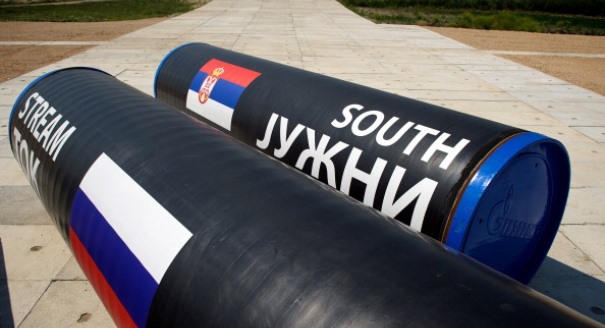
The European Union has an opportunity to increase diversification, transparency, and security across the energy sector. It should seize that chance.
President Vladimir Putin’s announcement on December 1 that Russia was abandoning plans to build a $50 billion gas pipeline throws down the gauntlet to the European Union and all its 28 member states.
If Putin sticks to his policy to scrap the South Stream project, which would have brought gas from Russia to Southeastern Europe, the move could turn out to be decisive for the EU’s energy strategy—if the EU uses that opportunity.
For one thing, the demise of South Stream could speed up the diversification of Europe’s energy sources. It could also encourage transparency in the energy sector. And it could bring into line those EU countries that have yet to ratify the EU’s third energy package, which is designed to introduce competition into Europe’s energy market. Those were the issues that South Stream had intended to impede.
The first was to bypass Ukraine as a crucial transit route for Russian gas destined for European customers. The EU is dependent on Russia for 30 percent of its gas supplies. Over half that gas goes through Ukraine, with the country earning big fees from Russia.
The gas disputes between Ukraine and Russia in 2005 and 2009 reinforced the Kremlin’s view that it had to weaken its dependence on that transit route.
The second reason for South Stream was to consolidate Russia’s grip over Southeastern and Central Europe by building a pipeline under the Black Sea. The pipeline would then weave its way up through Bulgaria and Serbia, with one spur branching off to Bosnia and Herzegovina and Croatia and another continuing through Hungary to Austria (see map).
South Stream’s third goal was to undermine the rival Nabucco gas pipeline. This ill-conceived project had no serious political backing from all the member states. In 2013, Nabucco threw in the towel after the Trans Adriatic Pipeline won a bid to bring gas from Azerbaijan to Southeastern Europe.
South Stream’s demise now gives the EU’s energy and competition commissioners a chance to speed up the diversification of Europe’s energy sources and increase the bloc’s energy security.
Diversification and the construction of interconnectors would weaken Gazprom’s existing grip on the energy sectors in many of the countries that supported South Stream. They include Austria, Bulgaria, Hungary, Germany, Italy, Greece, and Slovenia, as well as non–EU member Serbia. In varying degrees, they all depend on Russia for their gas.
Scrapping South Stream could be decisive for the EU's energy strategy.Tweet This
Energy diversification could also have the effect of introducing transparency over prices, contracts, and procurement procedures. That transparency is sorely lacking, especially in Bulgaria and Serbia.
The World Bank and the European Bank for Reconstruction and Development have repeatedly pointed out the endemic corruption in the region’s energy sector, which is largely dominated by local oligarchs, corrupt elites, and Russian interests.
Such malpractices are now being exposed by Nova Bulgaria, a new civil society movement in Bulgaria. The group has been writing about backroom deals and bribes between politicians, local businesspeople, and Gazprom.
Then there is the issue of the EU’s third energy package. Some members of the South Stream consortium, such as Bulgaria, were prepared to defy the EU’s energy liberalization legislation. Close ties to Russia took precedence over adhering to EU law until Brussels as well as the United States warned Bulgaria about what was at stake.
The EU’s third energy package is aimed at introducing more competition by breaking up energy monopolies. In essence, this means that the company that supplies the gas cannot own the pipeline. The pipeline has to be open to third-party access to foster competition, something that neither Gazprom nor the consortium members relished.
When the European Commission took a tough stance over the third energy package by warning Bulgaria and other EU member states that they would be in breach of EU law, Gazprom at first played down the pressure from Brussels. The company was prepared to test the resolve of the EU and the consortium over the EU’s energy liberalization package by going to the courts.
#Putin needs every euro he can earn from gas sales to the EU.Tweet This
In the end, Russia backed off.
Putin put the blame for the demise of South Stream squarely on the EU. “The EU will not benefit from Russian gas any more. That is their choice,” he said when announcing the failure of the project. Yet with Putin needing every euro he can earn from gas sales to the EU, the idea of Gazprom walking away from Europe is fanciful.

Nonresident Senior Fellow, Carnegie Europe
Judy Dempsey is a nonresident senior fellow at Carnegie Europe
Recent Work
Judy Dempsey
Judy Dempsey
Carnegie does not take institutional positions on public policy issues; the views represented herein are those of the author(s) and do not necessarily reflect the views of Carnegie, its staff, or its trustees.

As we close out another season of Strategic Europe, it is worth taking stock of the deep shifts underway.

Rym Momtaz
The EU had to compromise to adopt a twenty-first sanctions package against Russia, exposing growing cracks in the union’s resolve. Is this latest, weaker round worth it to keep pressure on Moscow?
Rym Momtaz, ed.

Trump is distracted and Ukraine wants Europe to step up. The continent’s leaders must find their voice and assert it in talks with Russia.

Alissa de Carbonnel

Mounting economic strain and battlefield losses will not necessarily make the Kremlin less dangerous. They could instead push Moscow toward a more aggressive hybrid campaign designed to test NATO’s Eastern flank, exploit allied hesitation, and fracture European resolve.

Maksym Beznosiuk

Over the past ten years, NATO has held almost as many summits as it did during the entirety of the Cold War. Are they still useful, or is it time to stop holding annual meetings?
Rym Momtaz, ed.