

Commentary
Judy Dempsey
{
  "authors": [
    "Judy Dempsey"
  ],
  "type": "commentary",
  "blog": "Strategic Europe",
  "centerAffiliationAll": "",
  "centers": [
    "Carnegie Endowment for International Peace",
    "Carnegie Europe"
  ],
  "collections": [],
  "englishNewsletterAll": "",
  "nonEnglishNewsletterAll": "",
  "primaryCenter": "Carnegie Europe",
  "programAffiliation": "",
  "programs": [],
  "projects": [],
  "regions": [
    "Europe",
    "Western Europe",
    "France"
  ],
  "topics": [
    "EU",
    "Democracy",
    "Civil Society"
  ]
}
Source: Getty
The murders at the French magazine Charlie Hebdo should encourage European governments to defend, not clamp down on, civil liberties.
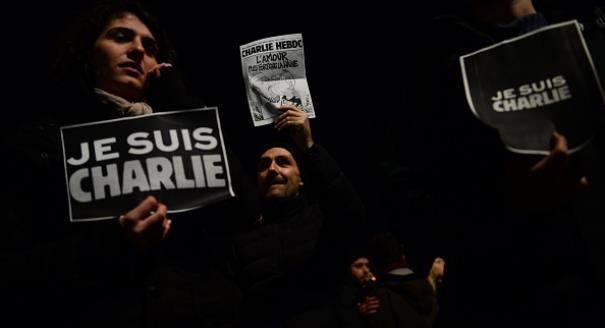
During the night of January 7, tens of thousands of French citizens took to the streets in several cities to pay homage to the twelve people who were gunned down earlier that day in Paris.
Most of the victims, who included four leading cartoonists, worked for the French satirical magazine Charlie Hebdo. The left-wing publication had been at the forefront in publishing cartoons. It spared no religion or creed.
Charlie Hebdo’s offices had already been attacked in 2011. The magazine’s provocative depiction of the prophet Muhammad enraged those who believed that the press had no right to publish such images. The latest shooting should encourage European governments to protect press freedom and other civil liberties, not restrict them.
In the aftermath of the Charlie Hebdo attack, the worry now is that the leaders of these anti-Islam and populist movements will use the murders of the cartoonists to justify their propaganda. Marine Le Pen, the leader of France’s National Front party, has called for a referendum on reintroducing the death penalty.
The danger too is that Muslims, whether European citizens or not, will become the target of such Islamophobia. Alexander Gauland, the vice chairman of Germany’s populist, right-wing, Euroskeptic Alternative for Germany party, said the attacks on Charlie Hebdo justified the anti-Islam protests. “All of those people who have ignored or derided people’s concerns of the imminent danger posed by Islamism have been proved wrong by this bloody deed,” he said.
Some government leaders, but not nearly enough, have already spoken out loudly against attempts to incite hatred and racism.
Angela Merkel, the German chancellor, has not hidden her disgust for such populism and nasty rhetoric. She has taken a tough stand against Pegida. And as soon as she heard about the attack on Charlie Hebdo, she made no bones about the need for Europe to further defend, not weaken, its values. Those values, she said, are universal. No doubt, authoritarian regimes and the Islamic State would—and indeed do—challenge that assumption.
Freedom of the press is inextricably tied to universal values.Tweet This
Freedom of the press is inextricably tied to universal values and is not an exclusively Western liberty. To curb that freedom now, and for anti-Islam movements at the same time to use the attacks on Charlie Hebdo to incite hatred against Muslims, would undermine the civil liberties and tolerance espoused by the West.
Such steps would also undermine the efforts of advocates of human rights in nondemocratic countries or in states where such rights are under increasing threat, such as Turkey and Russia. Yet however much authoritarian regimes or fundamentalists believe that the West’s values are poison, European governments must resist the temptation that they themselves poison those values.
The reaction by any government after such an attack as happened in Paris is to increase security. French President François Hollande has put his country on attack alert. His duty, as he said soon after the murders, was to protect the people of France. Any leader would say that. And any country’s citizens would expect that, too. But the line between protecting citizens and protecting civil liberties is very fine.
As it is, civil liberties movements, particularly in the UK and the United States, are increasingly critical of the way in which their governments’ antiterrorism measures impinge more and more on individual freedoms. The decision by Britain and the United States to suspend habeas corpus—thus preventing a detained person from being brought before the courts to examine that detention—was a serious blow to civil liberties.
That is just the tip of the iceberg. U.S. Senator Dianne Feinstein’s devastating report on CIA detentions and torture has greatly damaged America’s standing as a country passionate about defending human rights and civil liberties.
Those at #CharlieHebdo paid a high price for not poisoning freedom of speech.Tweet This
France’s and Europe’s reaction to the attack on Charlie Hebdo will be watched closely by those struggling for freedom across North Africa and the Middle East. Freedom House, a nongovernmental organization that monitors press freedom around the world, in 2013 reported an increase in the repression of the media. More recently, restrictions on the press in Turkey—not to mention the rise of the Islamic State—has imposed further pressure on the media, particularly on cartoonists.
And since cartoons are one of the few ways of describing so much with a minimum of words, their artists have become easy prey for those who fear that kind of freedom of expression. Those at Charlie Hebdo paid a high price for not poisoning that freedom.

Nonresident Senior Fellow, Carnegie Europe
Judy Dempsey is a nonresident senior fellow at Carnegie Europe
Recent Work
Judy Dempsey
Judy Dempsey
Carnegie does not take institutional positions on public policy issues; the views represented herein are those of the author(s) and do not necessarily reflect the views of Carnegie, its staff, or its trustees.

The EU can impose sanctions but struggles to enforce them without the United States. With Washington increasingly disinterested in backing European interests, the bloc must now fend for itself.


Nicu Popescu, Tiago Antunes

Russia is testing the waters of NATO’s mutual defense clause. What do strikes in Romanian territorial waters mean for the alliance’s posture toward Moscow?

Dimitar Bechev

With its public finances in shambles, the far right polling at 35 percent ahead of the 2027 presidential election, and a growing protest movement, is France’s crisis a threat to the EU’s geopolitical awakening?

Rym Momtaz, ed.

Ahead of a tough winter for Ukraine, Donald Trump’s swing back toward Russia bodes ill. But instead of panicking, Kyiv’s European allies are focusing on action.
Rym Momtaz

While the EU and European governments are embracing the much-lauded middle-power moment, this entails three difficult conundrums.

Richard Youngs