

Commentary
Judy Dempsey
{
  "authors": [
    "Judy Dempsey"
  ],
  "type": "commentary",
  "blog": "Strategic Europe",
  "centerAffiliationAll": "",
  "centers": [
    "Carnegie Endowment for International Peace",
    "Carnegie Europe"
  ],
  "collections": [
    "Europe’s Eastern Neighborhood"
  ],
  "englishNewsletterAll": "",
  "nonEnglishNewsletterAll": "",
  "primaryCenter": "Carnegie Europe",
  "programAffiliation": "",
  "programs": [],
  "projects": [],
  "regions": [
    "Russia",
    "Europe",
    "Eastern Europe",
    "Ukraine",
    "Western Europe"
  ],
  "topics": [
    "EU",
    "Security",
    "Foreign Policy"
  ]
}
Source: Getty
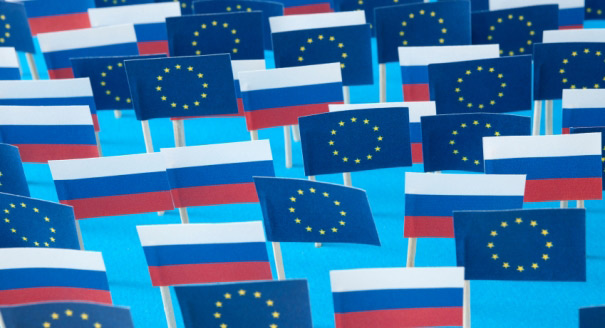
Angela Merkel and the European Parliament are holding firm over maintaining the sanctions the EU imposed on Russia. But where does Federica Mogherini stand?
Elmar Brok is a veteran German Christian Democrat politician and a long-standing member of the European Parliament. As chairman of the parliament’s foreign affairs committee, Brok’s role has become more important as the European Parliament has gained more powers.
So when, on January 15, European parliamentarians passed a tough resolution on Russia—insisting that sanctions imposed on Moscow after its intervention in eastern Ukraine should remain, and even be broadened—Brok said the parliament had no choice.
“We see nothing so far in Russia that would convince us to lift sanctions,” he told Carnegie Europe. “The European Parliament has made it clear that without any progress in implementing the Minsk agreement, [the parliament] will not consider lifting sanctions,” he added. So far, all the member states have supported the sanctions—but this unity is not a given.
According to Brok, with a few exceptions in other foreign policy areas, Russia has been uncooperative, to say the least. “Russia is not a constructive partner,” he said.
Compared with the European Parliament’s view on Russia, the European External Action Service’s policy seems to be shifting.
Federica Mogherini, the EU’s foreign policy chief, believes it is time to consider “how the EU might wish to engage with Russia in the short- to medium-term,” according to a new “Issues Paper on relations with Russia.” EU foreign ministers will discuss this “food for thought” document when they meet on January 19. “Such a process would need to be selective and gradual, and commensurate with the degree to which Russia responds positively,” according to the paper.
The timing of this paper is important. The EU’s first batch of sanctions on Russia comes up for renewal this coming March. In the meantime, Mogherini is seeking some “basis for trade-offs and could imply a give-and-take approach within or between sectors.”
But Brok and, more importantly, German Chancellor Angela Merkel are not convinced that this is the time to ease sanctions. And because Merkel’s attitude toward Russia in general and the sanctions in particular is crucial for influencing EU policy, Mogherini’s room for maneuver on this issue could be limited.
@FedericaMog and #Merkel see #Russia from two completely different stances.Tweet This
If anything, the EU foreign policy chief’s paper reveals that Mogherini and Merkel see Russia from two completely different stances.
Mogherini’s approach is based primarily on interests. “There are significant interests on both sides, which may be conflicting,” according to the paper. The implication is that there could be a chance to reconcile those interests. Selective and gradual cooperation could focus on “foreign policy, trade and sectorial cooperation,” the paper states. Mogherini also argues that the EU needs Russia to tackle “major regional challenges and in promoting the EU’s interests including human rights.”
Merkel holds a different view. Ever since Russia annexed the Crimean peninsula in March 2014 and invaded parts of eastern Ukraine, she has been uncompromising in her views about sanctions against Russian President Vladimir Putin. For Merkel, it is a question of defending values.
In an interview with the Frankfurter Allgemeine Zeitung newspaper, the chancellor called the annexation of Crimea and the events in eastern Ukraine a blatant violation of international law and of “our common values.”
As for considering easing the sanctions, Merkel was unequivocal. “In spring we will discuss the question of how to deal with the sanctions that we decided to impose after Russia’s annexation of Crimea,” she said. “Given the current situation, they will remain in place.”
For Merkel, sanctions against #Russia are a question of defending values.Tweet This
And any chance that Putin would be invited to the next summit of G7 leaders, which Merkel will be hosting, is out of the question. “The G7 and former G8 group has always viewed itself as a community of values,” Merkel added.
What, then, is the way forward with Russia?
It’s hard to see the Minsk Protocol being implemented, even though this is the only piece of paper the EU, Ukraine, and Russia latch on to.
The so-called Normandy format, which consists of French, German, Russian, and Ukrainian leaders meeting to address the Ukraine crisis, has gone nowhere. On January 15, with Putin unwilling to implement the Minsk accord, Merkel saw no reason to travel to Kazakhstan as scheduled to discuss Ukraine with her French, Russian, and Ukrainian counterparts.
Brok acknowledges that none of the negotiating formats has succeeded. “Yet we should continue to use any of them that will generate a dialogue. Clearly, there is going to be no quick breakthrough. But what we can’t do is to give the wrong signals to Putin about the sanctions,” he added.
For the moment, the sanctions are the EU’s only leverage.

Nonresident Senior Fellow, Carnegie Europe
Judy Dempsey is a nonresident senior fellow at Carnegie Europe
Recent Work
Judy Dempsey
Judy Dempsey
Carnegie does not take institutional positions on public policy issues; the views represented herein are those of the author(s) and do not necessarily reflect the views of Carnegie, its staff, or its trustees.

Before the next wave of EU enlargement takes place, the union needs to grapple with thorny questions of how power is distributed among its members.


Emil Sondaj Hansen, Ditte Brasso Sørensen

A summer of escalation in the Black Sea has hurt Ukraine economically and is exacerbating world food security. A truce is needed—as is a broader reframing of Europe’s Ukraine strategy.

Thomas de Waal

Are Germany’s economic, industrial, and political struggles becoming a liability for the EU’s ability to rise to the geopolitical moment?

Rym Momtaz, ed.

European Commission President Ursula von der Leyen is about to give her annual address on the state of the EU. Here’s what she won’t—but should—say.
Rym Momtaz

The aftermath of the Ceuta crisis shows Europe has drawn the wrong lessons. Rather than doubling down on failed migration policies, the EU needs to address the underlying roots of such episodes.

Richard Youngs