

Commentary
Judy Dempsey
{
  "authors": [
    "Judy Dempsey"
  ],
  "type": "commentary",
  "blog": "Strategic Europe",
  "centerAffiliationAll": "",
  "centers": [
    "Carnegie Endowment for International Peace",
    "Carnegie Europe"
  ],
  "collections": [
    "EU Integration and Enlargement"
  ],
  "englishNewsletterAll": "",
  "nonEnglishNewsletterAll": "",
  "primaryCenter": "Carnegie Europe",
  "programAffiliation": "",
  "programs": [],
  "projects": [],
  "regions": [
    "Europe",
    "Western Europe"
  ],
  "topics": [
    "EU",
    "Migration"
  ]
}
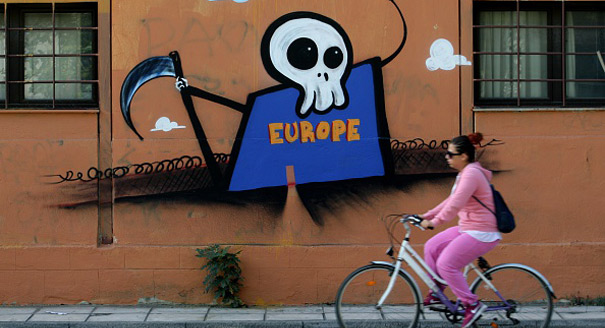
Source: Getty
Building walls to keep out refugees will destroy a European Union that is unable to agree on a common policy for this crisis.
First it was Hungary. Now Slovenia and Austria are thinking about doing the same: building fences to control the flow of refugees entering their countries. But if some EU states believe that putting up walls will make Europe’s refugee problem disappear, or that they can shut themselves off from the crisis, they are making a big mistake.
Erecting walls will put even more pressure on the Western Balkan countries that are already struggling with tens of thousands of refugees trekking across this part of Europe. And it will lead to a fortress Europe—precisely what the Eastern members of the EU didn’t want the union to become vis-à-vis their own Eastern neighbors once they joined the EU in 2004. The new member states didn’t want their neighbors isolated from Europe.
The hard reality facing European leaders and their publics is inescapable. Europe is facing the largest movement of people since World War II. It is also facing one of its biggest social and cultural challenges, which all EU countries will eventually have to accept. Failing that, as German Chancellor Angela Merkel recently said, the EU could be destroyed.
But Merkel’s success in keeping the EU together over the sanctions imposed on Russia in 2014 and in keeping the eurozone together during Greece’s financial crisis has not been replicated in the case of the refugees. It’s as if a Germany that showed leadership during both of these previous challenges to the EU is now expected to assume leadership in the refugee crisis—but this time without the rest of the EU in tow.
As it is, Germany has been remarkable in the way it has kept its doors open to refugees, despite growing opposition to this policy from Merkel’s own conservative bloc. Sweden, Austria, and Greece (as if Athens did not have problems of its own) have also been magnanimous in accepting refugees.
But as this handful of countries is discovering, solidarity—a word so many EU countries invoke when they want EU support—is absent. Up against resistance from many member states, the EU has been unable to deliver on a problem that affects all EU countries, whether or not they build walls to insulate themselves from refugees.
Why is this so? European leaders can always blame populist movements for their reluctance to accept refugees. And certainly, populist parties and politicians who simply don’t want foreigners settling in their cities, towns, and villages are gaining ground.
EU states that believe they can shut themselves off from the #refugeecrisis are making a mistake.Tweet This
In Germany, there is hardly a day without some attack on shelters for refugees or some despicable hate e-mails sent to politicians and local government officials who try to mobilize as much support as possible for the refugees.
But at the same time, there is hardly a day without another citizens’ movement springing into action in some way or other. A lawyer I know has organized his law practice to give German lessons to a group of Syrian and Eritrean refugees. “We contacted the local municipality that takes care of the refugees, bought a simple teaching manual, and now give classes at least once a week,” he told me. It’s all done on a voluntary and free basis.
These kinds of spontaneous actions humanize the refugee problem. Perhaps this is the key to trying to understand why Europe has been so unprepared and so unwilling to pull together in dealing with the crisis. The refugees are seen as foreign, meaning not European—not that the word “European” can be clearly defined.
Jarosław Kaczyński, the nationalist, conservative leader of Poland’s Law and Justice party, which won the country’s parliamentary election on October 25, has heaped racist scorn on the refugees. He is not alone. Viktor Orbán, the prime minister of Hungary, who built a wall along the Hungarian-Serbian border to keep out refugees, said the migrants would undermine what Europe stood for: its Christian values.
Cultural walls exist even where there are no physical barriers. Leading Slovak and Czech officials harbor the same fears and suspicions about having Muslims living in their countries—as do anti-immigration parties in the Netherlands, France, and other EU countries.
In short, because the refugees are predominantly Muslim and come from nondemocratic countries, their backgrounds have become confused with a kind of Islamophobia. This fuels support for populists but also frightens many people who fear the impact of immigration on the fabric of their societies. It’s as if they don’t have self-confidence in their own societies.
#Merkel has put a huge emphasis on integrating #refugees quickly.Tweet This
That is why Merkel has put a huge emphasis on integrating the refugees as quickly as possible, not only by teaching them German, getting the children into school, or establishing job-training schemes, but also by spreading the culture and values of democracy in a secular society.
It is a mammoth challenge that Merkel has made one of the main pillars of her refugee policy. It is a challenge she keeps repeating to the German public because she and her advisers know the high price to pay if integration, which is such a long-term process, fails.
With no end in sight to the refugees fleeing the war in Syria, one wonders how the EU and European governments would respond if the 1.4 million Ukrainians who have been internally displaced by the war and destruction in parts of eastern Ukraine sought refuge in the EU.

Nonresident Senior Fellow, Carnegie Europe
Judy Dempsey is a nonresident senior fellow at Carnegie Europe
Recent Work
Judy Dempsey
Judy Dempsey
Carnegie does not take institutional positions on public policy issues; the views represented herein are those of the author(s) and do not necessarily reflect the views of Carnegie, its staff, or its trustees.

Are Germany’s economic, industrial, and political struggles becoming a liability for the EU’s ability to rise to the geopolitical moment?

Rym Momtaz, ed.

European Commission President Ursula von der Leyen is about to give her annual address on the state of the EU. Here’s what she won’t—but should—say.
Rym Momtaz

The aftermath of the Ceuta crisis shows Europe has drawn the wrong lessons. Rather than doubling down on failed migration policies, the EU needs to address the underlying roots of such episodes.

Richard Youngs

An overwhelming victory by a far-right-wing party in a small state in eastern Germany will have major repercussions for Chancellor Friedrich Merz’s coalition.
Judy Dempsey

Canadian Prime Minister Mark Carney has twice inspired praise for standing up to U.S. President Donald Trump: at the 2026 World Economic Forum in Davos and on Canada-U.S. trade negotiations. Is Carney showing a third way better than the EU has in dealing with the Trump administration?
Rym Momtaz, ed.