

Commentary
Judy Dempsey
{
  "authors": [
    "Judy Dempsey"
  ],
  "type": "commentary",
  "blog": "Strategic Europe",
  "centerAffiliationAll": "",
  "centers": [
    "Carnegie Endowment for International Peace",
    "Carnegie Europe"
  ],
  "collections": [
    "EU Integration and Enlargement"
  ],
  "englishNewsletterAll": "",
  "nonEnglishNewsletterAll": "",
  "primaryCenter": "Carnegie Europe",
  "programAffiliation": "",
  "programs": [],
  "projects": [],
  "regions": [
    "Europe",
    "Western Europe",
    "Germany"
  ],
  "topics": [
    "EU",
    "Migration"
  ]
}
Source: Getty
The refugee crisis is changing the German chancellor and could change Europe, for better or worse.
Throwing caution to the wind, on October 7 Angela Merkel took on her critics in Europe and in Germany by defending her open-door policy toward refugees fleeing the war in Syria and other Middle Eastern countries.
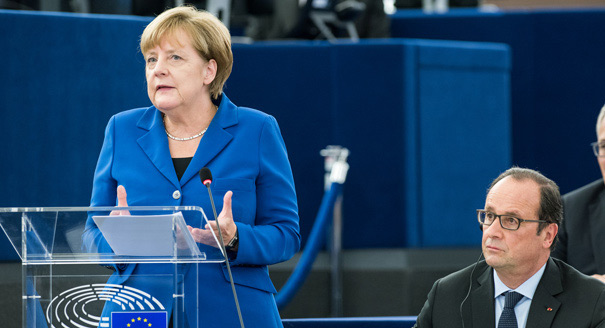
Speaking to the European Parliament with French President François Hollande and later to the German public broadcaster ARD, Merkel stood her ground over why Europe has to work together in providing security to the tens of thousands seeking safety on the continent.
During the hour-long television interview—rare for Merkel, who typically shuns such a medium—the chancellor used every minute to defend her policies. Repeating what is now her slogan in dealing with the refugees, “we can do it,” she said that there is no way that an EU country can simply put up a fence to keep refugees out.
The problem is you can’t shut the borders,” she said. “Then we’d need to need a 3,000 kilometer fence and we’ve seen in Hungary what happens when you build a fence. People find other ways,” she added.
Merkel’s robust defense of her refugee policy coincides with growing opposition to her stance from within her own conservative bloc. Thirty-four members of Merkel’s Christian Democratic Union wrote to her on October 7 criticizing Germany’s “open borders policy” and the fact that it does not reflect the party’s program.
Merkel’s popularity is slipping and her interior minister, Thomas de Maiziere, has been criticized for giving too little leadership. In a bid to speed up differentiating between an asylum seeker, a refugee, and a migrant, Merkel has put her trusted chief of staff, Peter Altmaier to oversee the entire crisis.
It is a crisis in the making. Volunteer groups in Germany speak of overcrowding, long delays registering refugees, and clashes at refugee centers.
Yet for all that, Merkel remains undeterred. Indeed, she remains determined to see through what she says is Germany’s biggest challenge since reunification.
This is something new for a politician who, since becoming chancellor nearly ten years ago, has made risk and caution the hallmarks of her leadership style.
Not anymore.
Merkel knows this refugee crisis could make or break her leadership. And it could tear Europe apart, judging from the harsh words she heard in the European Parliament from Nigel Farage, leader of Britain’s nationalist and anti-EU UKIP party and Marine Le Pen, leader of France’s National Front.
At the European Parliament in Strasbourg, Merkel spared no criticism of populists who are fueling anti-immigrant sentiments in many EU countries. “We need to see the migrants as people, not as an anonymous mass, irrespective of the fact if they have a right to stay or not,” she told parliamentarians.
Yet populist leaders didn’t refrain from meting out criticism—if not scorn—for Merkel’s policies and for Hollande’s support for the chancellor.
Farage lambasted Germany’s power and France’s weakness. “France is now diminished, trapped inside a [euro] currency,” he said. German reunification, whose twenty-fifth anniversary provided the occasion for Merkel and Hollande to jointly address the European Parliament, also came under attack. “It is an irony that a project designed to contain German power has now given us a totally German dominated Europe,” Farage said.
Le Pen, who is rising steadily in the opinion polls and building up a formidable grassroots network in preparation for France’s presidential elections in 2017, mocked Hollande. Instead of addressing him as “Mr. President,” she called him “Mr. Vice-Chancellor of France Province,” accusing him of submitting to policies decided in Berlin.
Merkel and Hollande shrugged off such criticisms.
If anything, a combination of circumstances—the refugee crisis, opposition from Europe’s populist movements and dissent from within her own conservative bloc—is forcing Merkel to change her policy toward Europe.
Until recently, she was a politician who had been more at home with the intergovernmental process that is based on the member states than the community one that is based on the European Commission. She may no longer be convinced of that approach.
“We must now resist the temptation to fall back into national government action,” Merkel told EU parliamentarians. “We must act together. It is precisely now that we need more Europe. Germany and France stand ready,” she added.
Hollande went further. “We need not less Europe but more Europe, otherwise we will see the end of Europe,” he said. “Faced with these challenges, I am convinced that if we do not move ahead with integration, we shall stop or slip back.”
But is there political will in other EU capitals for more Europe?
It was the strong member states that decapitated the EU’s common foreign and security policy. It was a weak Europe that refused to understand the consequences of its policies in the Middle East before and after the Arab Spring. It was a weak Europe that spent several years napping over the refugee crisis as Turkey, Lebanon, and Jordan carried the burden.
Belatedly, Berlin is waking up to this.
The logic of this awakening is for Berlin, supported by France and other eurozone countries, to take the lead in pushing for a more integrated Europe. The alternative is too dreadful to contemplate.

Nonresident Senior Fellow, Carnegie Europe
Dempsey is a nonresident senior fellow at Carnegie Europe
Recent Work
Judy Dempsey
Judy Dempsey
Carnegie does not take institutional positions on public policy issues; the views represented herein are those of the author(s) and do not necessarily reflect the views of Carnegie, its staff, or its trustees.
France and Germany’s failure to agree on the Future Combat Air System (FCAS) raises questions about European defense. Amid industrial rivalries and competing strategic cultures, what does the future of European military industrial projects look like?

Rym Momtaz, ed.
France has stopped clinging to notions of being a great power and is embracing the middle power moment. But Emmanuel Macron has his work cut out if he is to secure his country’s global standing before his term in office ends.
Rym Momtaz
Integrating AI into the workplace will increase job insecurity, fundamentally reshaping labor markets. To anticipate and manage this transition, the EU must build public trust, provide training infrastructures, and establish social protections.
Amanda Coakley
Europe’s interests in Syria extend beyond migration management, yet the EU trails behind other players in the country’s post-Assad reconstruction. To boost its influence in Damascus, the union must upgrade its commitment to ensuring regional stability.
Bianka Speidl, Hanga Horváth-Sántha
EU member states clash over how to boost the union’s competitiveness: Some want to favor European industries in public procurement, while others worry this could deter foreign investment. So, can the EU simultaneously attract global capital and reduce dependencies?
Rym Momtaz, ed.