

Commentary
Judy Dempsey
{
  "authors": [
    "Judy Dempsey"
  ],
  "type": "commentary",
  "blog": "Strategic Europe",
  "centerAffiliationAll": "",
  "centers": [
    "Carnegie Endowment for International Peace",
    "Carnegie Europe"
  ],
  "collections": [
    "Brexit and UK Politics"
  ],
  "englishNewsletterAll": "",
  "nonEnglishNewsletterAll": "",
  "primaryCenter": "Carnegie Europe",
  "programAffiliation": "",
  "programs": [],
  "projects": [],
  "regions": [
    "Europe",
    "Western Europe",
    "United Kingdom"
  ],
  "topics": [
    "Foreign Policy",
    "EU"
  ]
}
Source: Getty
A British “no” to remaining in the EU would spell ruin for a bloc so adrift and divided that its influence is rapidly diminishing.
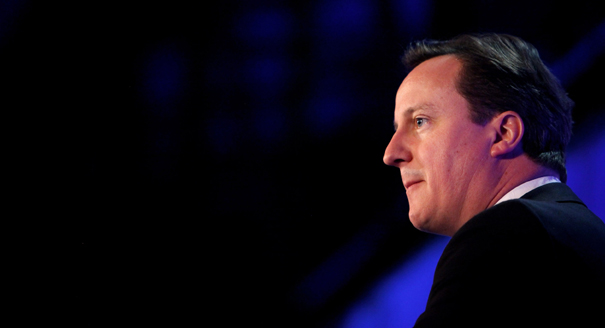
Of all EU leaders, it is David Cameron, the British prime minister, not Angela Merkel, the German chancellor, who holds the key to Europe’s future.
Merkel has been adept at keeping the eurozone intact and the EU united over the sanctions imposed on Russia for its meddling in eastern Ukraine. But she is now under immense pressure from her own conservative bloc over her open-door policy toward the refugees fleeing the war-torn Middle East.
This pressure has been fueled by the sexual assaults on over 100 women during the New Year’s Eve celebrations in Cologne, allegedly by migrants from North Africa and some Arab countries. Sensing the growing public concern about how to integrate the more than 1 million refugees who have arrived in Germany over the past twelve months, Merkel canceled her trip to the January 20–23 World Economic Forum in Davos.
However much Merkel has led Europe through the euro crisis and the Ukraine crisis—both far from over—there is one area in which she has not led: the debate about Europe’s future. For the leader of Europe’s biggest economy, with record low levels of unemployment, this may seem surprising. Given Germany’s unpopularity among, for example, the Greeks because of Berlin’s insistence that Athens implement very harsh austerity measures in return for financial support, maybe it was wise that Merkel never did explain how she saw Europe’s future direction.
Instead, it has been Cameron who has been the most forthright about what he wants Europe to become. He intends to hold a referendum in the coming months on whether Britain will remain in the EU. That’s assuming he will get some of the things he wants from the other 27 EU leaders when they meet in February in Brussels.
“My policy is to hold a renegotiation and a referendum . . . and abide by what the British public say,” he told the BBC on January 10. Asked whether he was suggesting the referendum could be held this summer, Cameron said, “That is what I would like to see, is a deal in February, then a referendum that would follow.” The vote would take place “later” if no agreement were reached, he said.
Cameron’s shopping list to his EU counterparts is straightforward. First, the euro should not be the only official currency of the EU, and non-eurozone countries should not be at a disadvantage. Second, the EU needs a big dose of competitiveness. That should entail the reduction of excessive regulation and extending the single market.
Third, EU migrants would be allowed claim certain benefits only after residing in the UK for four years—although it is hard to see any other member state agreeing to that. And finally, Britain should be allowed to opt out from further political integration while national parliaments should have greater powers to block EU proposals.
No wonder Cameron was applauded when he attended the annual New Year’s gathering of the Christian Social Union (CSU), the Bavarian-based sister party of Merkel’s Christian Democratic Union. The conservative CSU can easily identify with most of Cameron’s demands.
Cameron’s recipe for the EU’s future has one major shortfall—and he shares that shortfall with Merkel. He has said very, very little about Europe’s security, defense, and foreign policies. And as a corollary to this deficit, he has said little about the future of the transatlantic relationship.
As U.S. interest in Europe weakens by the year, it is all the more urgent for the EU to have a strategy that will strengthen its foreign, security, and defense policies. But it doesn’t have one. Input from Britain—and, for that matter, Germany—into a long-overdue update of the European Security Strategy after it was published in 2003 has been minimal.
The EU needs a new strategy. Not just because of the waning of the transatlantic relationship but also because the EU lacks a compass as member states, particularly Poland, pursue their own national agendas at the expense of Europe.
A Britain that remains inside the EU might be able to change the bloc’s dynamics. Until now, Cameron has shied away from talking about the future of EU defense and foreign policy because that debate always gets back to national sovereignty, even though member states can hardly go it alone anymore when dealing with the huge threats they all face.
If Britain does vote to remain in the EU, then Cameron has no choice but to pursue his goal to make Europe more competitive. A competitive Europe is incomplete without a strong foreign, defense, and security policy strategy.

Nonresident Senior Fellow, Carnegie Europe
Judy Dempsey is a nonresident senior fellow at Carnegie Europe
Recent Work
Judy Dempsey
Judy Dempsey
Carnegie does not take institutional positions on public policy issues; the views represented herein are those of the author(s) and do not necessarily reflect the views of Carnegie, its staff, or its trustees.

Are Germany’s economic, industrial, and political struggles becoming a liability for the EU’s ability to rise to the geopolitical moment?

Rym Momtaz, ed.

European Commission President Ursula von der Leyen is about to give her annual address on the state of the EU. Here’s what she won’t—but should—say.
Rym Momtaz

The aftermath of the Ceuta crisis shows Europe has drawn the wrong lessons. Rather than doubling down on failed migration policies, the EU needs to address the underlying roots of such episodes.

Richard Youngs

An overwhelming victory by a far-right-wing party in a small state in eastern Germany will have major repercussions for Chancellor Friedrich Merz’s coalition.
Judy Dempsey

Canadian Prime Minister Mark Carney has twice inspired praise for standing up to U.S. President Donald Trump: at the 2026 World Economic Forum in Davos and on Canada-U.S. trade negotiations. Is Carney showing a third way better than the EU has in dealing with the Trump administration?
Rym Momtaz, ed.