

Commentary
Nathalie Tocci, Jan Techau
{
  "authors": [
    "Jan Techau"
  ],
  "type": "commentary",
  "blog": "Strategic Europe",
  "centerAffiliationAll": "",
  "centers": [
    "Carnegie Endowment for International Peace",
    "Carnegie Europe"
  ],
  "collections": [
    "EU Integration and Enlargement"
  ],
  "englishNewsletterAll": "",
  "nonEnglishNewsletterAll": "",
  "primaryCenter": "Carnegie Europe",
  "programAffiliation": "",
  "programs": [],
  "projects": [],
  "regions": [
    "Europe",
    "Western Europe"
  ],
  "topics": [
    "EU",
    "Foreign Policy"
  ]
}
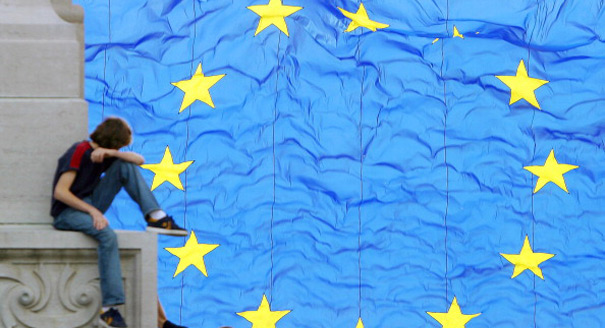
Source: Getty
The European Union of tomorrow will be defined by more integrated foreign policy, the end of the euro, a more complete single market, and more realpolitik.
At the end of all this madness, what is the EU going to look like? This is a question heard a lot these days, in one form or another. Most observers sense that these are extraordinary times for Europe, and that political realities might look very different rather soon. And while it is impossible to predict how the greatest political project in history will transform under existential pressures from both within and outside, all of these pressures point in a certain direction when it comes to Europe’s future.
Let’s start by saying that there will never be an end to all this madness. Human affairs never reach an end point, some sort of magic equilibrium of all driving forces at which those affairs can be frozen and preserved. In European integration parlance, this means that there is no such thing as finalité politique, that old canard. The EU serves a purpose, and its workings and its setup will be adapted as this purpose changes. Again and again. So instead of looking at some imaginary final outcome that will be outdated the moment it is reached, let’s look at the forces that shape the union.
What makes this moment different from earlier existential crises is that the direction of integration is more diffuse now than in the past. Some needs point toward more integration, but others perhaps point toward less. I am convinced that in the long term, the net result will be more integration. But it will not be wholesale “ever closer union,” the aim enshrined in the EU’s treaties. It will be something a little more diffuse.
The biggest overwhelming need is that Europeans will have to react to the harsh winds of political globalization in the future. Political globalization is more than just the economic globalization that has been talked about endlessly in the last decade. It is a quest for political order on a planet that has outgrown its merely regional structure. It will drag the Europeans out of their cozy, U.S.-subsidized corner of comfort, in which liberal order, pluralism, political stability, and the absence of major conflict were somehow taken for granted.
Europeans have a lot to lose in political globalization, because their lifestyles are so hard to maintain and defend. Others want to partake in it because they crave it. Yet others want to destroy it because they hate it. And fundamentally, it relies on a global order that the Europeans are unable to guarantee.
All of this creates a need for a vessel that allows Europeans to compete in political globalization and contribute to global order. In political globalization, even big European countries such as Germany, Britain, and France are mere footnotes. Together, they might have the chance to make a difference. The EU will have to be that vessel, or it will crack.
So my first prediction is that in the medium to long term, there will be more integration of European foreign policy, and even of security and defense. Not before enormous pain, and much national resistance. But if Europeans are not suicidal, and I don’t think they are (though I might be wrong here, given Europe’s poor track record on collective suicide), then this will come. Hopefully, sooner than later.
My second prediction is that the euro will not be part of a future EU. The common currency is a need that does not exist. I am not saying that the euro was a bad idea. I actually believe it was a very good idea, and I hope Europeans will manage to keep it alive by creating the political union needed to do so.
But strictly speaking, there is no compelling need for the euro. Political and economic globalization can be weathered without one. Contrary to what former German chancellor Helmut Kohl and former French president François Mitterrand thought when they paved the way for monetary union, a currency is not needed to forge deeper integration. Much bigger powers are at work. If they are not sufficient to bring Europeans closer together, the common currency will certainly not do the trick.
Third, I foresee, after heavy pains, a more complete single market, and also a common EU approach to migration—though not to the integration of migrants, which will remain primarily a national matter. There is a huge need for more closely integrated markets in Europe. The high level of economic integration is what has given Europe its strength in economic globalization, and this integration will play a huge part in Europe’s survival in the age of political globalization.
Naturally, this will be about more than coal and steel, bananas, or cassis de Dijon—the subjects of key chapters in the EU’s development toward a single market. Closer integration will have to include services but also the huge market for training and skills. It will comprise an energy union, just as it will have to comprise a proper “market” for people. This market will include not just the now-endangered EU principle of free movement in the EU. It will also include its flip side, a properly regulated shared “market” for immigrants. What seems impossible today will have to come, no matter how much nationalist sentiments stand against it.
Finally, the EU will be a lot more realpolitik-driven. This is where I predict I will be hammered by almost everyone. Realpolitik here means that the EU will be a union less of values and more of transactional politics. It will be less idealistic and more functional. I am not saying that this will be a good thing. I am not advocating this! I wish it were different, and that Europeans could integrate at the highest possible level of shared morals and values. But this is unlikely to happen.
Europeans will find out that ironically, by toning down their values rhetoric among themselves and by accepting a larger variety of approaches within their integrated club, they will be more effective at preserving the core of their values in the age of political globalization. So I predict a Europe in which values will be handled closer to the lowest common denominator than to the great ideals that Europe wants to stand for. This will be a source of never-ending tension, but it will prove less costly than becoming divided over maximalist morals only to lose out in the harsh world of political globalization.
Taken together, this will be a very different Europe indeed. The peoples of Europe will no longer integrate because they feel love for the idea of an integrated Europe—if ever they did. Integration will come only when the pain is really massive. And it is massive only in some policy fields, not in all.
There is no real hope for EU federalists in this vision, even though they will get some of what they want. Likewise, there is no reason for Euroskeptics to rejoice, as there will be much more integration than they deem desirable. But it might mean a Europe better equipped for our time. Until, of course, it changes all over again. As it must.
Director, Europe Team, Eurasia Group
Techau is director with Eurasia Group's Europe team, covering Germany and European security from Berlin. Previously, he was director of Carnegie Europe.
Recent Work

Nathalie Tocci, Jan Techau
Jan Techau
Carnegie does not take institutional positions on public policy issues; the views represented herein are those of the author(s) and do not necessarily reflect the views of Carnegie, its staff, or its trustees.

Russia is testing the waters of NATO’s mutual defense clause. What do strikes in Romanian territorial waters mean for the alliance’s posture toward Moscow?

Dimitar Bechev

With its public finances in shambles, the far right polling at 35 percent ahead of the 2027 presidential election, and a growing protest movement, is France’s crisis a threat to the EU’s geopolitical awakening?

Rym Momtaz, ed.

Ahead of a tough winter for Ukraine, Donald Trump’s swing back toward Russia bodes ill. But instead of panicking, Kyiv’s European allies are focusing on action.
Rym Momtaz

While the EU and European governments are embracing the much-lauded middle-power moment, this entails three difficult conundrums.

Richard Youngs

Much has been said of the changes Brussels is trying to make to the EU enlargement process. Here’s why gradual integration might—or might not—be the answer.
Dimitar Bechev