

Commentary
Judy Dempsey
{
  "authors": [
    "Judy Dempsey"
  ],
  "type": "commentary",
  "blog": "Strategic Europe",
  "centerAffiliationAll": "",
  "centers": [
    "Carnegie Endowment for International Peace",
    "Carnegie Europe"
  ],
  "collections": [],
  "englishNewsletterAll": "",
  "nonEnglishNewsletterAll": "",
  "primaryCenter": "Carnegie Europe",
  "programAffiliation": "",
  "programs": [],
  "projects": [],
  "regions": [
    "Europe",
    "Western Europe",
    "Germany"
  ],
  "topics": [
    "EU",
    "Migration"
  ]
}
Source: Getty
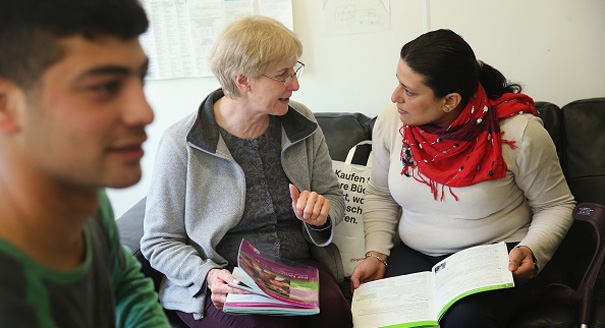
The German government is pinning its hopes on a new package of education and job creation measures to integrate the huge numbers of refugees now living in Germany.
Mohammad Alrefael longs for the day when he can return to Syria. Born in Damascus, the nineteen-year-old fled with his family to neighboring Lebanon. Having no idea how long the war in Syria would last, his parents got the money together and sent him and his younger brother to Germany. “They wanted a better life for us,” Alrefael explained in an interview.
Alrefael is one of 120 refugees housed in a school gym in Zehlendorf, a leafy district in southwest Berlin. Part of the main sports hall has been turned into a dormitory. On one side are bunk beds cordoned off with makeshift curtains to ensure some privacy. On the other side is a communal area where the men (only 5 percent of the refugees are women, and there are fifteen children) chat, eat, or work their iPhones. The potential for boredom is huge.
Unable to speak German and not allowed to work, the hundreds of thousands of refugees across Germany rely on the staff and volunteers who manage these refugee hostels to lay on programs such as German language classes and sports and cultural activities.
This limbo existence is now poised to end. At least, that is the hope, after German Chancellor Angela Merkel on May 25 unveiled an ambitious integration package, the first of its kind for Germany. If it works, the package will vindicate Merkel’s decision to throw open the country’s borders to over 1.1 million people fleeing the wars in Syria and Iraq. More importantly, given the anti-immigration mood in many EU countries, Merkel has to prove that it is possible to integrate so many people from different political and social backgrounds.
Under the terms of the draft law, learning German will be made compulsory. The bureaucratic red tape that has hindered those waiting for their asylum applications to be processed will be loosened so that they can find jobs.
After three months in the country, refugees will be able to apply for training courses. The government will extend the state-subsidized job system so that the refugees can enter the labor market. Training will not be given to those asylum seekers from so-called safe countries, some of whom have already been sent back home.
Permanent residence status will be extended from three to five years, provided the refugees have learned German and have the means to take care of themselves. And in a bid to prevent the establishment of ghettos, regional and local government councils will decide where the refugees should live. Those who have found permanent jobs will be exempt from that ruling.
Merkel described the set of measures as a “milestone.” Germany, she said, would be a country that made migrants “a good offer.” But she added that “we expect the people to take up that offer so that integration can work.”
Sigmar Gabriel, the German economy minister and leader of the center-left Social Democrats, recognized how far Germany had come in terms of dealing with the immensely complex issue of integration. The new legislation was a “real paradigm shift,” he said. “In a few years this law will be seen as a first step towards an immigration law.”
Merkel’s coalition government is clearly in a hurry to get the measures off the ground. Federal elections are due in late 2017. Until then, both her conservative Christian Democratic Union party and the Social Democrats, her coalition partners, have to find ways to win back voters who have been flocking to the anti-immigrant and Euroskeptic Alternative for Germany.
Merkel need not worry about the support she has from refugees such as Haya Alsebaai. The twenty-four-year-old Syrian, who arrived in Germany in 2014, said it was very tough in the beginning. “A new culture, a new language, a new way of life,” she said in an interview, speaking fluent German. “I can’t tell you how much the Germans have helped me. I feel at home here.”
Alsebaai, who is gaining work experience in the Zehlendorf refugee hostel before going on to study psychology, believes language is the key to integration. “Without that you can do almost nothing,” she added.
Outside, a group of children from Syria and Iraq were playing on the volleyball court. Almost all attended school. Almost all could speak basic German. Their integration has already begun.

Nonresident Senior Fellow, Carnegie Europe
Judy Dempsey is a nonresident senior fellow at Carnegie Europe
Recent Work
Judy Dempsey
Judy Dempsey
Carnegie does not take institutional positions on public policy issues; the views represented herein are those of the author(s) and do not necessarily reflect the views of Carnegie, its staff, or its trustees.
As we close out another season of Strategic Europe, it is worth taking stock of the deep shifts underway.

Rym Momtaz
The EU had to compromise to adopt a twenty-first sanctions package against Russia, exposing growing cracks in the union’s resolve. Is this latest, weaker round worth it to keep pressure on Moscow?
Rym Momtaz, ed.
Trump is distracted and Ukraine wants Europe to step up. The continent’s leaders must find their voice and assert it in talks with Russia.
Alissa de Carbonnel

Mounting economic strain and battlefield losses will not necessarily make the Kremlin less dangerous. They could instead push Moscow toward a more aggressive hybrid campaign designed to test NATO’s Eastern flank, exploit allied hesitation, and fracture European resolve.

Maksym Beznosiuk
Over the past ten years, NATO has held almost as many summits as it did during the entirety of the Cold War. Are they still useful, or is it time to stop holding annual meetings?
Rym Momtaz, ed.