

Commentary
Judy Dempsey
{
  "authors": [
    "Judy Dempsey"
  ],
  "type": "commentary",
  "blog": "Strategic Europe",
  "centerAffiliationAll": "",
  "centers": [
    "Carnegie Endowment for International Peace",
    "Carnegie Europe"
  ],
  "collections": [],
  "englishNewsletterAll": "",
  "nonEnglishNewsletterAll": "",
  "primaryCenter": "Carnegie Europe",
  "programAffiliation": "",
  "programs": [],
  "projects": [],
  "regions": [
    "Europe",
    "Western Europe",
    "Germany"
  ],
  "topics": [
    "EU",
    "Security",
    "Military"
  ]
}
Source: Getty
Germany’s defense ministry has published an ambitious and critical assessment of the country’s armed forces and their role in international security.
In early 2010, Horst Köhler visited German troops serving in Afghanistan. As German president at the time, he needed to explain to a very skeptical public back home why over 6,000 soldiers serving under a NATO flag had been posted in a faraway country rife with conflict and danger.
And that is exactly what he did. Köhler told German radio that his country could no longer avoid involvement in military missions. The reason, he explained, was that those missions helped “protect our interests, for example, free trade routes, or to prevent regional instability, which might certainly have a negative effect on our trade, jobs and income.”
The German media pounced on such remarks as if it didn’t want to accept that Germany had interests to defend and as if the president had put to rest a particular brand of German pacifism that had allowed the country to escape its responsibilities.
The outcry over Köhler’s remarks was so great that he was forced to resign. Neither German Chancellor Angela Merkel’s government, the opposition, nor the public rushed to his defense. They didn’t want to acknowledge that Köhler had dared speak out about the need to defend German interests, let alone define them.
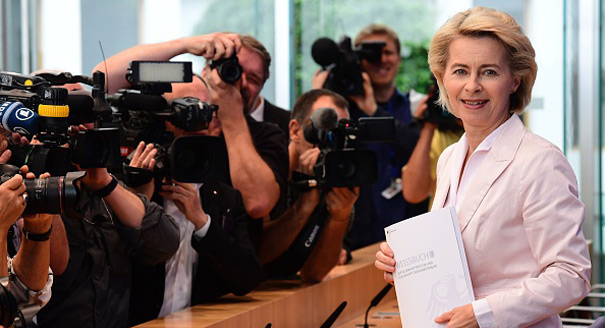
How things have changed. German interests are center stage in a new white book published on July 13 by the German defense minister, Ursula von der Leyen.
White books can be useless or useful. They can provide an opportunity to define a country’s strategic goal and interests, something that Germany’s last defense white book, published in 2006, failed to do. But then, Germany, Europe, and the international context were very different. There was no global financial meltdown, no eurozone crisis, no so-called Islamic State, no war in Syria, no refugee crisis, and no fear of terrorist suicide bomb attacks in Europe’s capitals. The new white book had no choice but to deal with these new, stark realities.
The document makes three main points. The first echoes Köhler’s remarks. “Germany is a globally highly connected country that has a responsibility to actively shape the global order.” It’s going to need the military and security tools to do just that.
Second, von der Leyen throws the white book’s weight (140 pages) behind NATO and rams home the importance of the transatlantic relationship. The Chancellery, which had a major say in the content of the white book, identifies with this. Indeed, Merkel’s tough speech she delivered in the Bundestag on July 7, the day before NATO began its summit in Warsaw, is a far cry from how the German foreign minister sees NATO. Frank-Walter Steinmeier completely ignored the alliance in a recent Foreign Affairs essay, preferring instead to pander to the pacifist wing of his increasingly beleaguered Social Democratic Party.
The third element is Germany’s changing perception of the European Union’s potential role as a serious security and defense actor. The EU’s miserable record in this regard is well-known. Berlin knows too that Europe desperately needs to take its security seriously—and soon.
As the white book states, “in view of geopolitical shifts and global demographic developments, the only way we can assert the security interests of the EU over the long term, and thus maintain the political weight of the countries of Europe, is by seeking a greater degree of commonality.” In short, “Germany is striving to achieve the long-term goal of a common European Security and Defence Union.”
The white book rattles off an impressive shopping list of what has to be done, such as integrating military and civilian capabilities and strengthening Europe’s defense industry. But these are not new tasks. They just have to be implemented. Let’s see if and how Germany can do this, without Britain.
Britain’s decision to leave the EU changes the entire dynamics of European security and defense. The EU is losing a country endowed with vast military experience. The EU is losing a country that strengthened the Atlanticist wing in the bloc. The big question that the white book doesn’t raise is whether Germany can begin to think about filling the vacuum left by Brexit and if indeed Germany can drive the EU toward thinking and acting seriously about its security and defense.

Nonresident Senior Fellow, Carnegie Europe
Judy Dempsey is a nonresident senior fellow at Carnegie Europe
Recent Work
Judy Dempsey
Judy Dempsey

The European Commissioner for Trade is headed to China. But after President Xi’s bridge-building visit to Washington, can a more isolated EU overcome Beijing’s stranglehold on critical raw materials? Who will blink first?

Rym Momtaz, ed.

The domestic impacts of how long it is taking to end the war in Ukraine have pushed the French electorate to the political extremes and compromised the country’s diplomatic capacity.
Rym Momtaz

Before the next wave of EU enlargement takes place, the union needs to grapple with thorny questions of how power is distributed among its members.


Emil Sondaj Hansen, Ditte Brasso Sørensen

A summer of escalation in the Black Sea has hurt Ukraine economically and is exacerbating world food security. A truce is needed—as is a broader reframing of Europe’s Ukraine strategy.

Thomas de Waal

Are Germany’s economic, industrial, and political struggles becoming a liability for the EU’s ability to rise to the geopolitical moment?
Rym Momtaz, ed.