

Commentary
The European Commissioner for Trade is headed to China. But after President Xi’s bridge-building visit to Washington, can a more isolated EU overcome Beijing’s stranglehold on critical raw materials? Who will blink first?
Rym Momtaz, ed.
{
  "authors": [
    "Alan Posener"
  ],
  "type": "commentary",
  "blog": "Strategic Europe",
  "centerAffiliationAll": "",
  "centers": [
    "Carnegie Endowment for International Peace",
    "Carnegie Europe"
  ],
  "collections": [
    "Europe’s Eastern Neighborhood",
    "Transatlantic Cooperation"
  ],
  "englishNewsletterAll": "",
  "nonEnglishNewsletterAll": "",
  "primaryCenter": "Carnegie Europe",
  "programAffiliation": "",
  "programs": [],
  "projects": [],
  "regions": [
    "Europe",
    "Eastern Europe"
  ],
  "topics": [
    "Security",
    "EU"
  ]
}
Source: Getty
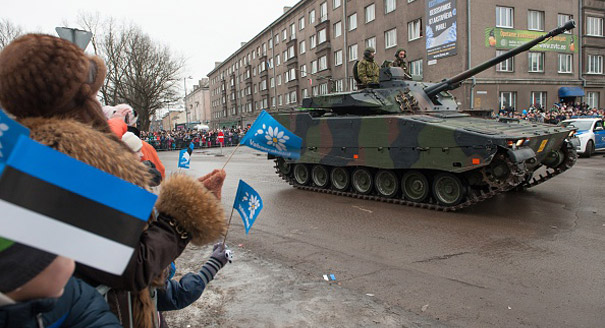
The Baltic states are enthusiastic members of NATO, the EU, the eurozone, and the Schengen passport-free travel area. They deserve the West’s unequivocal support.
So Donald Trump doesn’t want to protect the Baltic states against Russian President Vladimir Putin. Costs too much. This, basically, is what the Republican candidate for president of the United States said in an interview with the New York Times on July 21.
“Can the members of NATO, including the new members in the Baltics, count on the United States to come to their military aid if they were attacked by Russia? And count on us fulfilling our obligations?” asked the newspaper. Trump replied, “Have they fulfilled their obligations to us? If they fulfill their obligations to us, the answer is yes.”
And if not? Earlier in the interview, Trump said, “If we cannot be properly reimbursed for the tremendous cost of our military protecting other countries . . . I would be absolutely prepared to tell those countries, ‘Congratulations, you will be defending yourself.’”
Wow.
“If Trump doubts NATO solidarity in the case of Article 5 [the alliance’s mutual defense clause], then his election is dangerous for Baltic security,” tweeted Artis Pabriks, a former Latvian foreign and defense minister who is now a member of the European Parliament. And not only for Baltic security. But Trump has not been elected yet.
At its Warsaw summit on July 8–9, NATO agreed to deploy one multinational battalion—with troops from Britain, Canada, and Germany—in each of the three Baltic states as a reaction to Russia’s continued aggression and intimidation on the alliance’s Northeastern flank. Though unable to repel a massive Russian attack, these forces should act as a trip wire, triggering an automatic NATO response. That should give Putin pause for thought.
But what about Trump’s assertion that the Baltic states are not pulling their weight in the alliance? Estonia’s President Toomas Hendrik Ilves tweeted that his country had “fought, with no caveats,” under Article 5 in NATO’s operation in Afghanistan. Indeed, about 45 soldiers from the Baltic states are still doing their bit in Afghanistan. Given that the three countries together have just over 6 million inhabitants—2 million less than London—and that little Estonia alone has less than half the population of Berlin, this is not trivial.
Estonia is one of only five NATO allies that meets its commitment to spend 2 percent of GDP on defense, the others being Britain, Greece, Poland, and the United States. With Latvia planning to spend 1.45 percent and Lithuania 1.49 percent in 2016, they may be dragging their feet somewhat, but they are still ahead of Germany, with a shameful 1.19 percent, and Italy, with 1.11 percent. If Trump wants to bully someone, let him pick on someone near his own size, like Germany.
Beyond the numbers, however, the Baltic states—one of the most rewarding tourist destinations in Europe, by the way, with exciting cities like Tallinn, Riga, and Vilnius, wild forests, and beautiful coastlines—are coping with a problem that is unique in NATO and that Russia has exploited to dismember its neighbors Georgia, Moldova, and Ukraine. The Russian minority—Russian speakers who are mainly Russians but also Belarusians, Kazakhs, Ukrainians, and others from the former Soviet Union—makes up at least 30 percent of the population in Latvia, more than 27 percent in Estonia, and around 7 percent in Lithuania.
Russia has repeatedly used this minority and the complicated issues of citizenship and language in Estonia and Latvia to stir up trouble. Two years ago, Putin declared Russia to be the protector of ethnic Russians everywhere, including in the Baltics. As most of the Russians came to the Baltic states in the context of a Russification program by the occupying power, the Soviet Union, international law does not automatically confer on them the right to citizenship in their newly independent home.
All three Baltic states demand that Russians apply for citizenship and show a basic knowledge of the state language and constitution. This perceived discrimination, combined with nostalgia for Soviet times, when they were a privileged caste, and disdain for what Russians see as the peasant culture of the Baltic peoples has provoked resentment among many Russians.
It is hardly surprising, then, that Russia is viewed in a radically different manner by the majority population and by the Russian minority. Piret Ehin, a senior researcher at the Johan Skytte Institute of Political Studies at Estonia’s University of Tartu, found that ethnic Estonians almost universally regard Russia as a threat. Indeed, this perception has grown since the aggression against Ukraine that began in 2014. Ethnic Russians, by contrast, overwhelmingly regard Russia as a “trustworthy partner,” though the numbers have decreased slightly in the past few years.
Given these divisions, which are exacerbated by the fact that Russians tend to work in heavy and dirty industries threatened by globalization, eurozone membership, and EU regulation, the truly amazing thing is the relative docility and loyalty of the Russian minority. This is one of the very real contributions of the Baltic states to European stability.
One factor has been, paradoxically, emigration to the United Kingdom. Many upwardly mobile young ethnic Russians would rather learn English than Estonian (an extremely complicated language related to Finnish), Latvian, or Lithuanian, which are spoken by only about 1.2 million, 1.8 million, and 3 million people respectively. As soon as they finish school, these ethnic Russians head for London, where as EU citizens they have the right to live, study, and work. Unfortunately, Britain’s vote to leave the EU signals an end to this important safety valve—unless Scotland and Northern Ireland, which voted to remain in the EU, can do so.
But the Baltic states have made immense efforts to accommodate Russian speakers. In Estonia, parents can choose four different types of school for their children: Russian schools, in which teaching in Estonian does not start until ninth grade; normal Estonian schools, in which Russian is an optional third language after English; bilingual schools; and experimental total-immersion schools, which aim to equip the children of monolingual Russian parents with Estonian-language skills equivalent to those of ethnic Estonian pupils within one or two years.
During a recent trip to the Baltics, I spoke to Kristina Kallas, the hard-nosed director of a teacher training college in the city of Narva on the Estonian-Russian border. Kallas thinks that the rest of Europe, which is grappling with the problem of integrating ethnic minorities, can learn a lot from Estonia’s example. She believes that giving the Russians in Estonia, Latvia, and Lithuania “a European identity” is key to preserving stability in this part of the world. And the rising number of young Russians applying for citizenship shows that the efforts of people like Kallas are beginning to pay off.
These are efforts and costs that Trump does not include in his equations. He may be good at the art of the deal, but defense means more than troops and aircraft, dollars and euros. The Baltic states—enthusiastic members of NATO, the EU, the eurozone, and the Schengen passport-free travel area—are proving this point day by day. They deserve the West’s unequivocal support.
Alan Posener is a writer and columnist for the Welt media group.
Alan Posener
Carnegie does not take institutional positions on public policy issues; the views represented herein are those of the author(s) and do not necessarily reflect the views of Carnegie, its staff, or its trustees.

The European Commissioner for Trade is headed to China. But after President Xi’s bridge-building visit to Washington, can a more isolated EU overcome Beijing’s stranglehold on critical raw materials? Who will blink first?

Rym Momtaz, ed.

The domestic impacts of how long it is taking to end the war in Ukraine have pushed the French electorate to the political extremes and compromised the country’s diplomatic capacity.
Rym Momtaz

Before the next wave of EU enlargement takes place, the union needs to grapple with thorny questions of how power is distributed among its members.


Emil Sondaj Hansen, Ditte Brasso Sørensen

A summer of escalation in the Black Sea has hurt Ukraine economically and is exacerbating world food security. A truce is needed—as is a broader reframing of Europe’s Ukraine strategy.

Thomas de Waal

Are Germany’s economic, industrial, and political struggles becoming a liability for the EU’s ability to rise to the geopolitical moment?
Rym Momtaz, ed.