

Commentary
Judy Dempsey
{
  "authors": [
    "Judy Dempsey"
  ],
  "type": "commentary",
  "blog": "Strategic Europe",
  "centerAffiliationAll": "",
  "centers": [
    "Carnegie Endowment for International Peace",
    "Carnegie Europe"
  ],
  "collections": [
    "EU Integration and Enlargement",
    "Brexit and UK Politics"
  ],
  "englishNewsletterAll": "",
  "nonEnglishNewsletterAll": "",
  "primaryCenter": "Carnegie Europe",
  "programAffiliation": "",
  "programs": [],
  "projects": [],
  "regions": [
    "Europe",
    "Western Europe"
  ],
  "topics": [
    "EU"
  ]
}
Source: Getty
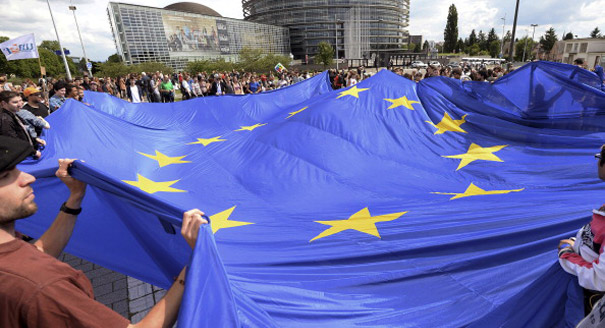
The prospect of Britain leaving the EU is boosting the popularity of the bloc—a trend that EU leaders should take advantage of.
When Donald Trump was elected the next president of the United States on November 8, the doom and gloom across most EU countries was palpable. Some former foreign ministers opined that this was the end of the West as we know it, that the transatlantic relationship was in peril, and that the post-1945 liberal order had come to an end.
Europe had to react. Some EU leaders, notably Jean-Claude Juncker, president of the European Commission, said Trump’s election showed why the EU needed its own army—as if European governments were going to sign up to such a project after refusing for years to strengthening the European pillar of NATO.
Trump’s victory did, however, confirm that Europe has no short- or long-term strategy for dealing with the changing political culture in the United States in particular and in the West in general. Indeed, it’s not even certain that Trump’s election will jolt Europe into grasping the immense challenges and disadvantages of globalization and digitalization. Instead, populist movements across Europe have seized on Trump’s victory as a justification to protect or return to a continent of sovereign nation-states.
But is this really the trend taking over Europe? Is the EU inevitably heading back to a disintegrated bloc of individual member states, as some populist leaders advocate? No, according to a short, fascinating report just published by Germany’s Bertelsmann Foundation.
Its main argument is that if anything, Britain’s decision on June 23 to leave the EU is boosting the union’s standing with the public. The survey of almost 15,000 respondents from the bloc’s six largest members (Britain, France, Germany, Italy, Poland, and Spain) showed that support for EU membership climbed to an average of 62 percent in August 2016, up from 57 percent in March.
In Britain alone, the EU approval rating before the referendum was 49 percent. After the Brexit vote, the rating climbed to 56 percent—presumably after Brits realized the enormous negative consequences of quitting the bloc. Bertelsmann reported that “for the first time since 2015, the Britons are more pro-Europe than the French or the Italians” (at 53 percent and 51 percent respectively). In Germany, the EU approval rating increased to 69 percent in August, up 8 points from March. In Poland, where the EU enjoys the highest overall positive response, the rating reached 77 percent, up 9 points. Why?
Aart De Geus, chairman of the board of the Bertelsmann Foundation, explained in the report that “the looming Brexit seems to have been the best advertisement for the EU. Unfortunately many Britons are only now coming to recognize the advantages of a united Europe. Now both sides must agree on clear rules for the future, because there won’t be an ‘à la carte’ Europe.”
But there is more to these findings. Their first inference is that the EU has nowhere to go. A return to a Europe of full-fledged independent nation-states is not an option, certainly not if any member state wants to survive the economic, social, and political ramifications of globalization.
Second, no thanks to most European leaders, Europe is popular because of its benefits. There are open borders inside most of the EU. There is the highly successful and popular Erasmus+ program, to which the EU has allocated €14.7 billion ($15.5 billion) in its 2014–2020 budget so that young (and old) people have the opportunity to study in any EU country or five non-EU countries. There is a seamless, unhindered flow of trade and capital throughout the bloc. All these achievements are genuinely European and not the exclusive domain of any one member state.
And there are EU structural and development funds worth €454 billion ($479 billion) for 2014–2020. Leaving aside the bureaucratic hurdles in obtaining them and complaints about how they are allocated or abused by officials, the funds have modernized infrastructure throughout Europe, from water and sanitation to roads, schools, energy, and public transportation. The Brexit vote means Britain will no longer have access to any of these funds.
Yet for all its benefits, EU leaders in the institutions and the member states rarely extol the virtues of this union that the British have chosen to leave. EU leaders rarely explain to citizens how these gains have to be protected.
More worrying is that with few exceptions (Estonia, for one), Europe is failing to grasp the enormous challenges of digitalization and how it will affect the political, social, and competitive dimensions of each European country and the EU as a whole.
The upshot should not be that the EU retreats into an untidy collection of member states as Brexit becomes a reality and the Trump administration prepares to take office. As the Bertelsmann Foundation report showed, there is wide support and a need for the EU. Both are largely untapped.

Nonresident Senior Fellow, Carnegie Europe
Judy Dempsey is a nonresident senior fellow at Carnegie Europe
Recent Work
Judy Dempsey
Judy Dempsey
Carnegie does not take institutional positions on public policy issues; the views represented herein are those of the author(s) and do not necessarily reflect the views of Carnegie, its staff, or its trustees.

Before the next wave of EU enlargement takes place, the union needs to grapple with thorny questions of how power is distributed among its members.


Emil Sondaj Hansen, Ditte Brasso Sørensen

Are Germany’s economic, industrial, and political struggles becoming a liability for the EU’s ability to rise to the geopolitical moment?

Rym Momtaz, ed.

European Commission President Ursula von der Leyen is about to give her annual address on the state of the EU. Here’s what she won’t—but should—say.
Rym Momtaz

The aftermath of the Ceuta crisis shows Europe has drawn the wrong lessons. Rather than doubling down on failed migration policies, the EU needs to address the underlying roots of such episodes.

Richard Youngs

An overwhelming victory by a far-right-wing party in a small state in eastern Germany will have major repercussions for Chancellor Friedrich Merz’s coalition.
Judy Dempsey