

Commentary
Peter Kellner
{
  "authors": [
    "Peter Kellner"
  ],
  "type": "commentary",
  "blog": "Strategic Europe",
  "centerAffiliationAll": "",
  "centers": [
    "Carnegie Endowment for International Peace",
    "Carnegie Europe"
  ],
  "collections": [
    "EU Integration and Enlargement",
    "Brexit and UK Politics"
  ],
  "englishNewsletterAll": "",
  "nonEnglishNewsletterAll": "",
  "primaryCenter": "Carnegie Europe",
  "programAffiliation": "",
  "programs": [],
  "projects": [],
  "regions": [
    "Europe",
    "Western Europe",
    "United Kingdom"
  ],
  "topics": [
    "EU",
    "Democracy"
  ]
}
Source: Getty
A ruling by the UK High Court on the procedure for the country’s withdrawal from the EU may be overturned. But whatever the outcome, Britain faces an uncertain future.
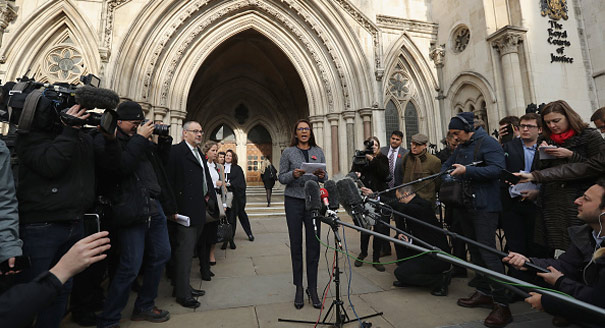
How dare they? Britain’s Brexit-supporting newspapers could not conceal their fury when the country’s High Court ruled on November 3 that Prime Minister Theresa May needed the parliament’s agreement to trigger the process that takes the United Kingdom out of the European Union.
“ENEMIES OF THE PEOPLE” screamed the front page of the Daily Mail, underneath pictures of the three judges who handed down the ruling. “The judges versus the people” was the Daily Telegraph’s front-page headline. The Sun combined an assault on the judges with this less-than-subtle attack on the woman who brought the case in the first place: “Handful of EU campaigners led by foreign-born multi-millionaire Gina Miller derail Theresa May’s Brexit plans.”
All three papers violated the age-old British principle of fairness in sport and politics: play the ball, not the man. The fact of the matter is that the verdict creates much uncertainty for Britain’s exit from the EU.
The judges did not hand down a finely balanced, on-the-one-hand-on-the-other-hand ruling. They delivered a comprehensive, closely argued denunciation of the government’s case that it could begin the process of leaving the EU without consulting the legislature. Drawing on precedents going back four hundred years, the judges upheld the right of the UK Parliament to decide on people’s rights and not to have those rights removed by executive fiat. The judges noted that the government itself had said that Brexit would be irreversible once it triggered Article 50 of the EU Treaty—and that, therefore, this act would set Britain on an inevitable course toward stripping away those rights that depend on UK membership of the EU.
Hence, the parliament needed to have its finger on the trigger, just as over the past forty-four years it has needed to pass the laws that created and amended Britain’s relationship with the EU. By finding against the government, the High Court was protecting a number of rights. More accurate headlines would have been “Friends of the People” or “The Judges Versus a High-Handed Executive.”
To which Brexit supporters would surely respond: the effect of the judges’ ruling is not to thwart an arrogant government but to thwart the will of the people, as expressed in the referendum held on June 23.
The judges demolished this argument with impressive brutality. They reminded observers that the act to hold the referendum “was passed against a background including a clear briefing to parliaments explaining that the referendum would have advisory effect only.” This, they said, was in line with the “basic constitutional principles of parliamentary sovereignty.” A referendum could only be advisory “unless very clear language to the contrary is used in the referendum legislation in question.” That led to the pungent payoff: “No such language is used in the 2015 Referendum Act.” It follows that this year’s referendum could not be the last word on whether the UK left the EU.
This section of the ruling goes to the heart of the matter yet was somehow overlooked by most of the UK journalists reporting the verdict.
That said, the High Court may not have the last legal word on the matter. The government has said it will appeal to the UK Supreme Court. That tribunal might come to a different view and rule that the government has the right, using the centuries-old royal prerogative, to invoke Article 50. Given the emphatic nature of the High Court’s ruling, this looks unlikely—but it’s possible.
One way forward has been offered by Lord Kerr, a former senior UK ambassador to the EU and secretary general of the 2001 European Convention, which drafted what became the Lisbon Treaty. He is strongly pro-EU and is currently advising Scotland’s government on how to protect its position, given that a clear majority of Scots oppose Brexit.
In a BBC interview the day before the High Court ruling, he said that triggering Article 50 would not make Brexit irrevocable: “You can change your mind while the process is going on. During that period, if a country were to decide actually we don’t want to leave after all, everybody would be very cross about it being a waste of time. They might try to extract a political price but legally they couldn’t insist that you leave.”
It’s just possible that the Supreme Court will agree with Lord Kerr. It would then follow that triggering Article 50 would not lead to the inevitable loss of any rights, because the parliament would have a subsequent right to block Brexit once the detailed terms of withdrawal were known. That argument would gain force if a number of senior EU figures—German Chancellor Angela Merkel? European Council President Donald Tusk? European Commission President Jean-Claude Juncker?—agreed that the UK could change its mind before Brexit takes effect.
The possibility that the UK will trigger Article 50 and then decide it doesn’t want to leave the EU after all looks feasible, though difficult. For the moment, however, May and her ministers face an uncertain future.
On the one hand, if the Supreme Court upholds the High Court’s ruling, then the UK Parliament will have to pass a new law to tell the EU that it wants to start the two-year countdown to Brexit outlined in Article 50. It won’t be known for some months how long that will take, or whether the bill will be passed in the form ministers want.
On the other hand, if the Supreme Court reverses the High Court’s decision, it is likely to do so because it rules that triggering Article 50 leaves open the possibility that Britain might stay in the EU. In that case, the parliament will be able to look at the detailed terms and decide, perhaps as late as March 2019, whether Brexit would be good or bad for Britain.
Either way, Britain is in for a far bumpier ride than seemed likely just a few days ago.
Peter Kellner is a journalist, political commentator, and former president of YouGov.

Former Nonresident Scholar, Carnegie Europe
Kellner was a nonresident scholar at Carnegie Europe, where his research focused on Brexit, populism, and electoral democracy.
Recent Work
Peter Kellner
Peter Kellner
Carnegie does not take institutional positions on public policy issues; the views represented herein are those of the author(s) and do not necessarily reflect the views of Carnegie, its staff, or its trustees.

The aftermath of the Ceuta crisis shows Europe has drawn the wrong lessons. Rather than doubling down on failed migration policies, the EU needs to address the underlying roots of such episodes.

Richard Youngs

An overwhelming victory by a far-right-wing party in a small state in eastern Germany will have major repercussions for Chancellor Friedrich Merz’s coalition.

Judy Dempsey

Canadian Prime Minister Mark Carney has twice inspired praise for standing up to U.S. President Donald Trump: at the 2026 World Economic Forum in Davos and on Canada-U.S. trade negotiations. Is Carney showing a third way better than the EU has in dealing with the Trump administration?

Rym Momtaz, ed.

The EU’s responses to two recent incidents expose the gulf between European perceptions and capabilities. Unless the union can bridge that gap, it will never become a real geostrategic power.
Rym Momtaz

In supporting Europe’s far-right, MAGA and Russia both want the same thing: a weaker EU. Europe must defend itself without abandoning the openness these forces exploit.

Armida van Rij