

Commentary
Are Germany’s economic, industrial, and political struggles becoming a liability for the EU’s ability to rise to the geopolitical moment?
Rym Momtaz, ed.
{
  "authors": [
    "Daniel Keohane"
  ],
  "type": "commentary",
  "blog": "Strategic Europe",
  "centerAffiliationAll": "",
  "centers": [
    "Carnegie Endowment for International Peace",
    "Carnegie Europe"
  ],
  "collections": [
    "Transatlantic Cooperation",
    "Brexit and UK Politics"
  ],
  "englishNewsletterAll": "",
  "nonEnglishNewsletterAll": "",
  "primaryCenter": "Carnegie Endowment for International Peace",
  "programAffiliation": "",
  "programs": [],
  "projects": [],
  "regions": [
    "North America",
    "Western Europe",
    "Europe"
  ],
  "topics": [
    "Security",
    "Military",
    "Foreign Policy",
    "EU"
  ]
}
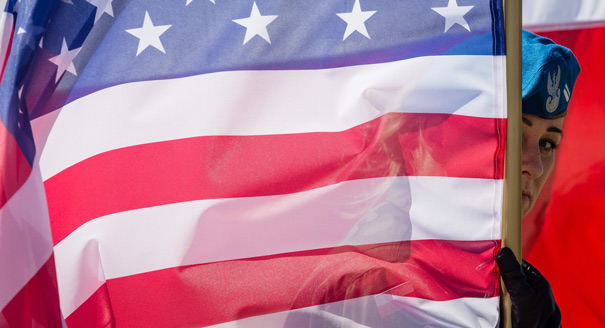
Source: Getty
The election of Donald Trump as U.S. president has the potential to transform Europe’s strategic landscape. The Europeans should respond by planning for their own defense.
Donald Trump is making Europe think again, especially about European defense. Some European politicians are so concerned that the U.S. president-elect may scale back American military commitments in Europe that they are making radical proposals.
The foreign policy spokesperson for German Chancellor Angela Merkel’s Christian Democrats, Roderich Kiesewetter, told Reuters on November 16, “The U.S. nuclear shield and nuclear security guarantees are imperative for Europe. . . . If the United States no longer wants to provide this guarantee, Europe still needs nuclear protection for deterrent purposes.” He added that Germany could play an important role in convincing nuclear powers France and Britain to provide security guarantees for all of Europe.
Whether a solo run or a trial balloon, this is an astonishing public statement by a senior German lawmaker from the traditionally transatlanticist chancellor’s party. For one thing, it is not necessarily wise to openly say such things so soon after the U.S. presidential election, as it could strengthen the case of those in the new administration who favor reducing U.S. military support for Europe. For another, most Germans want to ban nuclear weapons—a whopping 93 percent according to one recent poll. Many members of the governing coalition partner, the Social Democrats, strongly support nuclear disarmament.
Germany’s Social Democratic foreign minister, Frank-Walter Steinmeier, has previously called for U.S. nuclear weapons to be removed from German soil. But the combination of Trump’s election and Kiesewetter’s proposal was hardly the scenario he had in mind.
Although this is not a German government proposal, many outsiders must be thinking—to quote former American tennis player John McEnroe—“You cannot be serious!”
Yet France, which has a long tradition of independent strategic thinking, might consider a formal proposal seriously. Paris has sometimes argued that Europeans should not rely on the United States for their defense. It might help if Germany were willing to pay something for the French force de frappe. Maintaining nuclear weapons costs Paris €3.5 billion ($3.7 billion) on average a year, some 11 percent of the French defense budget.
In contrast, the UK would surely balk at the idea of a world in which the United States did not defend it. This is not only because Britain uses U.S. technology for its nuclear deterrent (which helps lower its cost, at 5–6 percent of the UK defense budget, relative to France’s version). It is also partly because such a radical notion would clash with the current mood in London, which is preoccupied with Britain’s decision to leave the EU. The British defense secretary said on November 14 that Trump is no threat to U.S. leadership in NATO, and perhaps some in London hope that he will somehow reinforce Britain’s position in its forthcoming EU exit negotiations, given his support for Brexit.
Even if France and the UK agreed to such a Euro-nukes plan, they would surely expect Germany to invest much more in its conventional defense forces (perhaps on top of paying them for nuclear protection). As a proportion of GDP, Berlin devotes only a bit over half of what Paris and London do to defense. But such an investment would be domestically difficult for Berlin. In a 2016 Pew opinion poll, only 34 percent of Germans favored increasing defense spending, while some 47 percent said expenditure should remain at its current level.
In other words, a Euro-nukes proposal is probably too bonkers to fly politically and militarily. But Kiesewetter is right in one respect: even if Europeans spend more on defense, no one knows what Trump will do in office. Will he cut a geopolitical deal with Russian President Vladimir Putin, who recently placed nuclear-capable missiles in the Russian exclave of Kaliningrad between Poland and Lithuania? Will Trump keep U.S. soldiers in Europe? Or withdraw them but keep the nuclear guarantee? Or worse, rip up the North Atlantic Treaty?
Europeans would therefore be wise to plan for their own defense, in case they can no longer depend on NATO—meaning primarily the United States. This means that Europeans, in particular the French, the Germans, and the Brits, should realize that they can defend themselves if they want to.
Currently, the main state-based military threat to European security is Russia. Although possible, it is not obvious that Moscow wants to risk a shooting war with any European NATO member, and Russia perhaps prefers to wage war via hybrid means. In 2015, France, Germany, and the UK combined spent $146 billion on defense, whereas Russia spent $66 billion.
But Russia is not the only threat to European security. There is a wide range of security challenges across the EU’s broad neighborhood that may require Europeans to use military means, such as preventing conflicts or helping weak states like Mali fight terrorists.
To follow through on a credible full-spectrum plan for European defense would entail two things: more money for defense and real political commitment to acting together if needed. Europeans would need to drain the swamp of their defense resource waste. They would have to make their differing political and security priorities converge. And they would have to be willing and able to defend the geographically isolated Baltic states.
This may seem much too daunting today, but events change strategic conventions. When pushed, France, Germany, and the UK have been able to act together—to help deter Russian aggression in Eastern Europe since 2014 and to combat the self-styled Islamic State since the 2015 Paris terrorist attacks.
The election of Donald Trump is potentially an even more profound event, because it could transform Europe’s strategic landscape. Putin made NATO defend again, and no European government wants to lose NATO’s protection. But someday Trump might tell Europeans that he will make them defend again. If he does, Europe’s response should be “Yes we can.”
Daniel Keohane is a senior researcher at the Center for Security Studies at ETH Zürich.
(A previous version of this post incorrectly stated that Russia had placed nuclear missiles, not nuclear-capable missiles, in Kaliningrad. Apologies for the error.)
Daniel Keohane
Carnegie does not take institutional positions on public policy issues; the views represented herein are those of the author(s) and do not necessarily reflect the views of Carnegie, its staff, or its trustees.

Are Germany’s economic, industrial, and political struggles becoming a liability for the EU’s ability to rise to the geopolitical moment?

Rym Momtaz, ed.

European Commission President Ursula von der Leyen is about to give her annual address on the state of the EU. Here’s what she won’t—but should—say.
Rym Momtaz

The aftermath of the Ceuta crisis shows Europe has drawn the wrong lessons. Rather than doubling down on failed migration policies, the EU needs to address the underlying roots of such episodes.

Richard Youngs

An overwhelming victory by a far-right-wing party in a small state in eastern Germany will have major repercussions for Chancellor Friedrich Merz’s coalition.

Judy Dempsey

Canadian Prime Minister Mark Carney has twice inspired praise for standing up to U.S. President Donald Trump: at the 2026 World Economic Forum in Davos and on Canada-U.S. trade negotiations. Is Carney showing a third way better than the EU has in dealing with the Trump administration?
Rym Momtaz, ed.