

Commentary
There is an elephant in the room when it comes to the EU’s upcoming security strategy: Donald Trump. Unless European leaders acknowledge the depth of the transatlantic crisis, true autonomy will remain out of reach.
Stefan Lehne
{
  "authors": [
    "Caroline de Gruyter"
  ],
  "type": "commentary",
  "blog": "Strategic Europe",
  "centerAffiliationAll": "",
  "centers": [
    "Carnegie Endowment for International Peace",
    "Carnegie Europe"
  ],
  "collections": [],
  "englishNewsletterAll": "",
  "nonEnglishNewsletterAll": "",
  "primaryCenter": "Carnegie Europe",
  "programAffiliation": "",
  "programs": [],
  "projects": [],
  "regions": [
    "Europe",
    "Western Europe"
  ],
  "topics": [
    "EU",
    "Political Reform"
  ]
}
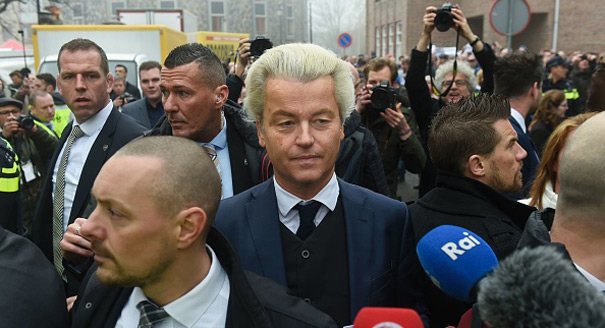
Source: Getty
Geert Wilders, leader of the far-right Party for Freedom, is unlikely to win the Netherlands’ upcoming election. But that won’t stop him from influencing government policies.
When the Dutch far-right politician Geert Wilders kicked off his election campaign on February 18 in a small town called Spijkenisse, several hundred people turned up to see him. At least half of them were TV crews from all over the world, police officers, or security guards. Even Wilders, who wants to ban mosques and the Quran and whose campaign promise is to “make the Netherlands ours again,” seemed surprised that the media outflanked his fans. “The balance could have been different,” he told a reporter.
The Netherlands holds a parliamentary election on March 15, and Wilders and his Party for Freedom (PVV) are at the center of national and international attention. As the Guardian reported from Spijkenisse, “Wilders, who has lived in hiding since the 2004 murder by an Islamist of Dutch filmmaker Theo van Gogh, is hoping a global upsurge in populism will propel him to power.” With crucial elections coming up later in 2017 in France and Germany, where populists are also challenging the postwar status quo, the Netherlands seems to be drifting into the eye of a European storm.
Almost everything Wilders says and does is reported. Even what he does not do creates a national stir. His refusal to take part in televised debates was a main news item for days. Then, Wilders tweeted a cartoon of U.S. President Donald Trump throwing a ball labeled “social media” over the heads of TV crews to a citizen in an armchair, with the hashtag #ilovetwitter.
But anyone who thinks the Netherlands could soon be governed by a far-right party that has promised to take the country out of the EU and the eurozone is probably mistaken. According to a combination of the five largest opinion polls on February 22, the PVV commands just 17 percent of the vote. In fact, the trend has been going steadily downward in recent weeks—the PVV’s performance always weakens a little before elections. In a system that relies on coalition governments, most other parties have categorically excluded forming an alliance with the PVV. It is thus very likely that after March 15, Wilders will remain where he is now: in opposition.
Why, then, is there so much attention on a party that is far from commanding a majority? The answer is simple: the other parties’ predicted vote shares are even smaller. Dutch Prime Minister Mark Rutte’s center-right liberal People’s Party for Freedom and Democracy (VVD) comes a close second, with 16 percent. The centrist Christian Democratic Appeal (CDA) and leftish liberal Democrats 66 (D66) are competing for third and fourth place, each with 11 percent. The Socialist Labor Party (PvdA), once a giant, is joint sixth, with 8 percent.
The real Wilders story is the complete fragmentation of the Dutch political landscape. Of many smallish parties, the PVV is the biggest—and the loudest. This enables Wilders, who rails against the EU and the elite from the opposition benches, to dominate the political agenda without bearing any responsibility.
The Netherlands has always had strong political diversity. For this year’s election, a record 81 parties tried to register, including a pirate party, an immigrants’ party, and an abstention party that never takes a stand on any topic. Most applicants were dismissed because they failed to pay the required fee or didn’t manage to get enough support. Some dropped out of their own accord. Still, there are 28 parties left, competing in a volatile political environment. Just weeks before election day, around 70 percent of registered voters indicated that they didn’t know whom to vote for (although this figure has been disputed). It is mainly this floating vote that the parties are after.
As in several other Western liberal democracies, the difference between Left and Right in the Netherlands has largely evaporated. Since Wilders broke away from the VVD in 2004 and founded the PVV, politics has been conducted increasingly along the lines of identity, religion, and values, rather than ideology. Much like Trump, Wilders, whose party program consists of just one page, dislikes the regular press and communicates almost exclusively by tweet, lashing out against what he calls the left-wing establishment and Moroccan “scum.”
He presents the Netherlands as submerged by jihadists and terrorists who are forcing the country’s original inhabitants to adapt to newcomers. In December 2016, Wilders, who is married to a Hungarian woman, was convicted of making racist remarks about Moroccans. Afterward, he launched a sharp attack on the judges, calling them “PVV haters” and “knettergek,” or “completely mad.” He has also labeled the Dutch parliament, of which he is a member, a “fake parliament.”
Few Dutch politicians openly counter these unprecedented attacks on national institutions and Dutch citizens. On the contrary, many politicians are moving in Wilders’s direction, slowly making his opinions mainstream. The PVV draws disgruntled voters from traditional left- and right-wing parties, much like the National Front in France or the Freedom Party of Austria. The other parties try to lure those lost voters back and prevent others from crossing over to the PVV.
After thirteen years of these dynamics, many issues that Wilders previously advocated now feature in the programs of others. Several parties now want to repatriate EU powers from Brussels back to The Hague to restore Dutch sovereignty and are much tougher on immigration than before. The word “patriotism” pops up everywhere. Recently, the prime minister even placed an ad in several newspapers urging immigrants to “act normally” or leave the country.
Rutte has taken his liberal party further to the Right in recent years because his main adversary—Wilders—is on his right flank. But he has said the chance of forming a government with the PVV is “zero.” Whatever the outcome of the vote on March 15, the next government is likely to be a multiparty coalition run by Rutte. If the PVV ends up as the biggest party, populists across Europe will celebrate a symbolic victory. This may boost Wilders’s allies in France and Germany later this year. If the VVD takes the lead, Rutte will be able to claim that sailing close to the populists pays off.
Either way, forming a government with several parties may be complicated. Governing will be even harder. Wilders will be encouraged to continue to rail from the opposition benches, influencing government policies by remote control—just as before.
Caroline de Gruyter is a Europe correspondent for the Dutch newspaper NRC Handelsblad. This blog post is the first in a set of guest contributions providing insights into the March 15 Dutch parliamentary election.
Caroline de Gruyter
Caroline de Gruyter is the European affairs correspondent for the Dutch newspaper NRC Handelsblad.
Carnegie does not take institutional positions on public policy issues; the views represented herein are those of the author(s) and do not necessarily reflect the views of Carnegie, its staff, or its trustees.
There is an elephant in the room when it comes to the EU’s upcoming security strategy: Donald Trump. Unless European leaders acknowledge the depth of the transatlantic crisis, true autonomy will remain out of reach.

Stefan Lehne
Defense tech innovations will be at the heart of Europe’s new security strategy. But so far, Brussels has been making moves without a broader plan, undermining readiness and credibility.

Raluca Csernatoni

When the U.S.-Iran memorandum of understanding was announced, the UK, France, Germany, and Italy declared their readiness to help demine the Strait of Hormuz and lift nuclear sanctions on Tehran. But does Europe need new tools to recover a diplomatic role?

Rym Momtaz, ed.
The Franco-German relationship is on the rocks again. But unlike previous moments of tension, the epochal changes on the world stage require that both step up investment in their bilateral ties.
Rym Momtaz
The EU is putting together a new security strategy to meet today’s myriad challenges. But for any proposal to be effective, the union needs to grapple with its identity and ambitions.

Pierre Vimont