

Commentary
Peter Kellner
{
  "authors": [
    "Peter Kellner"
  ],
  "type": "commentary",
  "blog": "Strategic Europe",
  "centerAffiliationAll": "",
  "centers": [
    "Carnegie Endowment for International Peace",
    "Carnegie Europe"
  ],
  "collections": [
    "EU Integration and Enlargement",
    "Brexit and UK Politics"
  ],
  "englishNewsletterAll": "",
  "nonEnglishNewsletterAll": "",
  "primaryCenter": "Carnegie Europe",
  "programAffiliation": "",
  "programs": [],
  "projects": [],
  "regions": [
    "Europe",
    "Western Europe",
    "United Kingdom"
  ],
  "topics": [
    "EU",
    "Political Reform"
  ]
}
Source: Getty
One of the trickiest questions in the UK’s impending negotiations to leave the EU is whether London will be expected to pay a penalty for quitting the bloc.
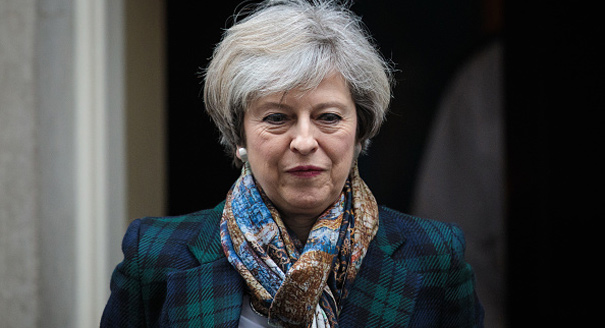
Theresa May could not have been clearer: “No deal for Britain is better than a bad deal for Britain,” the UK prime minister said on January 17, setting out the kind of British exit from the EU that she sought to negotiate. She qualified her assertion by adding that “I am sure a positive agreement can be reached.” But she chose to raise the possibility of a breakdown in negotiations, so the question is worth asking: Might the UK end up without a deal, resulting in a messy, fractious withdrawal from the European Union?
The rules of engagement are set out in Article 50 of the EU treaty. Any withdrawal agreement is to be concluded by the EU’s Council of Ministers, “acting by a qualified majority, after obtaining the consent of the European Parliament.” In EU parlance, a qualified majority is achieved if a proposal is backed by a certain number of member states and if those countries represent a certain percentage of the EU’s total population. If no deal is reached, then the UK automatically leaves the EU two years after triggering Article 50 “unless the European Council [which represents national leaders] unanimously decides to extend this period.”
Note the use of a qualified majority to ratify a deal, but unanimity to extend the deadline. If negotiations get bogged down but don’t break down, any state could veto a proposal to keep the talks going. Suppose that proposal came before the European Council. To take just one example of what might happen, Spain could threaten to veto further talks unless the UK offered concessions in relation to its overseas territory of Gibraltar. Indeed, any of the other 27 member states could throw a wrench in the works.
By contrast, Spain on its own could not block a deal if EU and UK negotiators did reach one. But neither could the UK’s friends in the EU insist on a favorable deal without building the necessary majority in the Council of Ministers. An example might be Ireland seeking arrangements that would keep open its border with Northern Ireland. So the qualified-majority rule is of partial, but only partial, benefit to the UK.
At this stage, nobody can be sure whether the negotiations will succeed or fail. But here is one reason why they might be extremely tricky. It concerns money. Already, the promise of the pro-Brexit campaign before the June 2016 referendum—that the UK could save the £350 million ($436 million) a week it contributes to the EU and spend it instead on the National Health Service—has crumbled. That figure relates to Britain’s gross contribution to the EU. But around half of that money comes back to the UK anyway, so the net transfer is much less. Furthermore, British ministers have accepted that the UK may continue to contribute to European programs of which it approves, such as science and space exploration.
That is not all. In Brussels, the talk is of demanding from the UK a one-off payment of €40–60 billion ($43–65 billion) for leaving the bloc. A Financial Times report suggested that this could be the cost of future spending commitments that the UK has agreed to help finance but that will not fall until after Britain leaves. Some are medium-term budget commitments; others cover longer-term liabilities such as pensions and loan guarantees. Ivan Rogers, until recently the UK’s ambassador to the EU, has told a committee of parliamentarians in London that this is indeed the amount that the EU will demand.
There is no reference to such an exit fee in Article 50. However, there is a precedent. When the UK decided in 2013 to opt out of parts of the EU’s police and criminal justice legislation, it accepted a protocol containing these words: “The Council . . . may also adopt a decision determining that the United Kingdom shall bear the direct financial consequences, if any, necessarily and unavoidably incurred as a result of the cessation of its participation in those acts.” It is easy to see the EU applying “necessarily and unavoidably” to the costs that Brexit will impose on the remaining 27 member states.
If there is a Brexit deal, then the chances are that the EU will impose a much smaller penalty on the UK. Some of the costs might be subsumed within transitional arrangements, for example to gradually withdraw both Britain’s payments and its rights of access to the EU single market over a number of years. There is also the possibility of brute political force: if everything else is agreed on, there will be immense pressure to compromise on the size of the penalty.
However, nobody should rule out the dangers of deadlock. Even if the calculations being done in Brussels turn out to be ambitious—and nobody has yet made public a detailed breakdown of the sums—it is certain that after Brexit, the EU will have future funding commitments to spread across fewer countries. UK negotiators will be asking the other 27 states not only to give Brits the best deal but also to increase their own contributions to the EU so the UK can pay as little as possible for Brexit.
Suppose the true cost of Brexit to the rest of the EU is €30 billion ($32 billion), but the UK refuses to pay anything above €10 billion ($11 billion). That will leave a €20 billion ($21 billion) gap, to be filled by larger contributions from other member states, or by cuts in EU spending, or by a mixture of both. Agreement on that might be possible, but it will not be easy. Some EU members in Southern and Eastern Europe may well plead poverty, while the leaders of richer countries, such as Germany and Sweden, would risk a backlash from their voters if they agreed to pick up the tab.
Worse, if there is no deal, there will be nothing to stop the EU from taking the UK to court to demand payment in full. In that case, it won’t just be the issue of applying WTO tariffs to UK-EU trade that clouds the UK’s future; it will be the possibility of the UK being sued for billions of euros.
If that is where Britain ends up, May’s words “No deal is better than a bad deal” could come back to haunt her.
Peter Kellner is a journalist, political commentator, and former president of YouGov.

Former Nonresident Scholar, Carnegie Europe
Kellner was a nonresident scholar at Carnegie Europe, where his research focused on Brexit, populism, and electoral democracy.
Recent Work
Peter Kellner
Peter Kellner
Carnegie does not take institutional positions on public policy issues; the views represented herein are those of the author(s) and do not necessarily reflect the views of Carnegie, its staff, or its trustees.
Montenegro and Albania are frontrunners for EU enlargement in the Western Balkans, but they can’t just sit back and wait. To meet their 2030 accession ambitions, they must make a strong positive case.


Dimitar Bechev, Iliriana Gjoni
Donald Trump has repeatedly bashed NATO and European allies, threatening to annex Canada and Greenland and deploring their lack of enthusiasm for his war of choice in Iran. Is this latest round of abuse the final straw?

Rym Momtaz, ed.
Donald Trump’s repudiation of NATO goes against the Make America Great Again vision of a U.S.-centered foreign policy. If the goal is to preserve the alliance by boosting Europe’s commitments, leaning into France’s vision is the most America First way forward.
Rym Momtaz
Hungarians head to the polls on April 12 for an election of national and European consequence. Three different outcomes are on the cards, each with their own implications for the EU.

Zsuzsanna Szelényi
The far right failed to win big in France’s municipal elections. But that’s not good news for the country’s left wing, which remained disunited while the broader right consolidated its momentum ahead of the 2027 presidential race.

Catherine Fieschi