

Commentary
Judy Dempsey
{
  "authors": [
    "Judy Dempsey"
  ],
  "type": "commentary",
  "blog": "Strategic Europe",
  "centerAffiliationAll": "",
  "centers": [
    "Carnegie Endowment for International Peace",
    "Carnegie Europe"
  ],
  "collections": [],
  "englishNewsletterAll": "",
  "nonEnglishNewsletterAll": "",
  "primaryCenter": "Carnegie Europe",
  "programAffiliation": "",
  "programs": [],
  "projects": [],
  "regions": [
    "Europe",
    "Eastern Europe"
  ],
  "topics": [
    "EU",
    "Democracy"
  ]
}
Source: Getty
Romania’s EU membership has not ridden the country of the deep, pervasive, and ubiquitous scourge of corruption. But the people are not afraid to speak out.
As a reporter during the 1980s, when Romania’s then Communist leader Nicolae Ceauşescu ruled his country with an iron fist, I was struck by two memories of the country that have endured to this day: fear and deprivation.
Those brave enough to speak to foreign journalists did so with courage, but also with a risk they would be punished. Those who wanted fresh vegetables or—a sight to behold—meat would either stand in line for hours at the main market in Bucharest or resort to bribes to obtain such basic goods. Even then, energy for cooking, heating, and hot water was rationed to just a few hours a day.
One dark winter’s evening in late 1988, I gently knocked on the door of a great source. The elderly lady living there, who had been imprisoned during the 1950s, whispered through the door: “Please don’t ask me any questions. Don’t come again. Go. I can’t speak anymore. I’m just too afraid.”
Back in my hotel, one of the few places where one could at least get a meal, my typewriter had been tampered with. The ribbon had been carelessly put back. Those were the days when the Securitate, the ubiquitous secret police, even tried to decipher what journalists would send back to their newspapers.
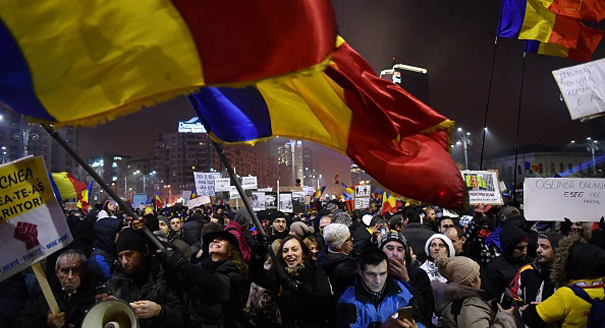
Nearly three decades later, the hundreds of thousands of Romanians who have taken to the streets over the past several days show how the fear and the deprivation have disappeared. Instead, they demonstrate a resilience and determination to complete the transformation of their country. At a time when the systems of checks and balances in Hungary and Moldova, Ukraine and Poland are being tested—and corruption dogs leading French politicians—Romanians want to prevent backsliding. They should be seen as a credit to Europe.
Over the ten years since the country joined the EU, civil society has blossomed in Romania. Individuals, especially the young, feel empowered. EU membership has given Romanians the chance to travel to and work in other EU member states and see how accountability works.
For all those great gains, the eclipse of fear and deprivation—now replaced by freedom—has not ridden Romania of the deep, pervasive, and ubiquitous scourge of corruption. That is what the demonstrators were protesting about. They want an end to a political culture and a special kind of elite that believes in the politics of entitlement and impunity, with politicians who think they can make laws to protect their own interests.
The decree that infuriated so many Romanians was an emergency law pushed through by the governing Social Democratic Party. If implemented, the legislation would have decriminalized corruption of less than €45,000 ($48,000), which is a very substantial sum for most Romanians. That decree meant that the party’s leader, Liviu Dragnea, would have benefited. He is facing fraud charges involving a sum of €24,000 ($26,000). He is not alone.
On February 5, the government scrapped the decree but will submit a revised bill to the parliament. The protesters, who called on Romanian Prime Minister Sorin Grindeanu’s government to resign, are not giving up. Too often, they have seen how successive parliaments have run roughshod over the rule of law.
That is why Klaus Iohannis was elected president in 2014. He ran a campaign based on stamping out corruption and strengthening the rule of law. Yet while Iohannis’s standing is high, his influence has not been enough to change the political culture of the elites.
Back in 2007, the European Commission established the Cooperation and Verification Mechanism (CVM) to address shortcomings in the judicial system and the fight against corruption. In its latest report on Romania’s progress under the mechanism, published just days before the protests, the commission highlighted one of the major weaknesses hampering the rule of law. “Legislative practice allows for the sudden introduction of changes through Parliament, bypassing better regulation and consultation, and making it harder to demonstrate the sustainability of the legal framework in areas like corruption,” the commission wrote.
The CVM has had an impact over the years. But Bianca Toma, an analyst at the Romanian Center for European Policies, said the commission needs a more hands-on approach if it wants to tackle the endemic corruption. “Watchdogs need to be put in place to oversee how the EU’s structural funds are spent,” she said. “And civil society has to be much more vigilant.”
Yet the question is why corruption is still so prevalent in Romania. Toma believes the old ties of the Ceauşescu era still exist. But thirty years later? “The economic, media, and political networks are still there,” Toma explained. “And on the local level, individual civil servants are too alone to speak out. They are afraid they would be sacked. The judiciary isn’t yet independent enough in the smaller cities and towns.”
This latest wave of antigovernment protests in Romania was not confined to the capital. Civil-society movements are spreading. And they have a common program. Romania’s counterparts in other EU countries can take heart from such determination to speak out and strengthen the rule of law instead of resorting to populist slogans and EU bashing.

Nonresident Senior Fellow, Carnegie Europe
Dempsey is a nonresident senior fellow at Carnegie Europe
Recent Work
Judy Dempsey
Judy Dempsey
Carnegie does not take institutional positions on public policy issues; the views represented herein are those of the author(s) and do not necessarily reflect the views of Carnegie, its staff, or its trustees.
Montenegro and Albania are frontrunners for EU enlargement in the Western Balkans, but they can’t just sit back and wait. To meet their 2030 accession ambitions, they must make a strong positive case.


Dimitar Bechev, Iliriana Gjoni
Donald Trump has repeatedly bashed NATO and European allies, threatening to annex Canada and Greenland and deploring their lack of enthusiasm for his war of choice in Iran. Is this latest round of abuse the final straw?

Rym Momtaz, ed.
Donald Trump’s repudiation of NATO goes against the Make America Great Again vision of a U.S.-centered foreign policy. If the goal is to preserve the alliance by boosting Europe’s commitments, leaning into France’s vision is the most America First way forward.
Rym Momtaz
Hungarians head to the polls on April 12 for an election of national and European consequence. Three different outcomes are on the cards, each with their own implications for the EU.

Zsuzsanna Szelényi
The far right failed to win big in France’s municipal elections. But that’s not good news for the country’s left wing, which remained disunited while the broader right consolidated its momentum ahead of the 2027 presidential race.
Catherine Fieschi