

Commentary
Judy Dempsey
{
  "authors": [
    "Judy Dempsey"
  ],
  "type": "commentary",
  "blog": "Strategic Europe",
  "centerAffiliationAll": "",
  "centers": [
    "Carnegie Endowment for International Peace",
    "Carnegie Europe"
  ],
  "collections": [
    "Transatlantic Cooperation"
  ],
  "englishNewsletterAll": "",
  "nonEnglishNewsletterAll": "",
  "primaryCenter": "Carnegie Europe",
  "programAffiliation": "",
  "programs": [],
  "projects": [],
  "regions": [
    "Middle East",
    "Russia",
    "North America",
    "United States",
    "Iran"
  ],
  "topics": [
    "Security",
    "Foreign Policy"
  ]
}
Source: Getty
The transatlantic relationship is not only about military spending; it is also about protecting values.
Carnegie Europe was on the ground at the 2017 Munich Security Conference, offering readers exclusive access to the debates as they unfolded and providing insights on today’s most urgent international issues. Check out our live coverage here.
*
A great many words were uttered during this year’s Munich Security Conference about why NATO’s European allies should spend more on defense. Mike Pence, the U.S. vice president, spent the best part of his speech on February 18 berating the Europeans. He mentioned values without once defining them.
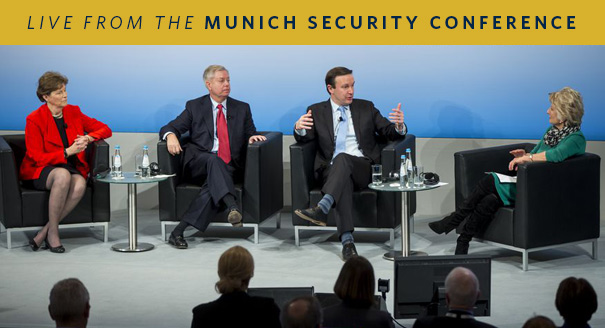
Now, on day three of this annual get-together of decisionmakers and defense experts, it took three leading U.S. senators to spell out that the transatlantic relationship was not only about increasing military budgets. It was, they said, also about defending values. In particular, they homed in on what was happening in their own country and how to deal with Russia and Iran.
The senators—Jeanne Shaheen, Lindsey O. Graham, and Christopher Murphy—didn’t hold back in explaining that they were extremely worried about U.S. President Donald Trump’s criticism of the media and attempts to prevent immigrants from seven mainly Muslim countries from entering the United States.
“Here’s the deal [with the media],” said Graham. “We are going to support the press’s ability to do its job. But it needs to have some sense of proportionality. Trump is not the first president to be upset about the press. The press can be a pain in the butt,” he added. Shaheen chipped in. “I’m very worried about the statement by President Trump about the press and overt efforts to manipulate the media in the United States,” she said.
The three senators said they were determined to speak out about defending their country’s values. In what was music to the ears of the Europeans sitting in the banqueting hall in Munich, Shaheen said, “We will do everything to support the EU.”
Murphy, who follows European politics closely, made the point that “if we are serious about the transatlantic connection, we have to say something about values.” He was echoing what German Chancellor Angela Merkel had said the previous day when she framed the transatlantic relationship in the context of shared values, including upholding a free and independent press. Pence was sitting in the front row, listening.
When it came to values and Russia, Graham pulled no punches. Russia, he said, was not going to get away with its alleged interference in U.S. elections. “The Russian dynamic has taken a different turn. Russia is an outright liar,” he said. “On top of the list will be sanctions against Russia. I’m very concerned about Trump not speaking out. We should introduce Russian sanctions for interfering in our [2016 presidential] election. My goal is to put it on Trump’s desk.”
There was agreement all round. Then, in a reference to the upcoming French presidential election, Graham quipped, “To my friends in France, [the Russians] are coming after you. Twenty-seventeen is going to be the year of kicking Russia’s ass.”
Iran wasn’t spared criticisms or warnings, either. The senators lashed out at Tehran’s support for terrorist movements and its system of government. Referring to a previous session, Graham said, “I didn’t believe a word of what [Iranian Foreign Minister Mohammad Javad] Zarif said about not producing nuclear weapons.” Trump, who has been highly critical of the 2014 nuclear deal between Iran and the United States and the other permanent members of the UN Security Council plus Germany and the EU, has also questioned Iran’s intentions to build a nuclear weapon.
The discussion about Iran steered toward values. During the short question-and-answer session, the panel was asked why it was so critical of Iran’s values, which, the questioner said, was a peaceful country and treated its people properly. The panel was having none of it. “The challenge is whether . . . Iran’s support for organizations in Lebanon and Syria and Yemen [represents] the kind of values that Iranians should support,” Shaheen said. “At some point, I hope there will be a free government in Iran,” she added.
This discussion about values in the United States and the way Russia and Iran were running roughshod over them could have gone on for hours. What was interesting about it was that U.S. senators spoke about the crucial need to defend their country’s values, which have an impact on the transatlantic relationship. That was new. It was as if their own country were in the dock.

Nonresident Senior Fellow, Carnegie Europe
Judy Dempsey is a nonresident senior fellow at Carnegie Europe
Recent Work
Judy Dempsey
Judy Dempsey
Carnegie does not take institutional positions on public policy issues; the views represented herein are those of the author(s) and do not necessarily reflect the views of Carnegie, its staff, or its trustees.

The EU can impose sanctions but struggles to enforce them without the United States. With Washington increasingly disinterested in backing European interests, the bloc must now fend for itself.


Nicu Popescu, Tiago Antunes

Russia is testing the waters of NATO’s mutual defense clause. What do strikes in Romanian territorial waters mean for the alliance’s posture toward Moscow?

Dimitar Bechev

With its public finances in shambles, the far right polling at 35 percent ahead of the 2027 presidential election, and a growing protest movement, is France’s crisis a threat to the EU’s geopolitical awakening?

Rym Momtaz, ed.

Ahead of a tough winter for Ukraine, Donald Trump’s swing back toward Russia bodes ill. But instead of panicking, Kyiv’s European allies are focusing on action.
Rym Momtaz

While the EU and European governments are embracing the much-lauded middle-power moment, this entails three difficult conundrums.

Richard Youngs