

Commentary
A summer of escalation in the Black Sea has hurt Ukraine economically and is exacerbating world food security. A truce is needed—as is a broader reframing of Europe’s Ukraine strategy.
Thomas de Waal
{
  "authors": [
    "Yannos Papantoniou"
  ],
  "type": "commentary",
  "blog": "Strategic Europe",
  "centerAffiliationAll": "",
  "centers": [
    "Carnegie Endowment for International Peace",
    "Carnegie Europe"
  ],
  "collections": [],
  "englishNewsletterAll": "",
  "nonEnglishNewsletterAll": "",
  "primaryCenter": "Carnegie Europe",
  "programAffiliation": "",
  "programs": [],
  "projects": [],
  "regions": [
    "Europe",
    "Western Europe"
  ],
  "topics": [
    "EU",
    "Economy",
    "Climate Change"
  ]
}
Source: Getty
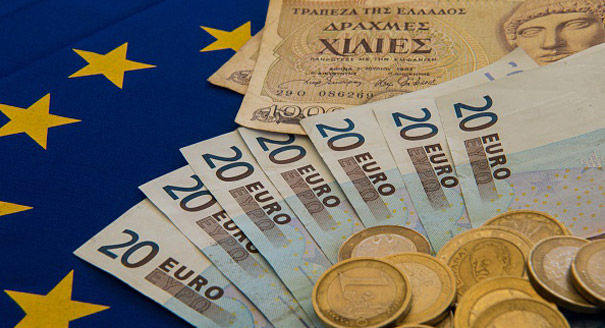
A combination of serious economic policy blunders by Athens and selfish policies by Greece’s eurozone partners have led to an impasse. It is time for sense to prevail.
The specter of a Greek exit from the eurozone, or Grexit, is gradually returning to haunt European politics. Fears stem in part from the international security environment, as an isolationist United States and an assertive Russia raise fears of a return to great-power rivalries. If Europe wishes to survive as a global player, it should stand on its own feet by developing a security policy based on higher defense spending and an active international presence. This, however, is conditioned by a strong European economy, which is currently far from guaranteed.
The EU should prioritize the completion of the half-finished construction of monetary union, by reinforcing its fiscal and financial structures and improving its system of governance. As the notion of more Europe is no longer popular, far-reaching changes cannot be envisaged for the foreseeable future. However, France and Germany have no other option than to set the train moving after their elections later in 2017, because monetary integration, once started, only goes in one direction.
In the midst of this turmoil, Greece is continuing to make a mess of its handling of the economy. Over the last decade, successive Greek governments have committed fatal policy errors that, coupled with selfish policies by Athens’s euro area partners, have led to the present impasse.
The conservative New Democracy party, which took over the government in the mid-2000s, allowed Greece’s fiscal deficit to reach a staggering 15.2 percent of GDP in 2009, bringing the country close to default. PASOK, the Socialist party, returned to power in that year with a new leader, George Papandreou, who promised further fiscal handouts while claiming—incredibly—that “the money exists.” Confidence soon collapsed, and in April 2010 the government was forced to accept a bailout loan from the euro area and the International Monetary Fund (IMF). German and French banks were protected against default procedures, while Greece was penalized with an extremely harsh program of fiscal adjustment with no compensatory measures to sustain demand.
A succession of short-lived governments failed to meet the challenges of the bailout process. The present coalition of the radical Left and extreme Right has managed to worsen Greece’s prospects because of its erratic negotiating tactics and refusal to own reforms that have been agreed to. Greece has lost one-quarter of its GDP, unemployment stands at 23 percent, and public debt represents 176.9 percent of GDP—much higher than at the start of the crisis in 2009, when the figure was 126.7 percent.
Crucially, reforms are being implemented inefficiently, so they do not produce the expected beneficial outcomes—either for the competitiveness of the Greek economy or for the investment environment. Privatization is proceeding very slowly. Deregulation is stumbling. The state of the administration and of the health, education, and justice systems is worse than at any time in the recent past.
Germany continues to insist on an irrationally tight fiscal policy while refusing to grant substantial debt relief. The IMF maintains that German-inspired fiscal targets are unattainable without either debt relief, which Berlin rejects, or new fiscal measures, which Athens does not accept.
A possible compromise could involve a mild version of labor-market reform, which Greece’s lenders demand, and a commitment to take fiscal measures when the need arises. If, however, negotiations drag on and the next tranche of the bailout loan is withheld, Greece may require further assistance by summer 2017. The lenders may choose to refuse such help and propose instead to start talks on Greece’s withdrawal from the eurozone. Alternatively, the government may opt for an early parliamentary election, which would likely be overshadowed by the question of whether Greece should keep the euro or revert to the drachma.
The Grexit option appears increasingly attractive in conservative European circles. Patience for Greece is gradually being exhausted, while the idea is gaining ground that a more restricted monetary union, freed from its weakest members, could make it easier to move to further fiscal integration without the risk of a transfer union—a German nightmare.
However, Grexit carries risks. It would inflict a further shock to the Greek economy, induced by skyrocketing inflation resulting from the expected large devaluation of the new currency, a corresponding explosion of public debt as a proportion of GDP, and irreparable damage to Greeks’ confidence. Social discontent and political instability would follow, raising serious geopolitical risks at a time when Russia and Turkey are challenging European security and the refugee problem has not passed its peak. Stabilizing Greece outside the euro area would require semipermanent surveillance and substantial injections of financial assistance from the country’s lenders.
It is therefore hoped that sense prevails among all interested parties so that agreement is achieved. Failing that, a fresh election should be held as soon as possible to allow a new government to assume power before the situation gets out of hand.
Yannos Papantoniou is president of the Center for Progressive Policy Research, an independent think tank.

Yannos Papantoniou
Carnegie does not take institutional positions on public policy issues; the views represented herein are those of the author(s) and do not necessarily reflect the views of Carnegie, its staff, or its trustees.

A summer of escalation in the Black Sea has hurt Ukraine economically and is exacerbating world food security. A truce is needed—as is a broader reframing of Europe’s Ukraine strategy.

Thomas de Waal

Are Germany’s economic, industrial, and political struggles becoming a liability for the EU’s ability to rise to the geopolitical moment?

Rym Momtaz, ed.

European Commission President Ursula von der Leyen is about to give her annual address on the state of the EU. Here’s what she won’t—but should—say.
Rym Momtaz

The aftermath of the Ceuta crisis shows Europe has drawn the wrong lessons. Rather than doubling down on failed migration policies, the EU needs to address the underlying roots of such episodes.

Richard Youngs

An overwhelming victory by a far-right-wing party in a small state in eastern Germany will have major repercussions for Chancellor Friedrich Merz’s coalition.

Judy Dempsey